Section iv. Structure of marketing organizations
Marketing must be based on a certain agency or sector, the marketing organization, which is responsible for developing and implementing marketing strategies and strategies. It is therefore important for enterprises to consider how to construct marketing organizations。
Principles governing the construction of marketing organizations
(i) mandate and objective principles
The mission and objective principle, that is, every marketing organization and every part of the organization, is related to a particular marketing mission, target, otherwise it has no value。
(ii) principle of precision and efficiency
The principle of precision and efficiency is that the marketing organization established by the enterprise should be lean, strong and efficient。
(iii) principle of relative closure
The principle of relative closure, i. E. The management tools and tools (institutions, systems, people and information) within an enterprise's marketing organization, must constitute a continuous and closed loop in order to form an effective management campaign and enable the enterprise to carry out its marketing activities。
(iv) the principle of balancing business realities with future development
A balance between the current state of business and the principles of future development is between the fact that the marketing organizations established by the enterprise must adapt to the current state of development, marketing characteristics and resource conditions of the enterprise in the context of scientific norms, and the fact that the structure of the marketing organization should provide space for the restructuring of the organization for the future development of the enterprise so that the marketing organization of the enterprise can adapt and improve as the enterprise develops, without the need for a “big-go”-type reform of the original organizational structure to effectively reduce the cost of doing business。
Steps towards the formation of marketing organizations
First, the overall planning of marketing services and processes around the marketing objectives of the enterprise and the optimization of the process is the starting point for the organization of the enterprise's marketing organization。
Second, marketing positions are designed according to optimized marketing services and processes, and marketing management positions and parts of institutions are designed according to the number of marketing positions and specialization。
Finally, posts are assigned, assigned and assigned. Following the design of the scientific marketing organizational structure, marketing organizations throughout the enterprise should meet the following criteria: first, there are direct and clear lines of authority and responsibility; second, there are continuous operating systems and logical lines; third, there is a rapid and coordinated flow of information upward, downward and horizontal at all levels of marketing organizations; and fourth, every member of marketing organizations is competent to work and has a high morale and high level of job satisfaction。
Iii. Model of marketing organizational structure
The actual marketing situation of the enterprise is different, as should the established marketing structure. In other words, the marketing structure designed by the enterprise should be individualized during the actual planning process。
(i) different functions-based marketing organizational structure
This marketing structure applies to enterprises with a limited range of products and a narrow market area coverage。
This marketing organization is the most common. Under the leadership of the deputy general manager, which is responsible for marketing, it is required to set up functional sections such as strategies and plans, market research and forecasting, advertising, promotion, public relations and consumer services。
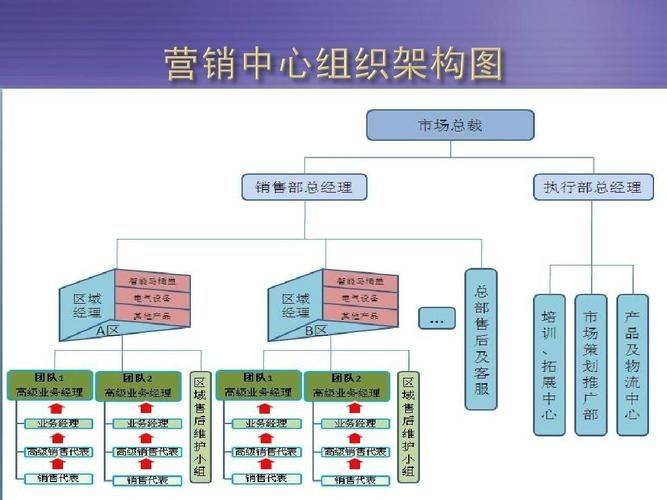
Some enterprises include the marketing department alongside the marketing department, mainly because it usually requires a large number of personnel, such as sales personnel, couriers, administrative employees, etc., working at the front line of sales, while the marketing department favours planning, with expertise and a holistic perspective. The separation of the two departments is aimed at streamlining the personnel of the marketing sector and highlighting its planning functions, leaving it out of cumbersome sales and working on market development and management。
This marketing organizational structure has the advantage of facilitating management - each functional unit has its own expertise and has a higher level in its own field。
However, as products and markets expand, the usefulness of this organizational model diminishes. First, in a different function-based marketing organizational structure, no one is fully responsible for a product or a market, and as a result enterprises may lack a complete product or market-based plan, some products or markets may be overlooked; secondly, sectors compete with each other in order to secure more budgets and higher status, resulting in a very heavy task of coordinating the deputy general manager responsible for the distribution of the market; and lastly, each functional sector needs a targeted marketing plan for each product, brand and market, which will soon be crushed if the firm's market is refined and brand series are complete。
(ii) market organization based on different products or brands
This marketing organizational structure applies to enterprises with a larger variety of products and a clear difference in consumer demand between them. Enterprises that produce multiple products or have multiple brands often set up marketing organizations by product or brand, i. E. A marketing director is appointed for each product or brand. This organizational model, first adopted by the procter company of the united states in 1931, is now widespread, especially among large consumer firms。
This marketing organizational structure has the advantage of being able to reflect in a timely manner the problems of a particular product (brand) in the market; the product (brand) manager, who is responsible for his/her own management, ensures that each product (brand) is not ignored; the product (brand) manager, who is able to better coordinate the various elements of the product marketing portfolio and react more quickly to the problems that arise in the market; and the talent-branch management that helps to develop the talent - product (brand) management in all aspects of business operations, marketing, and is a high-quality job for exercising talent。
The disadvantages of this marketing organizational structure are that there are conflicts that result from the limited powers of product (brand) managers to rely on cooperation with advertising, marketing and manufacturing sectors, which may not be given priority; that product (brand) managers, who are easy to become experts in specific products for which they are responsible, are not necessarily familiar with other operations, such as advertising, promotion, etc., and thus affect their ability to coordinate in an integrated manner; and that the cost of establishing and using product (brand) management systems is often higher than expected。
(iii) market organization based on different geographical regions
This marketing structure is organized and managed by geographical area。
This marketing structure applies to enterprises that develop product markets in a wide geographical area, especially those with limited product variety and homogenous characteristics, and requires rapid coverage in many areas。
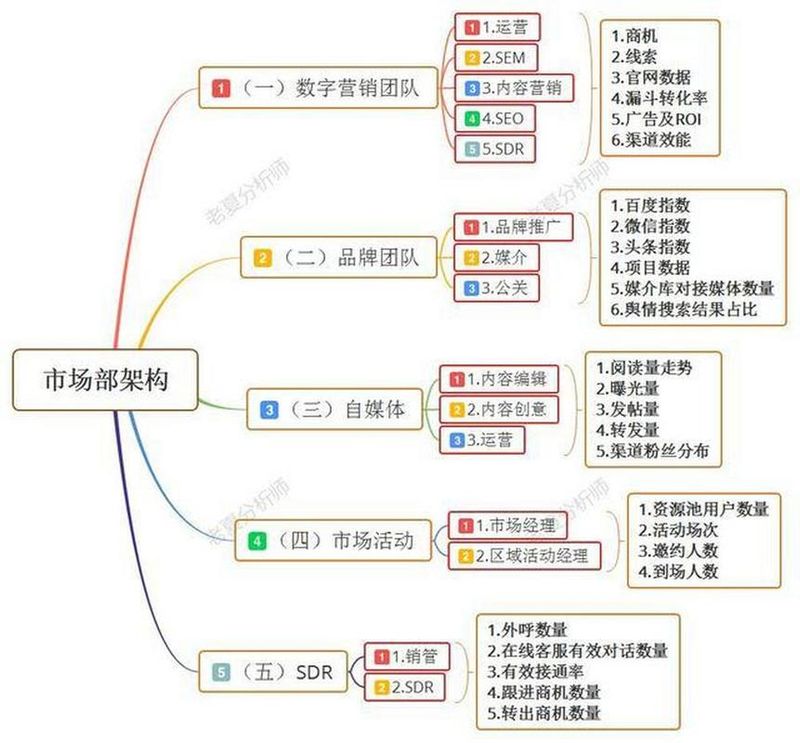
(iv) market organization based on different subdivisions
This marketing organizational structure organizes and manages marketing staff according to a breakdown of the market。
This marketing organizational structure applies to enterprises with more subdivisions of the market and the uniqueness of each subdivision。
Thinking
What are the components of the market
What is marketing in a narrow sense? What is a broader marketing
What are the differences between marketing and marketing and sales
How has the concept of marketing evolved
What are the principles in which marketing organizations are structured? What are the models of marketing organization