China's 10 years of mass migration! 149 cities are falling. Where are they going
Over the past decade, the population has become more concentrated in economically developed regions and urban clusters. The rapid population growth in some cities and regions has been accompanied by considerable regional migration。
The first financial reporter collated the seven-pu data published by the local authorities. The demographic changes in the country's more than 330 administrative districts (including municipalities, regions, autonomous regions and unions, hereinafter referred to as “municipalities”) over the past decade revealed a decrease in the population of 149 municipalities, which accounted for 44. 7 per cent of the population。
It should be noted that, in order to maintain consistency, some of the seven-punishment data published at the local level have been published separately in some provinces as county-level municipalities. In addition, in the case of hainan, only four municipalities have been included. In other cases, individual functional areas have been listed separately and not here。
Population decline in 149 municipalities
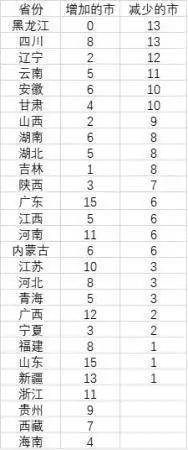
Statistics show that there are more than 330 administrative districts in 27 provinces outside the municipality. Of these, 184 municipalities achieved population growth and 149 experienced a decline。
Of these, 149 municipalities with declining populations came from 23 provinces. By region, there are 14 in the eastern region, accounting for 9. 4 per cent of the declining urban population; 47 in the central region, accounting for 31. 54 per cent; 55 in the western region, accounting for 36. 91 per cent; and 33 in the north-east, accounting for 22. 15 per cent。
Sub-provinces show that 149 municipalities come mainly from xantsi, gansu in the north-east, central region and north-west, sichuan and yunnan in the south-west. In some parts of the world, such as the north-east, shanxi and other regions, industrialization and urbanization are relatively early, the birth rate is relatively low, and the energy-recession industry is more important. However, in recent years, the energy-recession industry has been more pressured, and many local migrations have resulted in more population decline。
Of these, only three cities in the north-east have increased their population, namely, shenyang, dalian and changchun, and the rest of the cities have all experienced a decline. For example, compared to the 2010 six-pu figure, the population of the heilong river decreased by 6. 463 million, to a high of 16. 87 per cent, and the population of 13 municipalities in the province declined altogether。
The university of jilin, north-east asian institute of research, is teaching first financial analysis, with low birth rates and high population ageing in the north-east. At the same time, as a result of economic downturns, employment opportunities were reduced and many young people moved to the south-east coast. For the past decade, the north-east has been in a state of emigration。
As an energy province, shanxi has a relatively small population. In 2020, the resident population of the province was 34. 9156 million, a decrease of 79. 65 million, or 2. 23 per cent, over 10 years, compared to 3,571. 21 million in 2010, compared with 11 municipalities。
Beyond the west of the mountain, the central provinces of anhui, hubei and hunan also experienced a significant decline in population. For example, 10 of the 16 municipalities in anhui fell, 8 each in hunan and hubei (excluding county and forest areas under provincial administration) and 6 each in henan and jiangxi。
Most of the cities in the central region have declining populations, linked, on the one hand, to the proximity of the three economic circles in the central region, namely, the long triangle, the pearl triangle and kyinzu. In recent years, with the rapid development of the high iron network, the interior of the three economic circles has continued to expand, making it easier for people to move between the central and labour-rich regions。
In the case of henan, the proportion of the population displaced to jiangsu, zhejiang and shanghai increased by 5. 1, 2. 3 and 1. 4 percentage points, respectively, compared to 10 years ago. Henan accounted for nearly 40 per cent of the population that went to sugiang, almost 10 years earlier。
Ding, associate professor, department of economics, university of xiamen, presented the first financial analysis, which, with the development of long-triangular integration, has led to the improvement of transport infrastructure, including high iron, which has also made it easier to connect and move people between henan and sugiang。
On the other hand, the large number of municipalities with declining populations, including hubei, hunan and anhui, have also been explained by the strong growth of provincial capitals in recent years, which account for a rapidly rising share of GDP and population. The exodus of the population from the interior of the province is partly to the developed coastal areas and partly to the capital of the province。
In hunan, for example, the decreases in the cities of xingyang, chenyang, yiyang, changde and yuyang were significant. Of these, shunyang decreased by 508,000 compared to 2010 and chenyang by 496,000. The number of provincial governors has increased by 3 million over the decade, with the total population breaking the threshold of 10,479 million, making it the third provincial capital in the central region to break the threshold of 10 million。
This is also the case in the south-west and north-west provinces. For example, 7 of the 10 municipalities in shaanxi have seen a decline in their population, while the capital of the province, xian, has increased by 3. 8797 million people (excluding the xianyang region of the west) over the last 10 years, outnumbering the cities of wuhan and others by a total of 1295 million. In sichuan, the permanent population of the capital of the province increased by 5,818. 9 million, while 13 of the 21 municipalities in sichuan lost their urban population。
Where are they going
Statistics show that all municipalities in four provinces have achieved population growth: zhejiang in the east, guizhou in hainan and tibet in the west。
Zhejiang is the only province in the east that has achieved a decade of population growth in all municipalities. This is related to the more balanced economic development of the zhejiang region. In 2020, the per capita disposable income in all zhejiang municipalities exceeded the national average。
The analysis by the deputy director of the committee of experts of the hangzhou planning commission, yu sea and children, shows that the gap between urban and rural incomes in zhejiang is small and regional development is more balanced. Zhejiang is dominated by the private economy, with many counties forming their own industrial clusters with a strong industrial base, on the basis of which each municipality has a positive population growth rate。
In hainan province, owing to the small land area and the small number of administrative units divided into districts, direct provincial authority has been exercised over all counties, including municipalities at the district level, as well as municipalities and districts at the district level, totalling 19 municipalities and districts. Seven-pu data show that, despite the decline in the population of three counties in hainan over the past decade, all four municipalities have experienced growth。
All these municipalities have achieved population growth in both economically developed provinces, such as zhejiang, with balanced regional development, and in some places, such as hainan, guizhou and tibet, where the high birth rate has led to population growth。
If it is extended to other provinces, some provinces with relatively large growth and with a declining population of only a few municipalities, such as shandong, fujian, xinjiang and guangxi, have similar reasons, either related to a more developed economy, a higher inflow or to their own higher birth rate。
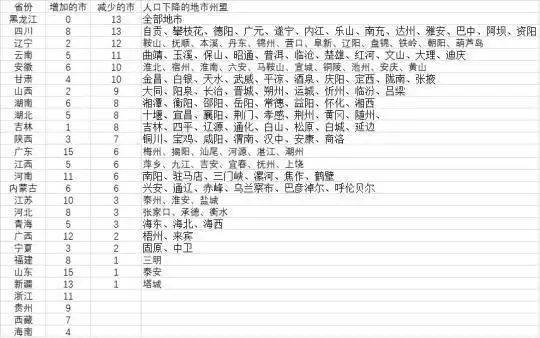
In terms of the direction of migration flows, out-migration occurs mainly in parts of the north-east, central and north-west and south-west provinces. According to the list of 149 cities, with the exception of harbin, a sub-provincial city, most of the other cities are 3-4-5. However, the specifics of these cities vary. Among them, many ordinary municipalities in the north-east are resource-depleted and shrinking cities, and not only the total urban population is declining, but even the urban centres are shrinking。
Since the population of the municipality refers to the total population within the municipal area, it includes both the population of the central city and the population of the sub-prefectures and municipalities. For many municipalities in the centre-west, the decline in the total urban population does not mean a decrease in the urban population. In fact, while part of the population of the municipalities is moving to the coastal and provincial capitals, part of the population is moving to the central urban areas of the municipalities where it is located, so these urban centres continue to do so。
In terms of the direction of population flows, guangdong, zhejiang, jiangsu and fujian are the main areas of population inflows. According to the first financial journalist statistics, eight southern provinces experienced a 10-year increase of more than 3 million people, namely, guangdong, zhejiang, jiangsu, fujian, guangxi, guizhou, sichuan and chongqing, a total increase of 5. 69 million, or 79 per cent of the national increase. Of that total, 4,443,580 million, or 61. 7 per cent of the total, were added in guangdong, zhejiang, fujian, jiangsu and shanghai provinces。
The population of guangdong province, the first economic province, has increased by 2,704. 4 thousand inhabitants throughout the province over the past decade, an increase of 20. 81 per cent, and guangdong's increase represents 30 per cent of the national increase. Data show that guangdong currently has a total mobile population of 5. 262 million, of which 296. 221 million are in the provinces。
However, there is a large regional development gap in guangdong, with a large gap between the west east west north and the pearl triangle. The economically developed pearl triangle has attracted not only large out-of-provincial inflows, but also large inflows of people from within the province. As a result, the population of guangdong has been declining in six cities, despite the fact that the birth rate has been high in east and west north. This also shows how attractive the population of the pearl triangle is。
In addition to the flow to the developed regions of the south-east coast, there has been a significant increase in intra-provincial mobility in many provinces in the centre-western region, mainly from ordinary-division to provincial capitals and central cities. In particular, in the central and western provinces of henan, sichuan, anhui, hubei and yunnan, there has been an acceleration in the development of the capital of the provinces in recent years and the movement of the population of the rest of the provinces to the capital of the province. (author: xiaoqiao lin)