1. Children's interests:
Interest is the motivation for children to learn, and different children have different interests。
2. Teacher interest:
It can be effective in galvanizing children's quest for inquiry。
3. The task of the child development phase:
At different stages of development, the child's developmental tasks are different; appropriate curricula offer children multiple opportunities to self-selected skills training activities that promote the child's social emotional development。
4. Activity materials in the physical environment:
Human-induced activity material is standardized and predictable, while natural activity material is non-standard and unpredictable — every plant and animal is different. Both activity materials are needed by children。
5. People in the social environment:
Children are interested in various social roles and eager to understand the interrelationships between members of different actors。
6. Course-related information:
Teachers can obtain a great deal of curriculum ideas and information from libraries, exhibitions, school resource centres, which teachers can adopt and apply in accordance with the realities of their activities, their own teaching style and the interests of children。
7. Accidents:
Accidents in classrooms, communities and society are of great educational value, and teachers can integrate them into their programmes (short-term or long-term) and provide on-site instruction。
8. Living together:
For children, cooperation, expression of will, conflict resolution and day-to-day care are potentially valuable elements of the curriculum. Physical protection, self-help skills, food and clothing, etc. Are important life experiences in the natural growth of children, and the concepts of sharing and interpersonal interaction are essential components of the curriculum。
9. Values in schools, communities, families and cultures:
This is an important part of evaluating the curriculum, which should be appropriate for the child's development and for the environment, and teachers should clearly define the implementation of the curriculum and know how to participate。
(ii) organization and implementation of courses
Understanding the child, the generation of the curriculum requires that teachers constantly plan it by observing and recording the interest of the child。
2. The content of the programme is flexible and non-mandatory。
3. Teachers are key decision makers in the curriculum。
4. Children, parents, community members are participants and collaborators in the implementation of the curriculum。
5. The content and activities that generate the course are continuous and interrelated。
Case:
Generation course on "shell"
In the summer, teachers picked up some shells at the beach and put them in the game room, which attracted the attention of the children, some of whom started playing the shells, and the teachers started with the shells, and they started thinking about them。
The teacher asked, "you have some shells, what would you do?"
Children say their thoughts:
"the shells are in the sand, so i'm going to put them in the pit."
"i'll bury my shells, so they won't find it."
"i'm going to do the same, and i'm going to pour some water over the sand, and the sand will cover them."
"i'm going to play with mom and dad."
Children disagree, teachers don't judge who is right or who is wrong, they just encourage children to express themselves freely。
And then, the teacher lets the kids sort the shells, and he's doing a full-scale study on the topics of marine life. Teachers provide children with lots of relevant books, and they design a shell unit in a game that helps them build their ideas, in which they learn knowledge, cooperate, understand, communicate, and develop their abilities and abilities。
Case profile:
The curriculum design is child-centred, sensitive to the interests and needs of children and serves as the basis for curriculum design, reflecting a child-centred approach to curriculum design。
Emphasis is placed on flexible schemes, which are constantly adapted to the realities of the activities, teachers and young children grow together and develop together。
02
Part
Child-centred project activities curriculum
Since the 1960s, the italian city of rio amelia, under the initiative and leadership of loris malaguzzi, has, after decades of effort, launched a unique early childhood education system, the régio early childhood education system。
It is based on the ideas of dewey, piage, vigorsky and others, as well as on the constructionist learning theory, from the point of view of children as an active and creative person with full rights to survival and development, against pre-defined curricula by teachers and the promotion of teacher-student co-construction. The term project activity is translated from project work in english, translated into programme teaching in taiwan, translated into planned teaching in hong kong, translated into project activities in mainland china, and translated into different ways。
Its curriculum design advocates “dynamic design” and “random generation” of courses, emphasizing that teaching and learning is an interactive process, and that project activities are continuously adapted to children's realities (interests, problems, experiences, recommendations) in their educational interaction, and revise and refine curricula。
(i) basic concepts of course design
The objective of the curriculum is to make children “more healthy, smarter, more potential, more willing to learn, more curious, more sensitive, more adaptable, more interested in symbolic language, more self-reflecting, more eager to friendship”
2. Rhegio does not have a pre-planned programme of educational activities, and the content of the curriculum comes from the surrounding environment, from things, phenomena and problems that are of interest to children in their lives, from various activities of children。
The organization and implementation of the courses are carried out mainly in the form of “project activities”. Project activities typically begin with teachers' observation of young children or their questioning of young children on a particular subject, starting with their spontaneousness, interest and teacher-aware judgment, and are carried out in a process full of randomity, leading young children to discover learning, free expression and creative solutions。
Project activities typically work in small groups, ensuring peer-to-peer learning, providing an opportunity for every child to realize that his or her views are different from those of others, and thus to realize his or her own unique ideas, and to develop a sense of self-identification; and, in communicating with his or her peers, enabling children to discover the different perspectives of others and understand the diversity of the world。
5. Emphasis is placed on teacher-student cooperation in the implementation of curricula, research on a particular issue, and the active exploration and free expression of children. The teacher's duty is to follow the children, based on the observation of the children, to grasp from their reactions the enormous learning value that lies in them, and to give them timely and appropriate guidance to promote their learning。
6. Archives are a better form of promoting teaching activities. The so-called archives refer to the systematic recording of the educational process and the results of the work of teachers and students together, including the children's own visual representational works and the recording of concrete examples of their activities. It manifests itself in drawings, objects, photographs, recordings, videos, slides, scripts, etc., throughout project activities。
Procedures for the implementation of courses on project activities
1. Initial planning of the project: the theme was developed by teachers in consultation with children。
Basis for the theme:
The theme is the value of learning for children。
Interest of children。
Curriculum requirements。
Availability of resources。
Development of thematic networks:
Brain storming, a theme network built by teachers based on their own experience and knowledge。
The creation of the theme networks, that is, the separation of a few small concepts from a central concept, the use of words, the use of webs to connect them, the formation of theme networks。
Case:
Thematic network 5 on water
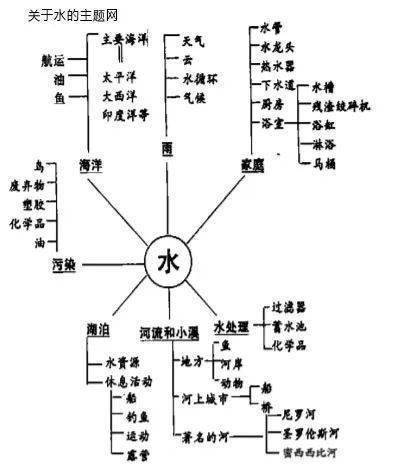
Functions of the theme network:
Auxiliary teachers design courses。
Assisted children in learning。
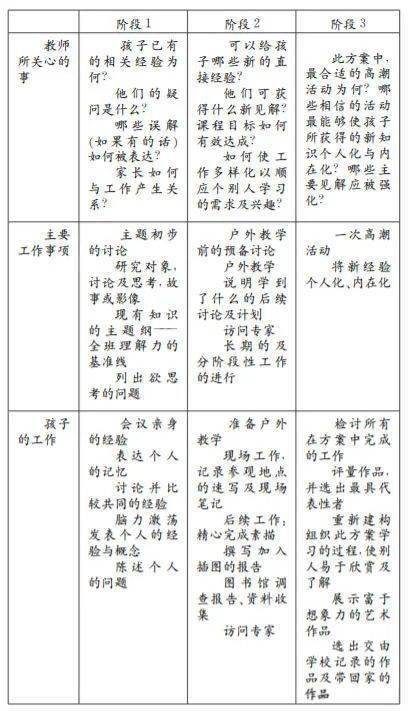
Development of project activities:
It consists of phases i, ii and iii, each of which focuses on the concerns of teachers, what children need to do and the main educational activities (see table below for details)
Phases of project activities
Case:
Project activities on “dinosaurs”7
Course theme: dinosaur courses
Organizer: roberta
At anna frank kindergarten, children often bring dinosaur toys to school and talk about dinosaurs, which teachers roberta noticed as a good opportunity to introduce them to their children, so they recorded their conversations and developed a course on dinosaur awareness。
Here's a group of boys talking:
Federico: no more dinosaurs, all dead。
Francesca: all the dinosaurs are dead, they kill them, and they bury them。
Michele: no! They didn't bury the dinosaurs, they died themselves。
Fabio: yeah, it's not true. Who could kill dinosaurs? Because the originals came after dinosaurs. But there are dinosaurs in cartoons, not really。
Federica: dinosaurs die, people appear。
Fabio: when there are dinosaurs, other animals are like insects, and the dinosaurs die, they get bigger, and they become monkeys and other animals, like the ones that are now。
Teachers recorded this set of conversations to organize and implement dinosaur courses. The next day, the kids didn't make any progress. So roberta decided to wait until the kids were interested to learn a long-term dinosaur course. By the second week, the children's interest rose, and roberta decided to make dinosaurs with clay. First of all, she started a discussion about where the children got their knowledge from, some from television, some from movies, and some from brothers, sisters or other relatives. Roberta then organized the children to the local library to gather information about dinosaurs and bring them back to kindergarten. At the same time, it is suggested that children invite friends and relatives to kindergarten to ask them questions about dinosaurs, which greatly stimulates their interest and motivation. And then the kids started to make dinosaurs with clay, paint them with water, paint them with chalk, and some of the kids also performed the leather scenes, so that they had direct experience with dinosaurs. But what they do and what they paint is their own imagination, not real, and they have difficulties in terms of the size and size of the dinosaur. So roberta decided to let the kids draw a true proportion of dinosaurs. There was discussion about how to measure and map a true proportion of dinosaurs, roberta and six children (three boys and three boys):
Giudia: we can measure the size of the dinosaurs in the book。
Roberta: sure。
Federica: i think his legs are as high as the ceiling。
Roberta: are all dinosaurs with legs that high or just some?
Federica: only a few。
Roberta: how about we draw a real dinosaur?
Federica: we might have to have a piece of paper as big as the table。
Roberta: maybe bigger。
Federica: it's big and long
After a discussion, the children determined the length of dinosaurs (27 meters), found a long plastic rope, cardboard, etc., and drew dinosaurs on the playground of kindergarten. After an experiment, a trial error, a correction, a giant dinosaur painting was completed. The children painted this dinosaur on a huge plastic sheet, on a garden-wide exhibition, showing their work and results. They picked some paintings and sculptures, made invitations and posters, and thought about how to show their results, showing great excitement and confidence。
Case analysis:
Dinosaurs are not planned in advance, but are based on the interest of the children, and through the interaction of teachers and children, teachers and students。
The child is an active learner, and the teacher's job is to seize the moment, guide the child to the right thinking, and help where necessary。
In the light of the above, the design of the kindergarten curriculum, based on the theory of buildingist learning, focuses on encouraging children to explore, not only to achieve certain intended goals or to obtain specified learning outcomes; cognitive development is the result of interaction between people and the environment. To develop a child's perception, teachers must understand and diagnose the existing level of knowledge of the child; the role of teachers should be changed from one of leaders to one of guides, using teaching methods such as discovery, pedagogy and practice to help children acquire learning meaning and develop understanding; the design of learning environments is open-minded, and teachers need to provide children with learning activities for real life scenarios to test, explore, expand and revise their learning theories。
The curriculum of kindergarten generation based on the constructionist learning theory, as well as the programme of project activities in rigeo, fully reflects this idea, that respect for children, that everything is premised on children's development, and that the promotion of children's ownership and creativity is a key part of the solution to the core problems afflicting early childhood education in the world - what kind of kindergarten should teach, what should it teach, what should it teach, what kind of experience is best learned in the design of curricula for young children。
It was originally sent to shandong educational science, no. 2, 2002