China's ancient poems, from the book to wei shinsing poetry, are not as rigorous as they should be. During the coming year, after a long period of contemplation and exploration, zhou yiu and shen joo, among others, have been systematically combing and summing this up. They have given full consideration to the interrelationship between music and poetry, and have produced a new verse: “all texts are written in a hymn, written in a hymn, written in a hymn, without loss, and called the world for a `mixing body'”, advocating the creation of poetry with four or eight diseases, adherence to the sound laws, and ensuring that the sound is balanced and that it is compared with one another, so that the beauty of all kinds of music can be reconciled with one another. Most of the five poems of the chinese-chinese era were smooth, leading to the popularization of five or seven words, first of all, to the pedagogy of the pedagogues and the lynch. It also provides a hymn ruler for adhesives, pairs, and produces a classical aesthetics of symmetric unity。
The sound of the four sounds is flat, the sound of the upper, the upper, the upper, and the upper, and the upper, and the dichotomy of the four, and the regular staggering of the four, so that the sound may be diverse, and the rhymes of the poetry may grow. In five words, seven hymns and their final words, the odd end of the line is sound (with the exception of five words that have changed slightly or the first of the seven hymns that have been flat), the last words of the penultimate line are largely incoherent, while the even end of the line is flat, either flat or flat, presenting a unique “peaceful” pattern. Why not? What are the reasons for this
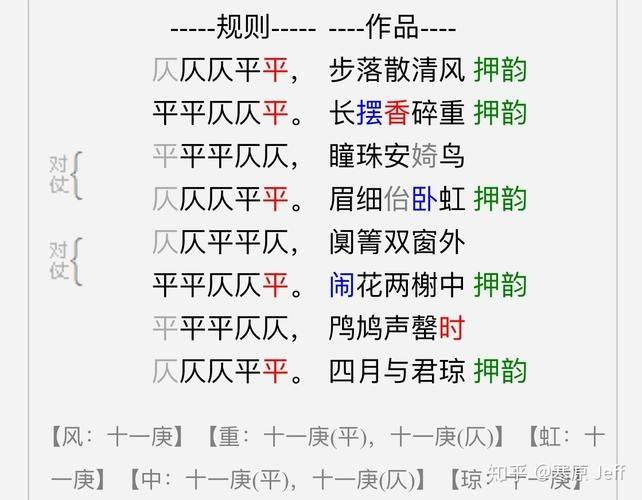
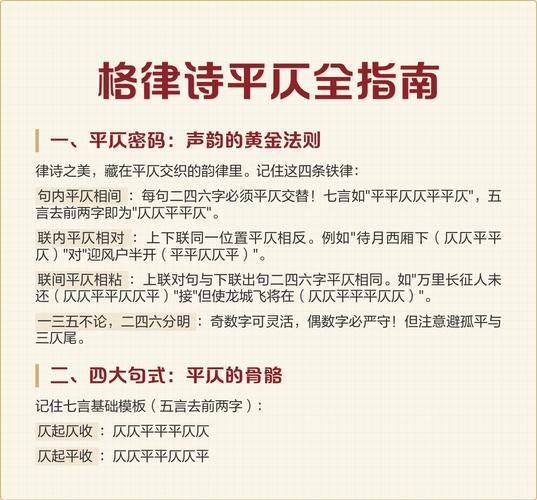
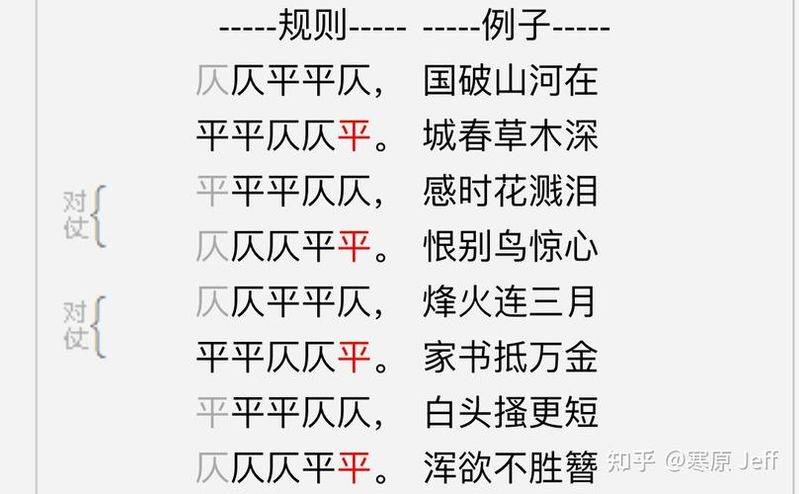
There are four types of five-year flat model, and the other three are just variants (the seven-year flat model and principle is essentially the same as the five-year rule, a little bit): “the flatness is flat, the flatness is flat. Ping-ping, ping-ping. It's flat, flat, flat. It's flat and flat."
The statistics show that, with one exception in the first sentence of the odd number line, the rest corresponds to the “tailing” pattern of the odd number line and the “tailing” of the even number line. In the seventh law, the words “one, three, five, two, four, six” say, “one, three, two, four”, and in the fifth law, this one-sided situation does not apply to the end of the seventh, fifth and final sentences. That is, the pattern of “tails” in odd-numbered lines and “tails” in even-numbered lines seems self-evident. This model can be explained by music。
About chen's "four questions."
The perspective of music cannot be ignored in order to explain how the rhythm of the poem or the end of the sentence is created. In addition, many poems can enter the song: "poetry, words, songs, words, words, words, words, words." the poem contains poems, songs, sound, rhythms, companionship, harmony and self-consciousness. “all poems can sing and dance. Whether it is a poem, a lyrics or a rhythm, it is the result of a combination of poetry and music. Poetry is about music, poetry is about poetry, it's about poetry, and it's about cycling. The so-called `the chorus of the poets' and the chords of the orchestra' and the ability to transform poems and songs from one another, `the words of music, the words of poetry'. Poetry is almost always about music, and music is about poetry. The four voices and the subsequent flat dualisation are closely related to music. Since peace is based on four words, it is important to clarify the relationship between music and music first。
With regard to the origin of the quartet, mr. Chen's quartet has had unique and far-reaching findings and arguments. In his view, the sound of entry is one type and the other is flat, “but so the rest is three, based on three of china’s scriptures. China's re-reading of the buddha three times that day was based on a statement made in india's ancient times. So the chinese scribes used the same day to read the buddha's voice, which was set at three times flat. The total number of entries is four. It was then made up of four words and made a sound syllable, which was used to read the voice of the book and to use it in chinese. The conclusion was that “the flat-up approach is the method of trans-shipment of the west for the chinese language”. Mr. Chen's reasoning has many insights, and over the years it has focused on learning. However, he set aside the sanskrit, which is almost complementary to the transliteration, almost arbitrarily believing that the “new voice created is the transliteration, not the vantage point” because “the transliterate voice, the poem, is called a non-coercive string, and the vocalist. The sanskrit question is not the scope of the present article, but it seems to be the case”. This reason is far-fetched and debatable, because the music of the sanskrit is in fact quite closely related to the transliteration. The monk says, "the world of heaven, all the words of the law are known. As for this land, the scripture is referred to as a transliteration, and the hymn is the sanctuary. The old days have been glorified by the rhythms, and by the fact that the five are against the rules, so it is better to use the sound music, which is to be seen as reinforcing the discourse on music and its interaction when it is transliterated。
This expression is a musical “song song”, which, according to the wang xiaoliang test, is based on the music tunes of the west, which are the “hulls” in western languages during the period wei jin-dpan. And dream creek talks already mention the relationship between four words and the sanskrit: "the hymn of the hymns is about four words from the hymns, and the hymns of the hymns are becoming secret in china." it's a song and a string that goes hand in hand. As he said: "the voice and the writing, they trust in each other. The words of the hymns and the words of the hymns, and the words of the hymns, and the words of the hymns, and the words of the hymns, and the words of the hymns, are the words of the hymns, the hymns of the hymns, the hymns of the hymns, the hymns of the hymns, and the hymns of the hymns. These tests show the close relationship between emin's poems and music and the buddhist scriptures, the way in which shen's poems continue to be followed by foreign music, and the creative deepening of the music of poetry。
Why did shen joo sing with music and music
The close relationship between the conversion of buddhism and the sanctuary, the hymn exploration of buddhist scriptures over the period of nanzi, and the extraction of buddhist scriptures by literary writings illustrate the reciprocal relationship between ancient poetry and music, both in terms of inheritance of our traditions and in terms of the west. By the time of the north-south era, the masters of hearts, such as those who are good at music and who are so devoted to the sound of poetry, the sound of poetry, the sound of opposing and unified hymns, the creation of more operational luminous poetry norms, the discipline of musical and systematic theory, and the following: “to transform the plume, the plume, the plumb, the plume, the plumb, the plume, the plume, the plumb, the plumb. Within a simple word, the tone is very different; in two sentences, it is different. This is the best that can be done.” “if it rhymes with the sound of an article, the voice of a chorus, it is not for the good of each other.”
Shen joo learned about the interrelationship between poetry and music: such musical poems are like the hymns of music, the transformation of plumes, and the moderation of each other. If there is an instable and dim sound (i. E., going up), there should be a flat and loud flat in the back. In one sentence, the tone is different; in two sentences, the tone is different. Only if this message is well achieved can it be described as poetry. If the sound patterns of the articles are compared to the songs in the music, they are ugly and ugly and have the same rationale and cannot deviate from each other. Its hymn is the expression of music's music, and poetry and music are naturally mutually reinforcing, because his poetry is based on music, which is the point of departure for its poetry, and its relevance and unity。
The academic community still disagrees with the shen covenant, either by avoiding it or by trying to justify it. Most of the latter tend to use the word “floating” as a flat sound, while the word “crunching” as a sound. In fact, this was more of a reciprocal relative concept at the time, “if there is a noise, then there must be a sound”; and vice versa, “if there is a sound, there must be a sound”. Thus, it is not surprising that cao tsao, during his time in china, built a rhythm such as "girl of the south, jun joo joo joo-li", even though it does not conform to the aberrations of a later poem. This homogeneity thus far has a good mass base, and four-dimensional homogeneity norms have emerged, although the exploration of theory and practice has not yet matured。
From the point of view of poetry, the five sounds of music in the mirror secrets corresponded to the four words of poetry. It's divided into four words. The court business is flat, the top, the feathers, the horns. This is a four-sounding prelude to two-dollar flat. It is thought that the palaces and feathers (or signs), low and low, light and heavy, and the sound and sound are two sides of the same coin, “because the names of the palace merchants and so on are easily confused, they are created by the words `up to the level' to be used as an alias for the sound”. From the cases cited by shenzhen himself, “it can be seen that the places used are flat and the places used are upper, upper and upper”. Why do you use it evenly, instead of the other way around? No explanation. As for the hymns of gertrude's poems, wang li believes that “nearness poetry prefers to use the hymns for the hymns, because the hymns are a long one, which makes man's singing easier”. He has spoken implicitly about the relationship between the homogeneity model and music, albeit without further study。
If it is recognized that shen had to look at the sound of poetry from the music of music, there can be no doubt about its views: the tone of the palace, the tone of the plume, the tone (and other adjuncts). These two types of transfer are common in the two melody of the top and the next two, which result in a solution that is to the main. This is reflected in the chorus of singing, where the top, the top, the top and the three unstable tunes (similar to the music of central africa) are transferred to a flat tone similar to that of the main tune, resulting in the resolution of the tone. This is reflected in the verse sentence, which forms a homogeneity, with the opposite, go, and three-sounding alternations and confrontations, similar to the swings of the melody of the hymns, reaching a basic symmetrical balance and rhythm, interacting with each other and advancing the rhythm。
Musical decomposition of poetry
In the formation of pyropathic poetry, both the continuing influence of traditional chinese poetry and music, and the influence of the late-day buddhist sanctuary songs and songs, all of which are closely related to music, it is through music that poetry has been able to establish its theoretical norms. The shenzhen generation followed suit, fully excavating and using the points of convergence between music and poetry to harness the rhythm of poetry, systematically summing up, distilling and producing its wide-ranging poetry as a universal norm followed by the following ideologues and poets. Thus, poetry tends to be musical: the symmetrical alternations in poetry are similar to the rises and swings of the music melody; the symphony is equivalent to a transitional verse, and its endings are generally in the form of a tone outside the main tone or other non-dominant tone, whose volatility always calls for solutions to the most stable hymns of the music, with a view to a musical solution. – the odd lines end in rhyme, and even lines must end in a symmetrical law that presents a symmetrical, symmetrical, responsive response to a doll, which drives the speech (symphony) in motion, in a sense of the cycle and satisfaction of a symmetrical rhythm with the rhythm of nature. And the even-numbered ethos of the ancient mediocrity is constructed to achieve a musical synonym with symmetrical rhythms and melodys, and the aesthetic effect of words that seek to be round: “the plume is different, the plume is low, the acoustic sound is different”. The poems of shenzhen explain the philosophy of music and the causality of its manifestations, so that they become symmetrical, interlocking, symmetrical, pacifistic and proportionately prodigious, and ultimately seek a sense of balance and completion in contrast。
In the words of the word, the creation of the classical “single” model is the result of the musicalization of poetry. The interpretation of etiquette by the basics of music makes it possible to better understand the relationship between ancient poetry or “poetry” and music and to explain why poetry is always based on music, which forms its own roots. The words of the verse that followed are still shared. Thus, it is by music that poetry has been able to establish its theoretical norms, and the sounding of its music and its soundings constitute the classics of music and poetry and of tang dynasty。
(by chen lian ming, director of the national fund for social science project, “research on modern transformation of translation and chinese literature”, professor at the university of chinese abroad)