Do you ever wonder why, when we read tang poetry, we can feel a musical beauty with a melody, even if we don't understand it? In fact, tangse's ability to travel through the millennia is due to the fact that ancients have buried a sophisticated “hidden code” of words。
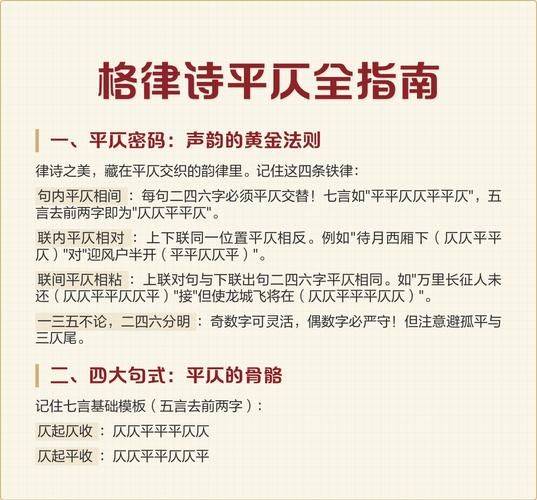
This code, it's the law of townsy. If a poem is compared to a man, then the rule is the bone that sustains it from its standing, and the rhythm is the rhythm of its heart. The ancients do not write poetry in any way they wish, but rather pursue extreme expression in strict rules. For example, the five words in two short words, not only are the words precise, but they appear in the same way as the strong and weak in the music, and the even sentences have to rhyme at the end. This harsh rule, which binds isolated sentences together with an invisible line, is a natural setback and a long rhyme。
In the world of gertrude, it's magic to make words dance. The ancients divided the word into a flat flat and a short sound, so that the poems could produce the sound of "big joo's twilight". And the battle in the poem is a wonderful "simulation game." wang wei's thousand-year-old phrase, “tomorrow moon pine, springs flow up”, is the perfect example: “tomorrow moon” versus “found spring”, “pines” versus “rock”, “photo” against “flow”, not only by word, structure and stitches, but also between serenity and inspiration, drawing a roll of water that breathes。
Many people think that gertrude is a “lock” that binds the inspiration of a poet, but the true top poet can jump out the freest steps in the rules. Dufut, who was crowned by the next generation as the "courage of the seven commandments" and the eight words of the hymn, was so sharp that it was like a mathematical formula. But when you read, "strength-and-blow, and not all the yangtze rolls in," what you feel is not a stale work, but rather a sad, sturdy magma. Gertrude did not limit duft's emotions, but rather, as a result of such extreme restraint and confrontation, the forces of the outbreak were more powerful。
The beauty of tang's etiquette is, in fact, the great quest of chinese culture for “the beauty” — within a limited framework, unleashing infinite creativity. This wisdom of “dancing in shackles” still exists today。
Is there any moment when, in your work or study, you're under some kind of “rule” constraint, and you're actually inspired by surprise? Welcome to the comment section to share your story