In the 1980s, when i was a little boy, i was just remembering that i often saw my grandmother swab under a kerosene lamp, knitting at night: a cotton line in a roller coaster, and a twig in grandma's hand i fell asleep unconsciously in the sound of the rhythm. Wake up in the middle of the night and see the white cloths on the knitting machine that are already finished
Grandma knitted the cloths, made them comfortable, made sheets, covered them soft and soft. Until i graduated from high school, my clothes were mostly knitted by my grandmother. In my heart, grandma is a magic magician
Of course, i know how hard it is to knit. The machine, together with a tube, occupied two entire rooms and heard from grandma that it had taken a lot of effort to get it. As for fabrics, grandma did it at night after she had finished working at home and in the earth。
It's hard to be a weasel, but i'm on the road。
In the 1990s, i went to work at a textile factory in my hometown of ann birchin. There, i first saw the machine. The shape and working principles of the machine are similar to those of grandma's old machine, which uses a shuttle to pull the veil. The difference is that when grandma weaves, she has to step on the pedals and throws the shuttle over and over with both hands. The shuttle shuttles are electric-driven and very fast。
In a few years, new technologies were introduced into the plant and more advanced water-weaving machines were imported from abroad. When the machine first arrived, you were watching as if you were looking at a baby: it was a little bit bigger than there was a machine, there was no shuttle, and the screws were round... I heard that the water-weaving machine sent the lairs through the water line controlled by the pumps, and we were all wondering: how can we woven the cloth without a shuttle, just a water line
At that time, there was no one who would operate, and the factory would send personnel to study at textile factories in the south and invite technicians from foreign manufacturers to direct them. After a period of study and training, you learned to operate. Water-weaving machines are safe, their noise is low, their velocity is two to three times that of a machine, and a textile worker can supervise four to six machines at the same time. After the delivery of the new machine, production efficiency in the plant has increased significantly。
By 2005, however, for a variety of reasons, our plant had begun to operate with difficulty and indebtedness, and many workers had chosen to work in textile factories in the south. After many contacts, i went to a textile factory in zhejiang with a number of workers。
Since ancient times, the textile industry in jiang zhe has led the country. Come to the new factory, we'll see. In addition to the scaffolding machine and the water-jet-weaving machine, the swordstick-weaving machine, the flower-lifting machine, the jet-weaving machine, etc. Weavers have four colours of red, yellow, green and blue: the red light is on, indicating that the machine is malfunctioning; the yellow light is on, most of it is electrical; the green light is on, representing the number of rice in the fabric has arrived and needs to be clothed; the blue light means that the machine is functioning normally. A worker is required to operate according to the colour of the instruction light, and a worker can control 12 machines at the same time. In addition, the knitting machine is highly sensitive and some equipment is equipped with infrared devices, which stop as soon as their hands touch。
A few of us have a technical base, and soon we learned a simpler liner and how to manipulate the machine. In a few years, we all became the backbone of production。
Not only is it technologically advanced, but there is something unique about the management of the plant that can be useful in mobilizing productive motivation. A few years ago, a piece-rate wage was introduced in the factory. Every day, as a game, even walking becomes a small run, trying to fabricate itself, produce more than others, and then earn more by the end of the month. Each machine had an efficiency and production schedule, and in order to motivate you, the plant had electronic screens on the walls of the workshop, and workers were able to see their efficiency rankings every hour。
In addition, skills competitions are held in factories and industries, offering generous rewards. At the end of last year, my small-town union specially organized a skills contest in which many of our workers, including me, were awarded awards. On the podium, i felt the glory and pride of being a textile worker。
Now, our plant is more productive, with 20 weavers, almost half a workshop. Weavers are getting more advanced, with little failure, and our daily work is mainly to check for break-lines, and to change the veil, to drop the coded cloth and pull the handyman away. Compared to the previous period, the work was much less intense, requiring constant movement in the workshops and tens of thousands of steps per day. You're showing this to the factory, where you're working on an electric seat for everyone。
A few years ago, i was contacted from home and asked if i wanted to go back to work. Originally, home-town businesses had been engaged to attract some southern bosses to invest in textile factories. The conditions set out in the textile factory are that the salary per month is not lower than my level in the south, but that it requires the supervision of more than 30 weaving machines and that electric seats are provided to reduce labour intensity. I was so excited to work at the door, but i couldn't say yes when i thought i'd look at 30 machines。
I went back to my home a few days ago and went to visit grandma in the country with my mother. Grandma, 95 years old, heard me talk about the textile factory, like she was listening to heaven. She was surprised to open her big mouth and smiled like a stitch: "it's amazing how people are now! I was so busy with a knitter, i couldn't knit a few metres a night. You could see so many machines, and a machine could knit hundreds of metres a day." grandma said something and threw her hand away, and it was like a slingling, making my mother and i laugh。
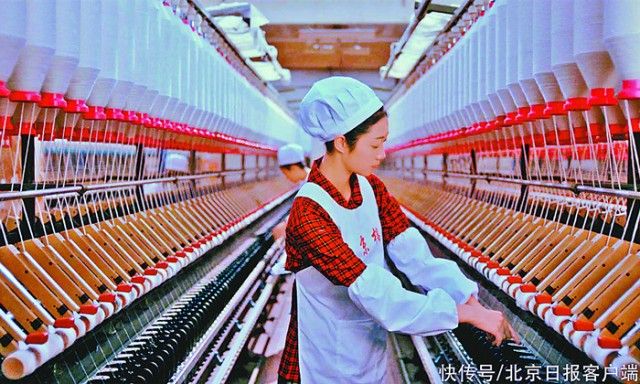
(themograms of the textile women in the film "the ages of the fry")