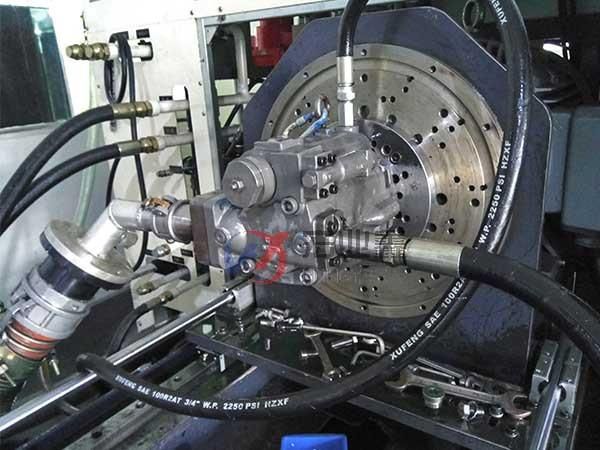
Pumps used for fuel use are refuelled and, after 3,000h, operators are required to inspect the pumps one or two times a day to check whether the hydraulic pumps are functioning properly. In the event of a drop in the speed of the hydraulic tank or a stifling of the vehicle, the break-up of the recharge pump should be checked for any scratches along the side of the wheel and for the size of the internal gear pump. For self-sorting pistons, the fluids in the hydraulic tank shall not be below the lower limit of the oil mark and a sufficient quantity of hydraulic fluid shall be maintained. The higher the cleanness of hydraulic fluids, the longer the life of the hydraulic pumps. The most important component of the piston pump is the bearing, which, if there is a pyrotechnic gap in the bearing, does not guarantee a normal gap between three pairs of grinding sub-pumps, while also undermining the thickness of various rubbeds of static piping and reducing the useful life of the pump bearings. According to the hydraulic pump manufacturing plant, the average useful life of the bearings is 10,000h, and beyond this value new vents are required. The disassembly bearings cannot be detected without specialized detection instruments, but only by visual means, and must be replaced if scratches or colours are found on the surface of the rolling column. In replacing the bearings, care should be taken of the english letter and type of the original bearings, most of which use a large load capacity bearing, purchasing the original manufacturer, the original specification of the product, and, in the event of a change in another brand, training of experienced persons in the bearings, in order to maintain the accuracy of the bearings and the load capacity. The length of the service life of the piston pump is related to normal maintenance, quantity and quality of hydraulic fluids, cleaning of fluids, etc. Avoiding the corrosive wear and tear caused by particles in the fluids to the piston pump is also an effective way of extending the piston pump life. The replacement of spare parts in maintenance should maximize the use of spare parts produced from the original plant, which are sometimes more expensive than other counterfeit parts, but of better quality and stability, and which appear to have saved costs in the short term if they are purchased at a cheaper price, but which may pose a greater risk to the use of pistons. The mix is in the form of a flat-level and a spherical stream. The smoothing side of the spherical stream shall be repaired by grinding at a time when the scavenging surface of the tank is relatively shallow; when the scavengers are deep, they shall be filled with “surface engineering” techniques before grinding, which shall not be made blindly, in order to prevent the copper layer from thinning or spilling out of the steel base. Pumps can also be used to save electrical power by frequency transformers. Pumps are usually operated under pressure or flow during actual production. When the actual pressure is greater than the pressure required, it is regulated by the spill valve, which stabilizes its work pressure and releases the spill valves beyond. And the power is running at full speed and repeatedly, and the power is running constant. When spills are used to regulate pressure and flow, there is a partial residual spill back into the system, resulting in a non-functional and inefficient piston pump, which can be closed if it is used as an energy-saving variable, which automatically adjusts the work pressure through the energy-saving variant itself, stabilizes the work pressure and automatically tracks the pressure of the equipment. Automation of controls to save energy consumption. The greatest advantage of this mode of regulation is that it can reduce the running energy consumption of the piston pump and save more than 30 per cent。