In the analysis of inhibition in the ion chromatography, the rinsing fluid used is a strong electrolyte, and in the absence of inhibitors, the background is highly conductive and is less sensitive. In the case of anion analysis, the function of anion inhibitor is to transform high-conductive rinsing fluids into low-conductive acids or water, thereby increasing the sensitivity of detection. For example, the usual rinsing fluids are the combined solution of na2co3-nhhco3 and the koh, which are powerful electrolytes with high electrical conductivity, while the conductor detector is a universal detector, with relatively poor selectivity, and has a conductive response to the conductor material entering the electric conductor pool, i. E., both the rinsing fluid and the ion to be detected, so that the electrical conductor signals for ion detection under the high rinsing background conductor are relatively small, as shown in figure 1。
If detection sensitivity is to be increased, rinsing fluids need to be converted into low-conductive substances, and the inhibitor is to perform this task by connecting them to columns and electroconductors, and by converting rinsing fluids and ion to corresponding acids following the separation of samples from chromatography columns, such as na2co3-nshaco3 to carbon acid; koh to water; and cl-, so4 to hydrochloric acid and sulphuric acid。
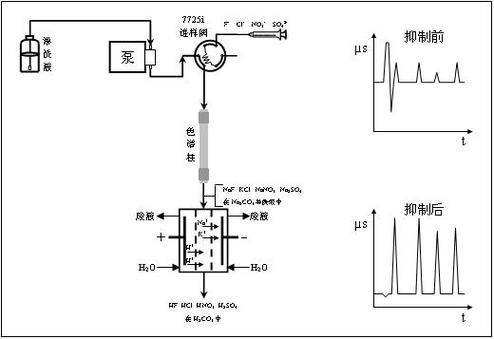
As a result, the rinsing fluid becomes weak acid, resulting in a significant decrease in background electrical conductivity. The anion to be detected has been converted to h+, and the maximum molar conductor for h+ is 350, which is higher than the maximum molar conductor for n+ and k+. The detector tested the sum of the ions of the cyanide, which resulted in an increase in hcl response from nacl and kcl in the original sample. This has increased detection sensitivity. In summary, the response of the ion to be measured has increased the sensitivity of detection through a significant decline in background conductivity after the anion inhibitor. The role of inhibitors is shown in figure 1。
As shown in figure 2, the anion exchange membrane, represented by light blue dotted lines (the ion selective permeation membrane, which can be passed only by the anion), divides the inhibitors into three rooms, the anode regenerative room on both sides of the diaphragm and the cathode regenerative room on both sides. The regenerative room contains electrodes and the water reacts with electrochemicals separately in the regenerative room:
Anode: h2o - 2e = 2h+ + 1/2 o2 ↑
Cathode: 2h2o + 2e = 2oh-+h2 ↑
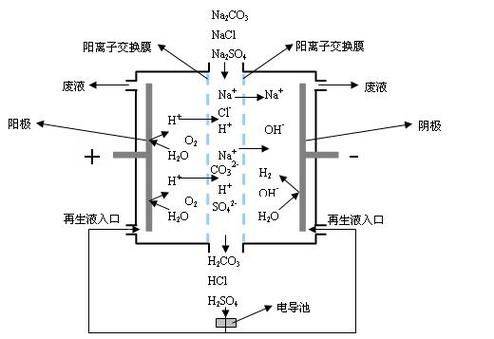
Under the power field, the anode-generated h+ enters the inhibition chamber through the anion exchange membrane, while the inhibition chamber rinsing fluids and the anion in the sample (e. G. Na+) enters the cathode chamber through the anion exchange membrane, thus converting all the lymphoma and samples in the inhibition chamber into corresponding acids, such as na2co3 to h2co3 and the sample nacl to hcl。