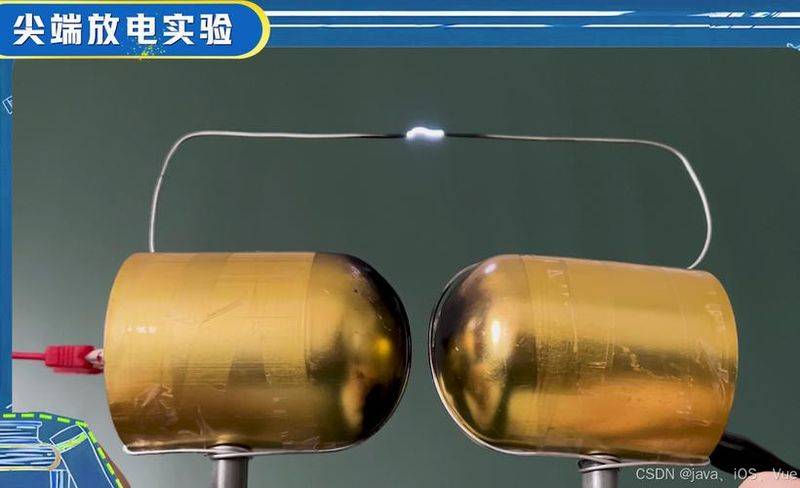
I don't know why the lightning didn't affect the inside of the faraday cage. Can't tell the physical principles of lightning rods and high pressure suits? Is it always confused with the electrical pattern of metal shells in an unfielded state? The course is structured around the core properties of electrostatic balance, subdivided into three practical modules, namely, cutting down the cutting edges of electrical discharge, electrostatic shielding, and electrostatic adsorption, combining examples of life and classics, decomposition of principles, combing conclusions, circumvention of easily miscalculated points and protection and utilization from electrostatic penetration. Core logic: dismantling three types of electrostatic phenomenon 1. The electrostatic balance is the foundation: internal conductor induction field offsets the external electric field, the internal co-location is zero and the charge is retained only on the external surface of the conductor, resulting in two types of phenomena, namely, cutting-edge discharge and electrostatic shielding; 2. Precise concentrated charge distribution patterns: the conductor's cutting-edge charge density, strong field penetration of air to achieve charge release, are classified as harmful prevention and beneficial use; 3. The electrostatic shielding is divided into two types of scenes: the aerodynamic conductor isolates the internal and external electric field, and the adjoining and unconnection to the different shielding effects, and understanding of static adsorption in combination with the dust case. Ii. Core point decomposition: principle + example + operation, breach of key logic of 1. Conductor electrostatic balance (theoretical basis) in layers: free charge-directional movement of the conductor under the action of the outer field, large reverses such as the sensor field and the outer field, resulting in zero movement at the end of the interior without charge; the charge is spread only outside the surface of the conductor, with greater density at the tip of the point where the curve is greater. Common scenario: a pillow conductor senses electric charge in an external electric field, and a charge distribution judgement is applied within a metal ball shell. The solution is critical: bearing in mind that the internal field is strong at zero, the net charge does not move, the transient conductor is integrated with the land, and the external surface charge is combined. 2. Critical logic of cutting-edge discharge principles and applications (living high frequency): the conductor's cutting-edge charge is concentrated, the nearby air is ionized to produce electric particles, and the conductor charge is combined with the air charge. Common scenes: thunderstorm formation, lightning rod avoidance, high-pressure equipment, cutting-edge electroshock depletion; key problem resolution: distinction between applications using (thick needle) and protection (high-voltage device into arc outer form). 3. Key logic of electrostatic shielding and electrostatic adsorption (optional test): aqueous metal casings rely on electrostatic balance to isolate the electric field, shielding the interior from the external field and shielding the internal and external field from the external field; electrostatic adsorption relies on electric field ionizing air and dust belts are then adsorpted to the extreme plate with electric force. Common scenario: faraday cage experiment, metal protective clothing for high pressure workers, esp structural analysis. The solution is critical: to see whether the metal shell is grounded and to determine the type of electrical charge on the outer surface of the shell in conjunction with the charge moving pattern. Iii. Solving techniques template: standardized steps directly apply 1. The electrostatic balance judgement template: 1 to determine whether the conductor achieves a balanced internal field strong default of 2 equals zero →3 charge to the outer surface only, and the outer surface charge is imported into the land when the cutting point charge is 4; 2. The electrostatic shielding template: 1 to observe the condition of the crust. (c) esp analysis template: 1 linear electrode field with a greater power to emit 2 dust from the electron belts is adsorbed to sink by positive collector panels. Iv. Error-prone thunder-shield! These four pits should not step on 1. It's recommended three times a key + three times a collection! Eating through the three main applications of electrostatic balance is no longer a matter of life physics selection! Remember to button the "static appliance clear" card in the bomb screen, and ask questions from the surface metal crust, esp challenge section # high school physical electrostatic field # static balance # sharp discharge # static shield # high physical stress point