If you're in the cnc processing industry, and you often have to deal with the drilling of some of the alien sheet parts in production, it will take you 10 minutes to read this article, because you may also have to face the problem of using a mechanical device, the cnc vacuum suction, which is specially equipped with a cardboard piece。
My article, which is based on years of experience in this industry, is intended to increase awareness of the equipment and enhance the choice of vacuum cleaners。
Don't talk too much. Go straight to dry. It begins with a presentation of the rationale for its work, whether it be a sealed vacuum suction or a porous vacuum suction, which is formed by air pressure differentials on both sides of the project. This is similar to what we've been encountering in our lives. Because of the advantages of a sealed vacuum cleaner technology, stable performance, high accuracy and high value, it will last forever. But when we need to process an exotic piece or finished product as an empty piece of work, we cannot be satisfied with a sealed vacuum suction. Although some would say to leave the bottom behind and then use the machete to make it clear, this is an extra process, and some other processes require a one-time penetration of the piece, and we would have to use a multi-pore vacuum suction。
Then let's focus on some pore-pore vacuum cleaners, which are easily available in many online shops in the country. Why should i share knowledge about vacuum cleaners here? I often see comments in the relevant video comment area of a certain sound that “this suction is a high-tech toy”, that it is bought for a few days, that it is not used, and that it is sold to the corner for ash for days”. I've been in deep communication with users who have been using this. It was found that the problem they were talking about was that the empty vacuum suction they bought was so easily blocked that when it was blocked, it weakened and then it was so easy to fly, that one man would continue to use it down and spent thousands of dollars in vain. Some of the user reactions said that the floppy flounders were easily fractured. The first was a leak, and the precision of using a soft tape pad did not meet the requirements. In any case, it is felt that the vacuum is not mature enough to achieve the desired effect. Let me also say here that the problems these users are talking about are objective and that the multi-pore vacuum cleaners are not a single product like the permanent disks used to grind beds, and that we should understand the multi-pore vacuum cleaners as a small system. Because it requires a stable source of negative pressurized gas, and if we open cutting fluids, it will be accompanied by cutting fluids that will be released from the vacuum cleaners and that will be accumulated and regularly cleaned with a special discharge tank (but we have now developed a package of automatic discharges). The problem of precision is actually a good solution, and the current market-based suction that uses a design that replaces a hard panel that can fly is a good solution. And finally, we're going to have to talk about the problem of a porous vacuum cleaner。
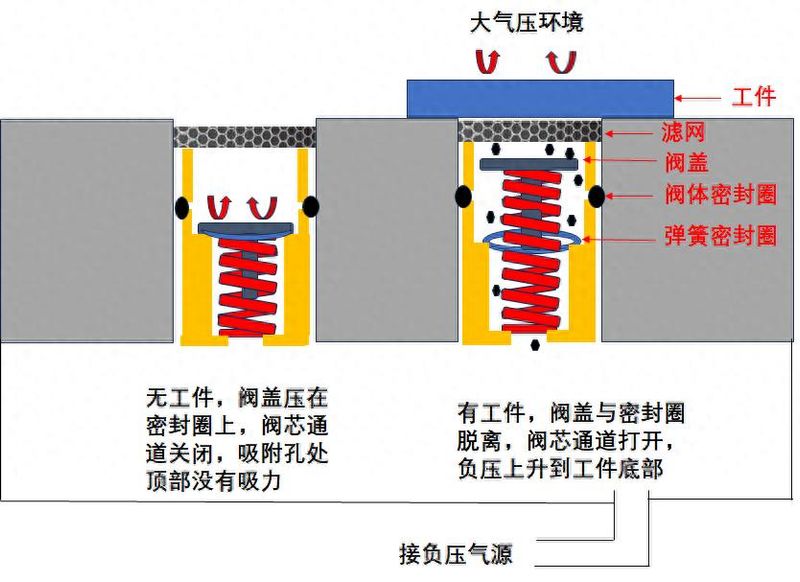
Before addressing this issue, it is necessary to understand, through a schematic chart, why the porous vacuum is prone to holes. Actually, some of the users who used it found me, and when i explained it to him, he realized. Of course, it can't be done without a suction, but with a new type of structure, a multi-pore vacuum suction, and then a solution. Let us look at this map first, and you will find that the vast majority of the porosity vacuum cleaners currently on the market are this type of structure, including the brand of meihwa in our island of taiwan, and the one used by japan's most famous kanetec (which sold tens of thousands of dollars a year ago at home). The single adsorption hole, if not covered by the work, opens the negative pressure at a single moment, creating a pressure differential on both sides of the cover, and the valve is drawn to the lower valve seal, blocking the passage of the core. At this point, you can't feel the suction when you put your hand on the suction hole. When the individual adsorption hole is covered by the project to open the negative pressure for an instant, because the adsorption hole is covered by the project, the negative pressure will continue through the core to the bottom of the project, creating a pressure differential on both sides of the project, which creates a suction. It looks like a perfect design, and it should have a good performance. This would indeed be an ideal performance if the environment of cutting fluids and microcrumb particles were not taken into account. But the reality is that we're going to water the cutting fluid, and we're going to produce tiny pieces, even tiny ones. Now, let's get an analysis of the reasons for the failure of the hole. The time of covering and inside the valve core is seen vertically as a loop gap, which is typically a unilateral gap of about five threads. And some of the scrap particles inhaled from the horizontal gap between the workware and the suction surface to the filter range range between 5 and 10 twigs (in which many people are wrong, it is believed that at the time of the drilling, microcrumbs would have leaked from the adsorption filters outside the scope of the work, and in fact the adsorption holes would have been completely closed at the time, and there would not have been small pieces of crumbs from here), which would have filtered only through a super-intensity filter, or would have been stuck in the loop. These filters need to be rebuffed and cleaned every time they are finished. But the reality is that we can't completely clean up the tiny pieces of debris that are stuck in the valve core filter, store some, blow 90% back, and then build another 90% back (90% just to help you understand more image). Over time, the penetration of the filter on the adsorption hole has dropped to about 30 per cent of the new filter. The suction is strongly related to negative pressure values and pump exhausts, which are almost disconnected from the filter. The suction came down naturally. What i'm saying may be somewhat abstract, and if there is an animation, it might be more understandable. Unfortunately, i'm not animated. Let's try to understand。
If i can understand what i'm saying, i'm sure i can see how empty the spring valve core is, and it's difficult to get rid of the blocked fate from the design. You can only do more work on filter cleaning and prepare some money on the replacement valve core。
I can't write this article just to throw out the problems, point out the problems, and we can't all provide solutions. Otherwise, it would not be a very difficult question for everyone to see for a few minutes。
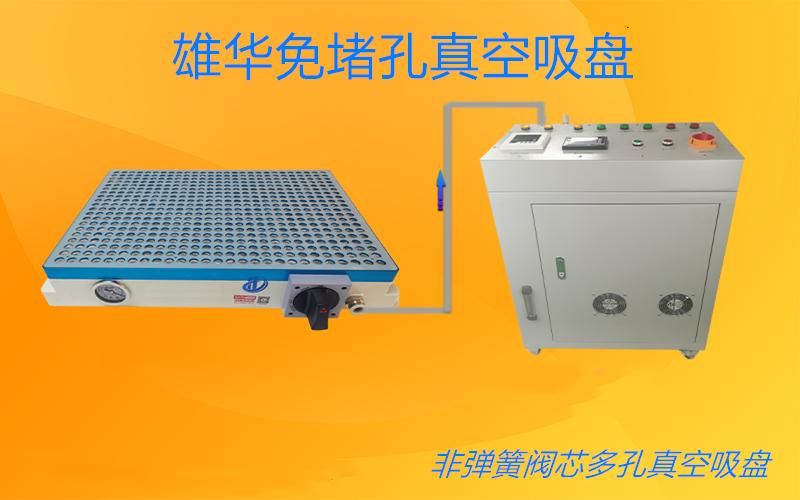
The point is here. The country's porosity vacuum cleaners are actually broken down into two types: spring valve cores known to 98 per cent of the population on the market (as i said above), and non-spring valve cores, which may be known to only 2 per cent, which i used to call "the male free of hole vacuums" because it's an invention patented technology, without a second. The latter has undergone a fundamental structural change, and i mean a data indicator, and the channel shape of the valve core is no longer such a loop gap (as i have also written in previous articles, it has allowed passage of debris particles that are no longer such a five-width gap, and its core allows passage of debris particles that are more than 100 threads, an increase of more than 20 times. So the filters that have been configured are not limited to 5-10 filtrations of microcrumbs that have been washed from the horizontal gap between the work and the suction surface (the filtration net eye is larger), and the filtration net eyes are larger than the particles that can theoretically be sucked into the filter. So you can't find scraps stuck in the filters of these suctions, and you know how sesame particles can block a sifter of corn grains. That's the essence of a non- spring valve cortex vacuum suction. It is often accepted by those users who have used spring valve cores for multiple holes in the vacuum, and whose holes are unbearable. It was because of the blockage that the work was reworked and the search was retraced. Finally, let me tell you that if you don't have an active porosity vacuum cleaner, and if you're working on some materials, such as ceramics, glass, quartz, fibreglass, graphite, you're not advised to try the porosity vacuum cleaner at the spring valve core and think of the porosity vacuum cleaner at the non-spring valve core, because these materials are accompanied by a lot of dusty shredding in the drilling process, and the filters that correspond to the spring valve core are the easiest to block. The non-s spring valve core multiple-pore vacuum suction solves not only the problem of impermeability, but also the problem of low processing precision by using a replaceable hard panel to adsorb the working table and allowing the user multiple one-time hacking of the work。
If you want to learn more about pore vacuum cleaners, you can keep an eye on me if you happen to be dealing with these problems. It can be passed through the bow medium: the male without holes, the find me。