Specific content
The leadership life cycle theory is based on a curved relationship between the behaviour of the leader's work, relationship behaviour and maturity. It emphasizes that the effectiveness of the leadership is to be seen in the conduct of the subordinates. In line with the leadership life cycle theory, when the level of maturity of the lower levels increases, leadership behaviour will need to change accordingly, moving from work-based to relationships-based, and ultimately to focus on ownership. One
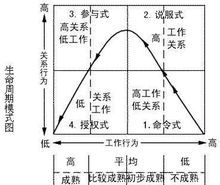
As shown in the figure, the theory suggests that, as we move from premature to mature, leadership behaviour should evolve according to the following procedures: high work and relationship, high work and low work and low relationship。
First quadrant: command type (high work, low relationship). When the maturity of the subordinates is low, there should be a high level of command and low-level leadership. Leadership should emphasize planned, structured, supervised and inspected; otherwise, subordinates would feel weak, overwhelmed and uneasy. This is particularly important for new workers, workers with lower levels of knowledge and lower levels of business competence, and at the grass-roots level。
Second quadrant: convincing (high work, high relations). When the maturity of the subordinates is at an early stage, it is more appropriate to adopt a convincing leadership pattern that combines mission and relationship behaviour. At this point, the job is to explain not only what to do but also why to do it in order to be reasonable and not blind。
Third quadrant: participatory (low, high-level) leadership behaviour is reduced, relaxed, relationships are strengthened and participatory as lower-level staff mature. Leaders are required to communicate information to lower levels, to share feelings, to involve lower levels of participation in leadership, to provide information and advice, to improve relationships and to enhance trust。
Fourth quadrant: delegation of authority (low work, low relationship). When the subordinates are highly mature, highly skilled, skilled and skilled, the leader should take a low-working, low-relative, delegated leadership, and, when a mandate is put forward, let the subordinates do their job, giving full effect to the subjective dynamics of the subordinates; they can be assisted and supported when required. Otherwise, too much concern and support can lead to a sense of disenchantment at the lower levels, where superiors do not give up and trust, thereby discouraging motivation, creating suspicion and undermining the effectiveness of their work. One
“mature” in life cycle theory
In life cycle theory, maturity is defined as a sense of achievement, responsible will and ability, work experience and education。
Age is a mature factor, but not the only one. The degree of maturity refers to the degree of psychological maturity, not the degree of biological maturity. Everyone has a development process from premature to progressive maturity. The average level of employee maturity in an enterprise is equally true for its development: premature — gradually mature — more mature — mature. In these four phases, the way in which leadership is conducted cannot be static, but will change accordingly, otherwise it will affect the effectiveness of leadership. Two
Example
The headmaster of a school manages teachers in three ways: for young teachers, especially new teachers, he gives them a monthly assignment and tells them how to accomplish it. With regard to middle-aged teachers, he was very concerned about their difficulties in life and was interested in listening to them in teaching. In addition to caring for their bodies, the head teachers do not ask questions about their daily work。
The principal uses the leadership life-cycle theory rationally. Young teachers are also at an immature stage, and school principals take “order” assignments to teach methods. Middle-aged teachers are at a more mature stage, and school principals are “participatory” in their approach and listen to them frequently. The old teacher has reached a very mature stage and the headmaster has adopted the “authority formula”。
Comment
This theory, which graphically reflects the relationship between the conduct of the leadership and the maturity of the subordinates, has some guidance on the conduct of the leadership, but it cannot be transposed in a dogmatic manner and does not necessarily require that this curve be followed in the course of actual leadership。
As productivity and science and technology progress, the level of education of employees is increasing, many of them have a higher level of education and standard of living and are mature. As maturity changes, it is more the need for belonging and recognized, respected and fulfilled talent that leaders take into account. One