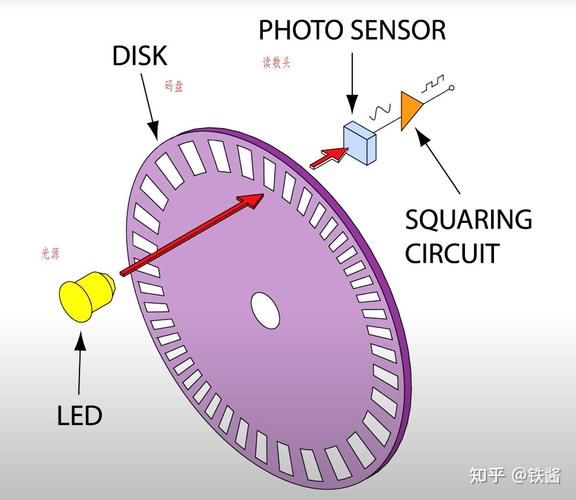
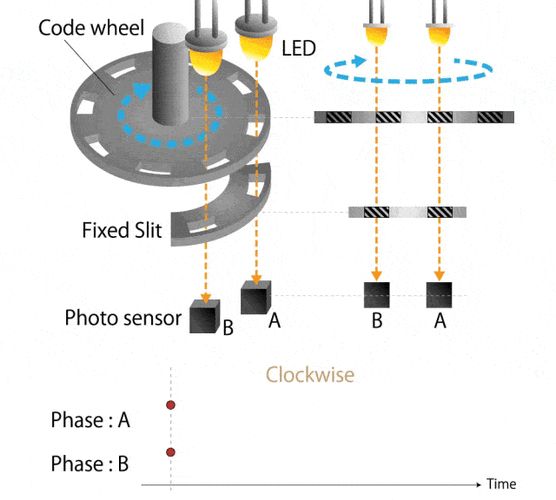
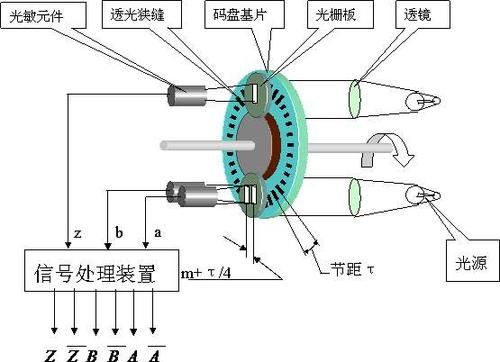
Working principle: when the pv encoder turns, both a and b lines generate pulse output, with a 90-degree azimuth between the a and b pulsations, which allows the pv encoder to move in the direction and speed of the power. If the a-phase pulse is positive before the b-phase pulse, the pv encoder is positive, otherwise for the reverse... Z-line is zero pulse, the pv encoder produces a pulse at each turn ... Primarily for count purposes. Line a is used to measure pulses, and line b, in conjunction with line a, can measure direction.
N turns the power
Δn = nd-nd measurements
For example, the speed of our car is 1. 5 m/s, the diameter of the wheel is 220 mm, c=d*pi, the electric power is controlled at 21. 7 turn/s, and according to the server system indicators, the electric power is set at 1,500 spin/min, so the pulses per second from the optical disk are nd= 21. 7*60 = 130 turn/minute:
Pd = 130 x 600/60 = 1,300 veins charge
When the number of pulses measured is different from the standard values calculated, you can incremental voltage u, which is exported to the server system, is calculated on the basis of the correspondence between voltage and pulse numbers, converted by d/a, and additional pulses are calculated, minus。
When the longer we run, the longer we go, the more we're moving away from our prefabricated routes. At this point, the system activates the loop, calculates the incremental p and converts it to the corresponding d/a output volume by continuously measuring the pulse of the pv encoder output per second and comparing it with the standard pd (ideal value), reduces the pulse of the transmitter by means of the controller, subtracts the increase from the original output voltage, and forces the motor to turn down, and ceases to regulate when the pv detects is close to zero, so that the rate of transmission can always be kept within permitted limits。
The codifiers can be divided into optical, magnetic, sensory and electric. Depending on the scale method and the form of signal output, it can be divided into three types of incremental, absolute and hybrid。
1. 1 incremental encoder
Incremental encoders are the direct use of the pv principle for the output of three sets of aerobic pulse phase a, b and z; the 90-thousand pulsation phase difference between a and b sets of two sets of pulsations is a pulse for each of the spinal phases, which is used for benchmarking points. It has the advantage of being simple in principle, having an average mechanical lifetime of tens of thousands of hours or more, and having a high resistance to interference, reliability and suitability for long-range transmission. The disadvantage is that it is not possible to output absolute position information for axle rotation。
1. 2 absolute encoder
The absolute encoder is the sensor for the direct output of numerical quantities, and there are several concentric comprehensive paths along its circular coding disc, each of which consists of a swath of light and a non-lighted sector, with the number of sectors in the adjacent channel being double, and the number of codings on the coding being the number of its binary numbers, which is a light source on one side of the coding and a light-sensitive element on the other side of each channel; when the coding is in different positions, the light-sensitized elements convert the corresponding electro-level signals to a binary number, depending on whether or not they are lighted. This encoder is characterized by the absence of a counter, which can read a fixed digital code at any point in the axis. It is clear that the more the code, the higher the resolution, the more the code will be, and that for an encoder with a n-bit binary resolution, it must have a n-bar. There are currently 16-bit absolute encoder products in the country。
Absolute encoders are pv conversion using natural binary or circular binary (gray code). The absolute encoder differs from the incremental encoder in the light-trapped, non-luminant line graphics on the disk. The absolute encoder can have several codings that detect absolute location according to the code on the readout disk. Encoding may be designed using binary code, circular code, binary supplement, etc. Its features are:
1. 2. 1 direct reading of the absolute value of the angle coordinates
1. 2. 2 no cumulative error
1. 2. 3 information on the location of the power removal will not be lost. However, the resolution is determined by the number of binary digits, which means that precision depends on the number of digits, and there are currently 10, 14 and so on。
1. 3 mixed absolute value code device
Mixed absolute-value encoder, which produces two sets of information: one set of information to detect magnetic polar positions with absolute information functions; the other set is identical to the output information of the incremental encoder。
The pv encoder is an angle (angular velocity) detection device that enters an angle to the axle, converts the pv principle to the corresponding electrical pulse or numerical volume, with the advantages of small size, high accuracy, reliable work, digitalization of interfaces, etc. It is widely used in devices and equipment that require detection angles, such as numerically controlled machine beds, reverse stations, servers for transmission, robots, radars, and military targeting。