What's the rationale and function of the codifier
The communication server is divided into three parts, i. E., the fixed, the rotor, the encoder. It consists of steel cores and wires. The rotor is usually a permagnetic. Other components include assistive components such as end covers, fans, etc。
Let's look at the structure of the telecommunications servos, as shown below, which consist of steel cores and circuits. We're talking about a trio exchange service, so it's sort of a trio. The stationary function is to generate a rotating magnetic field through three-phase exchanges, which operate on the same basis as the normal three-phase motor。
Share the structure of the server rotor. The rotor of the communication server is a permagnetic, and the principle of servulating the machine is to rotate simultaneously with the magnetic field as a result of the spin field generated by the indent, so the server can also be described as a synchronized electric machine。
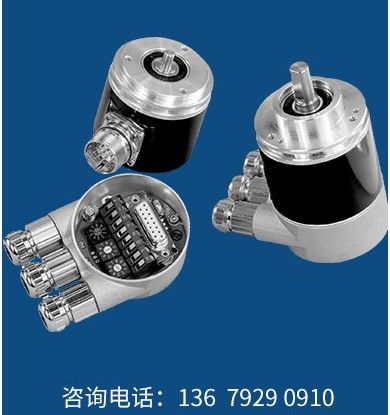
Share the structure of the server encoder. The encoder is placed on the rotor axis of the communication server, and the encoder's coding disk follows when it turns. The encoder for the server is an pv encoder, with mitsubishi's encoder for the machine having a resolution of 13,1072 pulses/turns, i. E., when the machine rotates for one week, the code is capable of exporting 13,1072 pulses. The encoder for the server is the determination of the performance of the server, and when the machine rotates, the pulse of the output of the encoder is fed back to the server driver, constituting a closed loop control. The encoder consists of several components, such as coding, luminous tubes, pv receivers, and amplification of whole circuits。
The following figure is the encoder's coding disk, which is usually composed of a piece of glass with a layer of metal chromium plating on the surface of the glass, and which, using laser technology, is carved into a stripe of a dark phase. As can also be seen from the chart, there is a striping on the outer edge of the disk, assuming an a-phase pulse from the encoder, and inside, a strip equivalent to a b-phase pulse from the encoder, which is the z-phase pulse from the encoder. If the encoder's resolution is higher, the more stripes on the disk. The z-phase pulse usually has only one stripe, meaning that the encoder rotates for a week, and the z-phase produces only one pulse。
The encoder works. As shown below, the luminous luminescence is received through the stripes of the glass coding tube, which follows the wheel as the machine rotates. Since the discs contain strips of some dark phase, the pv cavities receive light pulses, which convert the light signal into a telecommunications number, which in turn is converted into a rectangular pulse by magnifying the whole circuit. Because the stripes that are carved in the a- and b-phases on the disk are separated, there is a phase difference between the a- and b-phase pulses that amplify the whole circuit output. Here we ask for a 90-degree difference between the a- and b-phase pulses. Because of the z phase on the plate
There's a stripe, so a week's rotation of the electric power creates only one z pulse. The encoder we're talking about here is a relative encoder, which, in addition to a relative encoder, has an absolute encoder, and some servers use absolute encoders。
Return list>
Product list
Absolute encoder
Incremental encoder
Reload blast-proof encoder series
Import brand coders series
Pull the line shift sensor
The gate opener
Encoder-specific attachment series
Instrument instrument series
Geometric sensors series
Ultrasound sensor