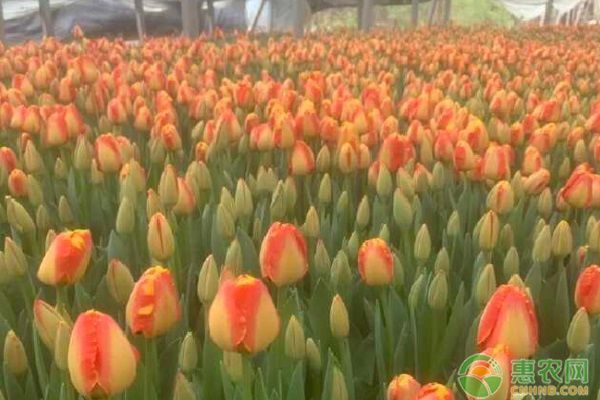
The tulip is a multi-year herbivorous plant with a flat cone-shaped, strong cold tolerance, and a ball that can withstand low temperatures of up to below 35°c but not heat. It grows at suitable temperatures of 15-18°c and 17-23°c when the buds are divided, and if the temperature exceeds 35°c the buds are reduced. The following is a brief study of tulip cultivation techniques and cultivation management。

(i) tulip conventional field cultivation
1. Soil preparation: a choice should be made to plant tulips where the soil is lax and fertilized because of their taboos. Pre-plantation requires a deep upturn of 35-40 cm and soil disinfection, accompanied by the application of 2,000-3,000 kg of decomposition organic fertilizer per acre to improve the soil, so that the ph value of the soil remains between 6. 5 and 7. 5。
2. Plantation: tulip planting is generally carried out in the north between late september and october. In the north-east and north-west regions, due to earlier temperature reductions, planting should be done well in advance. North china can be established later, and beijing is usually established in mid-october. The timing of planting is important, and if planted too early, the warmth of the climate will allow the tulips to grow out of the leaves, and cover will be required in winter to avoid freezing. Late planting can lead to bad rooting, which in turn affects growth in the coming years. Cultivation depths of about 3-5 cm, or 3-5 cm topsoil above the ball, need to be straight up。
3. Post-plant management: water should be poured once before planting to ensure soil moisture during planting. Once planted, water should be poured again immediately, both to reduce soil temperature and to increase soil moisture and to facilitate the rooting of tulips. After rooting, the stem base forms a strong root system that allows the absorption of moisture and nutrients in the soil to sustain the normal growth of the upper leaves. Freezing water must be poured once before winter, and water should be poured in time to keep the soil wet when the young leaves are soiled in the coming spring. In winter, water is generally not necessary and soil moistation is the criterion for the rest of the time. The application of thin liquid fertilizers once at the beginning of the fast-growing long-term leaves and the luminous revels can make the flowers larger and more colorful。

(ii) 5°c tulip planting in greenhouses contributing to cultivation
A 5°c tulip ball: after harvest, the tulip ball is treated at a high temperature for a period of time, then at 5°c for a period of 8-12 weeks, and the tulip ball, which is processed at 5°c, can bloom in the greenhouse for 45-60 days. But it needs to be noted that not all tulip balls are suitable for 5°c treatment。
Soil preparation: soils in the greenhouses should have good soil structure, drainage, soil ph values between 6. 5 and 7. 5 and be at low salt and low nutrient levels. Soils must be sterilized prior to planting and 40 per cent of the ff can be sterilized。
Sphere treatment: one method is to carefully remove and disinfect the brown skin on the roots of the package before planting. The removal of skins can reduce the root damage to the tuber disinfection, promote the homogeneity of the roots, symmetry the whole tulip and shorten the planting cycle in the shed. Another method is direct planting without removing the brown skin。
4. Depth of implantation: if a penis removed from the skin is used, it will be better if the top of the ball is slightly exposed. The top of the ball is 3-4 centimetres from the soil table, if it is used without the skin。
Plantation density: 230-280 ball/m2. When it's set in autumn, the density should be smaller. At winter planting, the density should be higher. The specific density will also need to be determined on the basis of different varieties, the size of the stem and the time of planting. In general, the size of the crowns, such as the heavy petals and the darwinian-breeding variety, should have a smaller plant density. And early flower varieties can be properly planted。
6. Post-plant management:
Temperature: the first two weeks after the 5 °c ball is planted are the root phase, the soil temperature should be maintained at 9-12 °c and if above 12 °c causes blind flowers and lower flowering rates. Soil surfaces can be covered with straw or straw after planting, both to prevent sunlight from lowering soil temperature and to preserve moisture. If the soil is too hot, it can be irrigated with cold water and covered with straw. After two weeks, the temperature of the greenhouse can gradually rise to 15°c, and after three to four weeks the temperature can rise and remain at 17°c。
Humidity: water must be poured once before planting to ensure soil moisture during planting. Water is poured once after planting, allowing the seedlings to be fully in contact with the soil, thereby facilitating rooting. The subsequent application of water to ensure that the soil is wet, i. E., the hand grabs the soil below the stem, which is just the norm in the group. Watering times are best chosen in the clear morning, with better dripping. The tulips must never be more than 80 per cent wet in their growth, preferably less than 70 per cent。
Fertilizers: tulips require a large amount of nutrients in the bud and in the current curvature, and tulips for cutting flowers are more sensitive to fertilizers and, if they are insufficient, the leaves are weak and the flowers soft. After a good rooting of the ball, some nitrogen fertilizer can be considered and calcium nitrate is applied three times per 100 m2 at a one-week interval. Calcium ion in calcium nitrate also prevents tulips from falling. Potassium pernitrate and 28-14-14 high nitrogen fertilizer can be applied in the 20-8-20 four-quarter seasons when the tubers are budding to the height of 2-3 cm from the newly sprouts. Four seasons of potassium pernitrite fertilizer are applied once the buds are formed to help the tulip bloom. At this point in time, the leaves are so thick that in the application of fertilizers, care is taken not to damage the leaves, while the fertilizers do not stain the leaves。
Light: light is important in enabling cultivation. There is plenty of sunlight that can make the leaves thick, hairy and colorful, but too much light can shorten the flowering period and make the color fade too early. On the contrary, during successive winter rains or rain and snow, normal light co-operation is affected, the colour of the leaves is diluted, the flowers are long and soft, sometimes down or down, directly affecting the quality of cut flowers. The need for additional light at this time is beneficial for early listing of the tulips。
Promotion of flowering: can be treated with cactinin and light. In mid-november, at 7-10 cm high, cactin (0. 5-1. 0 ml) was injected into the acne leaf for a second treatment after 7-10 days. Water is to be controlled for 1-2 days before the charge, so that there are no droplets in the leaf, so that the treatment can bloom 10-15 days in advance. The effect of cacinoxin processing combined with extended photoprocessing would be better。
(iii) tulip common pests and control methods
1. Tulip disease: also known as the disease of fire, astrophy, is one of the most common and most dangerous diseases in the cultivation of tulip sheds。
Symptoms: plants grow bent and die wither when they are affected, partly as a result of brown spots, easily decomposed as a result of their infarction, and in the case of seedlings. When the rods were injured, the whole tulip dwindled and turned to light yellow, withered flowers, decomposed outside of the tubers and tubers, and produced many black or dark brown bacterial cores。
Prevention and treatment: before planting, careful examination of the runners, removal of the battered runners and sterilization. Residual solutions on the saps need to be washed and dry before planting. In case of an illness, a microbicide solution can be sprayed for treatment。
Tulip-based corruption
Symptoms: leaf leaves are yellow, atrophy and death is severe. The victim's roots are rare and the foundation rots. The rods that were violated during the storage period were white and the rotting parts of the base had become hard wrinkled, sometimes in a wheeled pattern。
Prevention and control: burger digging should be carried out as much as possible during periods of dry weather and low soil moisture. The water temperature is controlled at 28-30°c for 15-30 minutes with 0. 15% - 0. 3% benz. After disinfection, the skin is dryed and placed in a cold, ventilated place for storage。
3. Tulip virulent decomposition
Symptoms: the main harm is to the runners, who are highly perishable in their places and are also highly susceptible to other healthy runners。
Prevention and treatment: healthy seed balls should be selected and disinfected before planting。
4. Tulip stasis
Symptoms: often occurring in highly petal-type varieties, and exposed to a plague of disease, plumes close to or below the foliage are wrinkled, decayed, downsided and cause flowers to fall。
Prevention and treatment: there is no effective method of prevention, mainly through planting in well-soiled, well-ventilated sites。
In summary, there are features and requirements for tulips as a flower of high value, their planters and pest control. In the process of planting, the tulips can only grow well if they are well understood and followed in their growth patterns, and if they are properly prepared, planted, managed and managed。
You may be interested in and welcome the content of the following recommendations of the network on tulip cultivation techniques and management。