Contents
Why can it replace single-phase circuits and become the core of the power system? How do we understand the three-phase power supply, how the load is connected, and the complex relationship between wire voltage, phase voltage, wire current, phase current
The note will take you from "why three" to a system that combes the basic concept of a three-way circuit, the core variable relationship, to the principles and applications of the y-to-one equivalent transformation on the side of the power supply, to a clear knowledge framework that allows complex three-way circuits to be visualized。
I. Why is there a three-phase circuit rather than a single one
In our daily lives, we hear more about zero-line, fire-line, ground-line, such as the usual three-problems, with the top and the bottom being a line of fire。
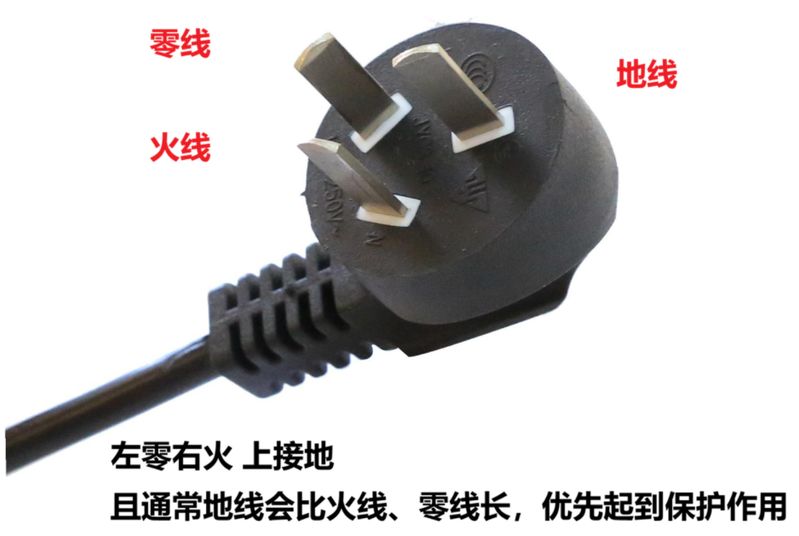
Then why is the concept of three-way circuits in the air? In fact, the three-phase power plants are used in power plants, which have significant advantages in terms of transmission efficiency, smoothity and reliability, and are gradually becoming the basis for modern power systems。
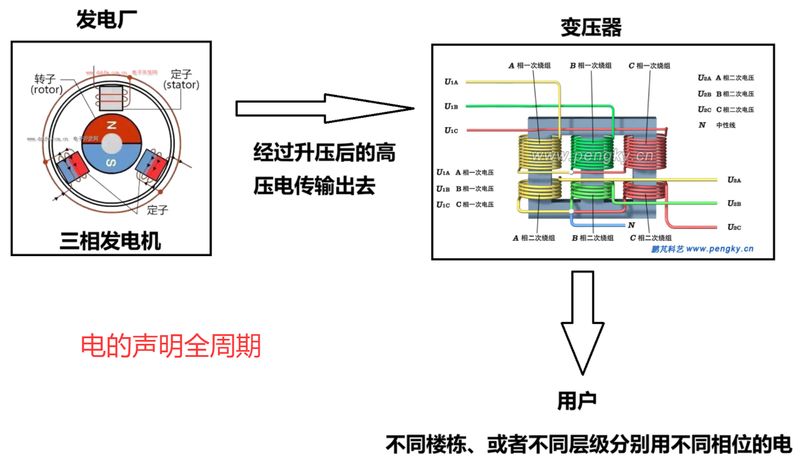
When the generator rotor rotates in the magnetic field, three sets of fixed circuits with a difference of 120° will be cut, resulting in a three-phase exchange power with an equal range of 120°. This natural three-phase structure gives three-phase circuits an irreplaceable advantage over one-phase circuits:
The transmission efficiency is higher: under the same transmission conditions, three times the power of a single phase of the three-way transmission, with less consumption of conductive materials. This means that the three-phase system can significantly reduce costs and energy losses during long-range transmission。
Power output is smoother: the instant power of a single-stage exchange will fluctuate over time, while the sum of the instant power of a three-stage exchange is constant. This makes the three-phase (e. G., industrially large) more smooth, vibrations and noise smaller, especially suitable for driving heavy machinery。
The power supply is more reliable: in the three-phase system, even if one malfunctions, the other two can continue, greatly improving the continuity and reliability of the supply。
For the time being, this part of the generator can be understood in depth and studied in detail during electrical studies。
When a three-phase power is transferred to the vicinity of the destination by high-voltage wire, there will be a transformer station to carry high-voltage electricity and convert it to a low-pressure 220v active power, although it will still be a power source at three stages at this time. As a result, the three-phases are usually distributed to different users by floor and unit number, so single-phase communication is always used on the user's senses。
Ii. Basic concepts of three-phase circuits, three-phase power sources
To truly master three-phase circuits, it is first necessary to clarify the definition and some basic physical volumes (such as wire voltage, phase voltage, etc.), which are the basis for understanding subsequent connections, calculations and the central basis for distinguishing between single and three。
(1) three-phase power
The so-called three-phase power is made up of three different-phase power sources, mainly symmetrical three-phase power sources in modern power systems, i. E. Each power source has a different phase, with identical independent power sources in terms of model values, frequencies, wave shapes (usually sine)。
1. 1 y and power
Since there are three separate sources, connectivity can be divided into type y and type y。
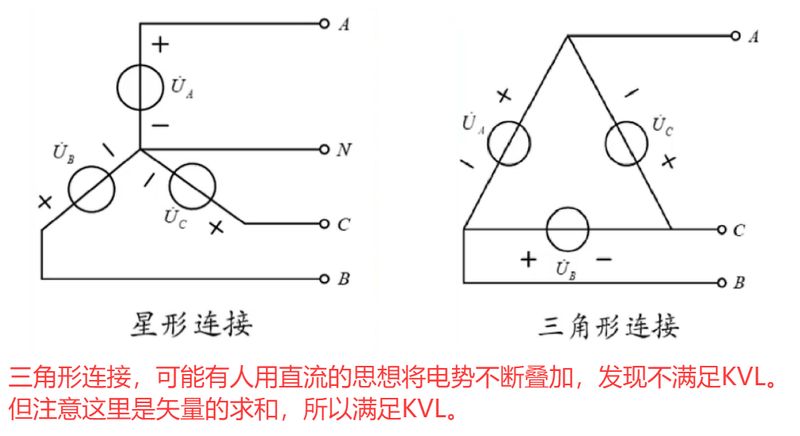
Among them, the y-type connection has a clear neutral point n, commonly known as n-z, and abc is a single line of fire; the connection does not have a clear neutral point, so it is usually only used in specific industrial large-scale equipment and domestic appliances are not able to use type-connected power。
(even if a connected power is constructed, the power effectiveness between any two points is 220 v, but the three-phased communication electricity varies 120° by time phase, and the a and b two-phase power levels fluctuate in real time (no fixed 0v reference), which results in normal operation of currents within the household, steady voltage circuits, or even damage to components due to the displacement of the power. So there is no precise zero line and it is easy to burn down household appliances
And the most critical point is that in our electricity system, electricity of type only supplies large-scale industrial equipment, and household access lines are the lines of the type y electricity。
Among these, the power-end y connection, because of the distinction between firelines and zero lines, can be derived from two methods of active value: abc and n = 220v of any line of fire; and industrial voltage of 380 v of any line of fire。
The type connection, on the other hand, is only a fireline, so only industrial voltage of 380 v, equivalent to the second method of use of the type y connection, can be generated。
1. 2 sequence
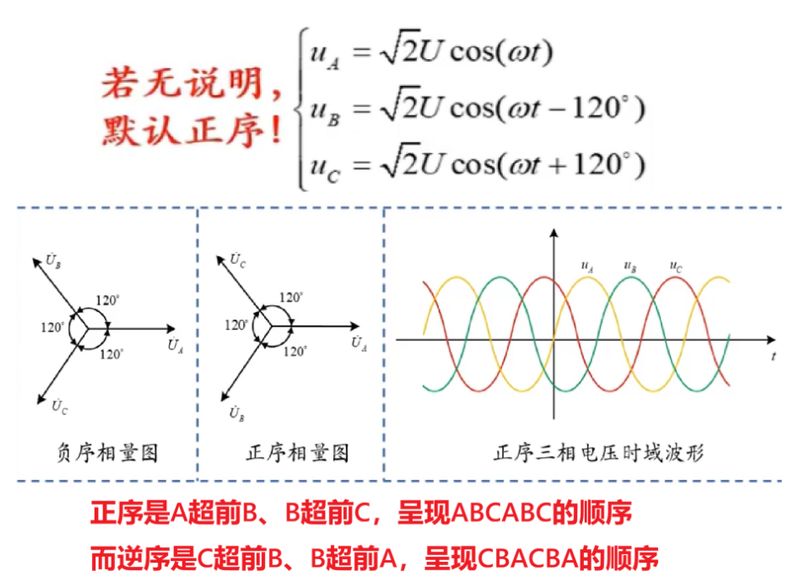
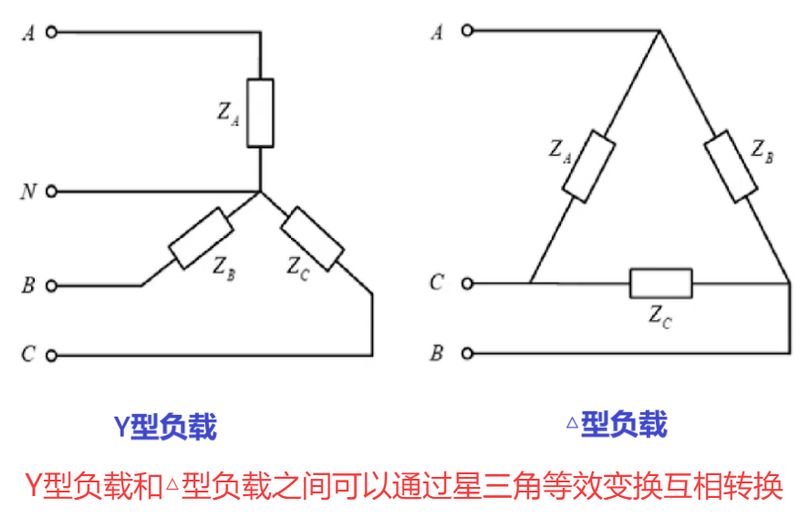
(2) triple load
As with the definition of a three-phase power source, the three-phase load is usually considered only in symmetrical form, at which point the three-part loads are the same in terms of emulation, resistance angles。
And since there are two different ways to connect the power side, there must be two ways to connect the load side。
(3) different modes of connection consisting of three-phase power, three-phase voltage
There are also different modes of connection when power, load combinations come together, as there are multiple connections。
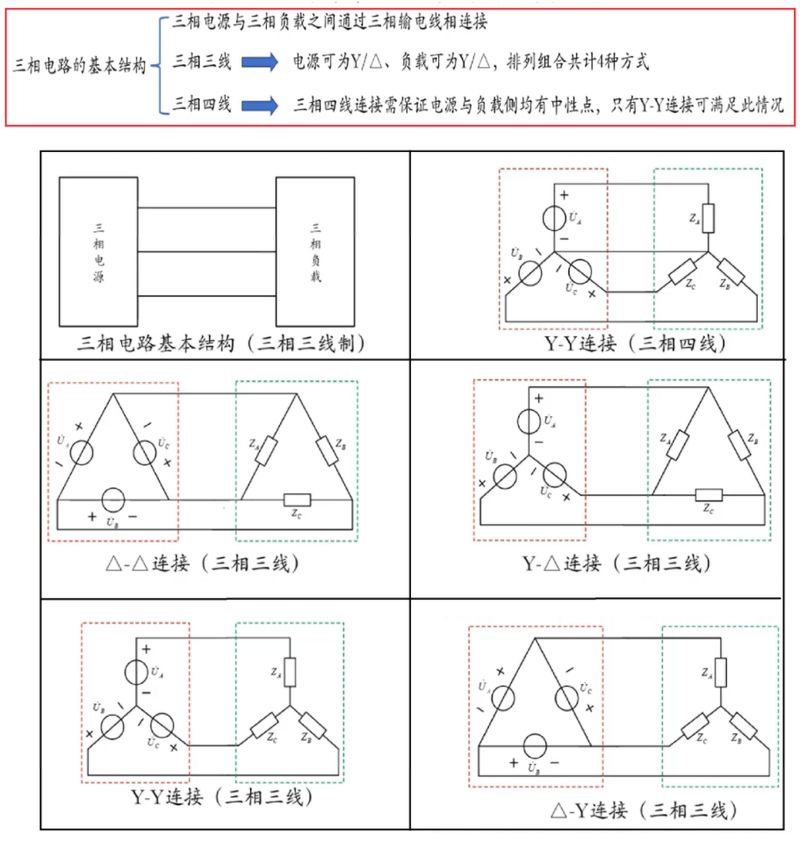
Note that some of the numbers in the above figure may be confusing. The correct judgement should be: ab against a, bc against b, ca against c. And the so-called phase is the power that connects both ends of the point。
Iii. Basic variables and their relationship (1)
We primarily discuss the concepts and relationships of phase voltage, phase current, wire voltage, wire current。
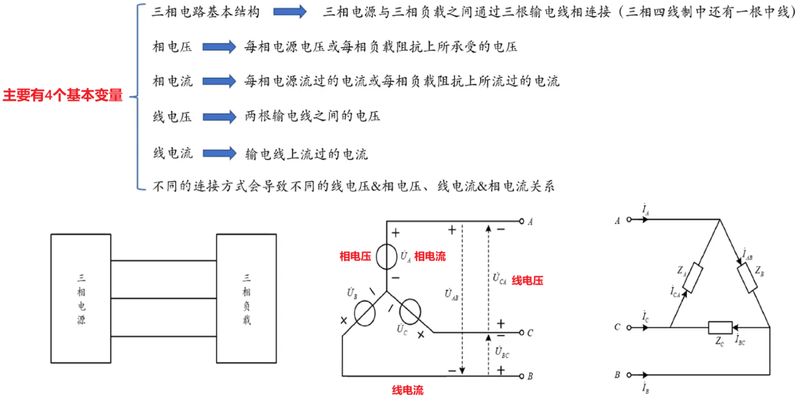
One thing that can be confused is that it is highlighted here: it's related to “symmetry”, which can be understood both as a variable on the power source and as a variable on the load resistance (as each power source only provides the corresponding load, so each is independent, symmetrical circuit, without interference). And all the variables associated with the line are on the transmission line。
(2) relation of wire voltage to phase voltage (power side)
All the following analyses are based on symmetric voltage, symmetric load conditions。
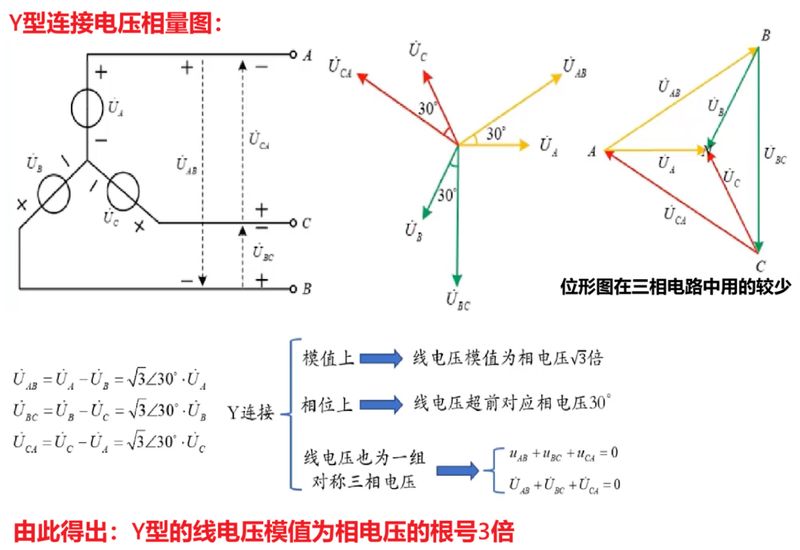
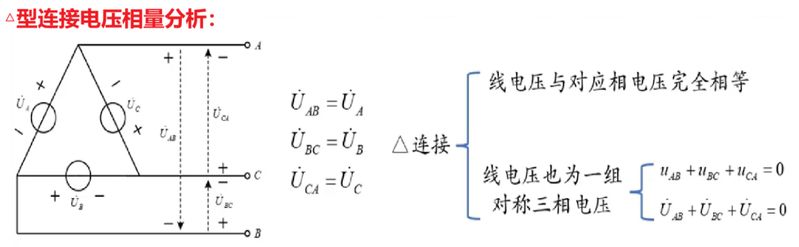
Here's to remember: in the y-type connection, the wire voltage is the multiple of the phase voltage -- three times the root. The wire voltage is exactly the same as the phase voltage in the connection。
(3) relationship between wire currents, phase currents (load side)
The analysis below is still based on power supply, load resistance and full symmetrical conditions。
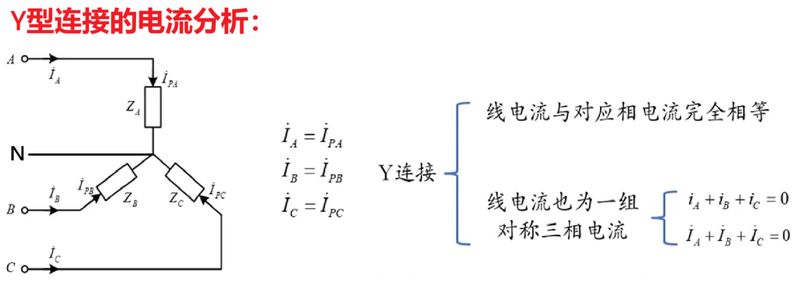
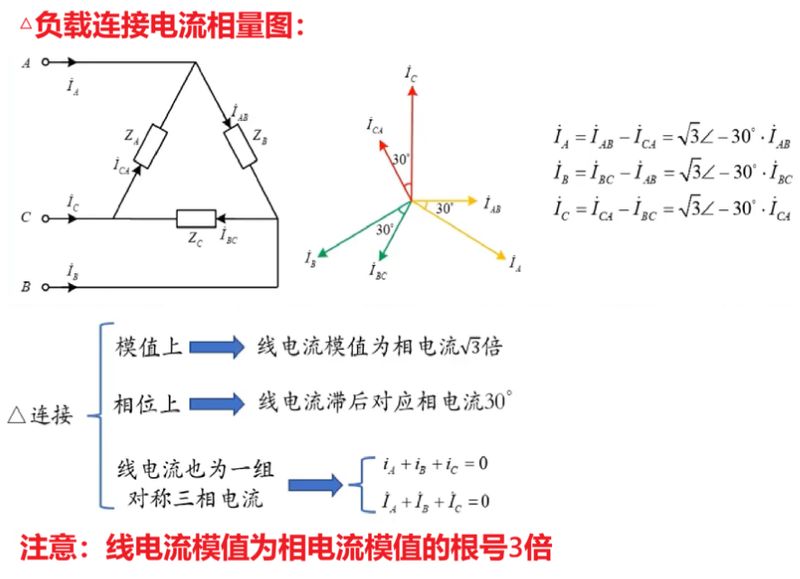
Here, attention is drawn to the fact that wire currents are three times the root number of phase currents in a connection, while the y type connects medium-line currents and phase currents are identical。
Since wire currents are paired with phase voltage, their conclusions are also entirely in the form of a pair, and this can be recalled。
(4) summary and analysis 4. 1 consolidated conclusions
These two scenarios are basic units for the analysis of voltage and currents. However, the cyclops found that voltage relationships were analysed from the side of the power supply; currents were analysed from the load. But because of this grouping, there are five power-loading modes of connection, so who is the dominant
The answer is both. For example, one circuit is y power, triangle load. Will the two characteristics be combined? The wire voltage is three times the root of the phase voltage and the current is three times the root of the phase
The answer is: yes, in a combination of “y-type + loads”, the two “three times” conclusions will come into effect simultaneously, and they work in different parts of the circuits and are not conflicting。
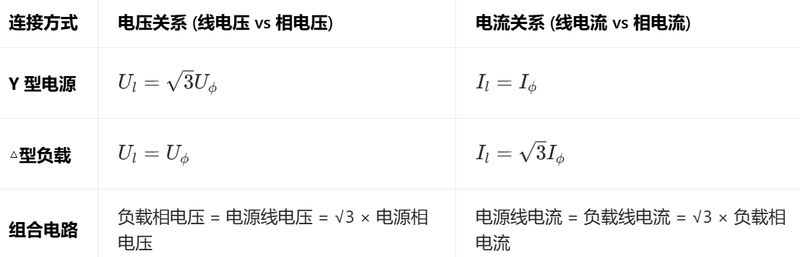
This conclusion also applies to other groupings。
Sometimes there may be multiple loads of a secondary road in the title, allowing you to calculate a particular load of wire, phase voltage, while they still have three times the root。
4. 2 “independent” analysis and discussion
In the three-phase circuit, the essence of “independent” is that the current of this phase, with or without its own exclusive circuit, does not require a “interbor” or other phase。
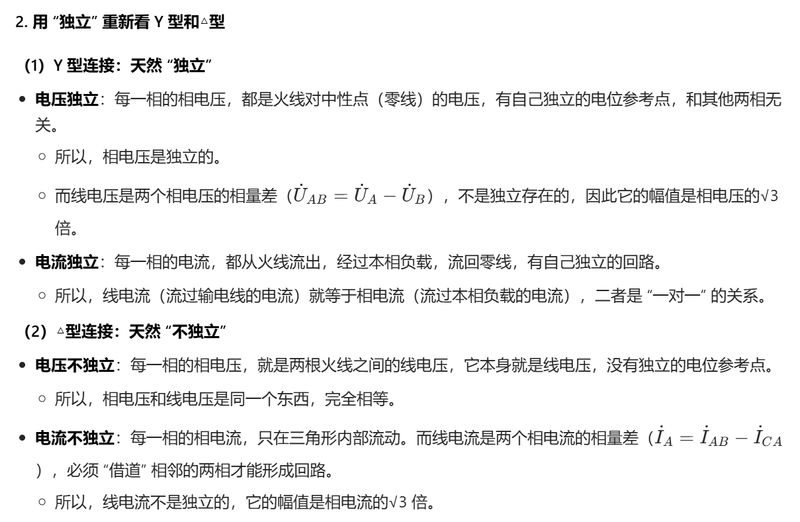
Iv. Basic analytical methods for symmetrical three-phase circuits (1) conclusion of basic y-y connections using node voltage method
The symmetric three-phase circuits are still, in essence, symmetrical and steady circuits, except for the addition of an independent source to three symmetrical independent sources, where all the analytical methods and conclusions that can be used in the symmetrical segment are still valid, with the exception of special analytical methods. Like the y-y connection here。
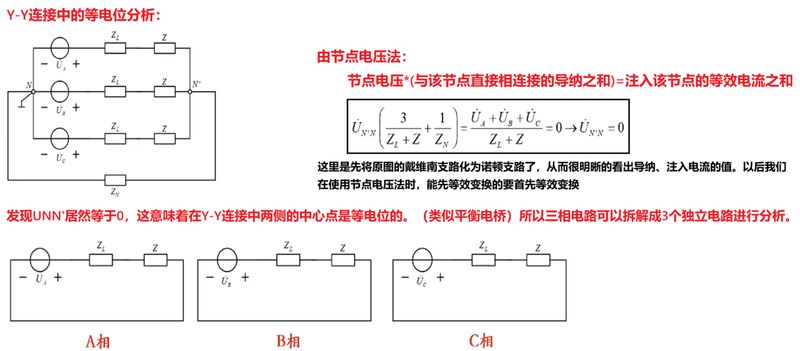
It's in the circuit connection structure, which directly connects n. N.'s points, so it's obvious that unn'the voltage between them is zero. But the analysis we have just given is one that is universal and universal. So even if there's no connection to the subject'two o'clock, it can be assumed that there is a virtual connection. Because they have the same level of power, they can see short circuits and break paths。
Then, as a result of y-changes, all three-phase circuits can theoretically be reduced to a simple y-y connection and analysed using a level-to-level conclusion. We will follow up on this point。
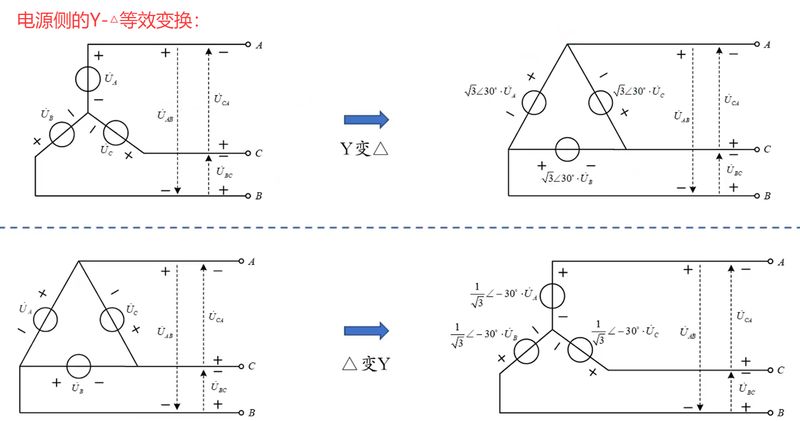
(2) no internal resistance to y-equivalent transformation of three-phase power
We discussed earlier in our analysis that the side of the load can directly use the resistance equation for y-change. But what if there's a need to change the power side
Here we need to understand the reasoning: the load end can only feel the sequence, wire voltage. In other words, no matter how you change the side of the power source, as long as you guarantee that the sequence and the wire voltage remain constant, the load has no idea that you have changed, thereby using this feature to make y-equivalence changes on the side of the power source, thereby simplifying the analysis process。
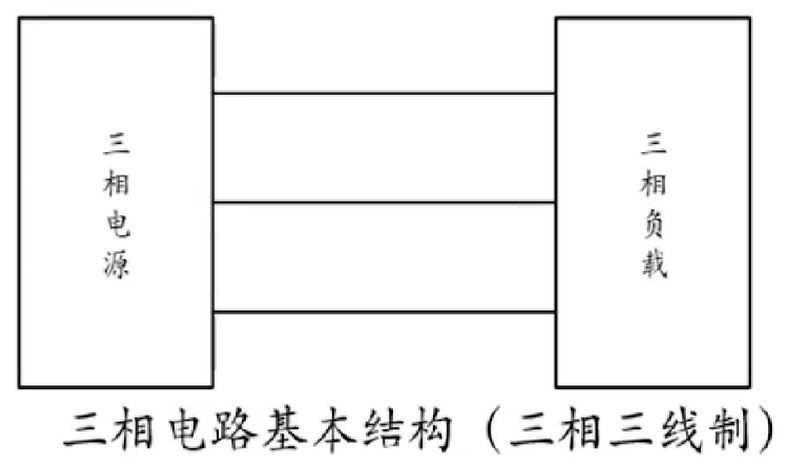
Equivalent mutations: the above figure is the basic structure of the three-phase circuits, and the four-line nature of the y-connection can still be seen as a special case for trilinears, so that in the view of the load end, as long as the three lines to the left introduce the same power (the same wire voltage), the equivalent may be altered (the black box principle)。
Since the wire voltage of type y power is three times the root number of the phase, and the wire voltage of type y power is exactly the same as the phase voltage, the conversion of type y power equivalents to type electricity requires a change of the root number by three and a symmetrical shift of +30°; whereas the conversion of type y power equivalents to type y power is the opposite process, with three times the root number and a shift of phase by -30°。