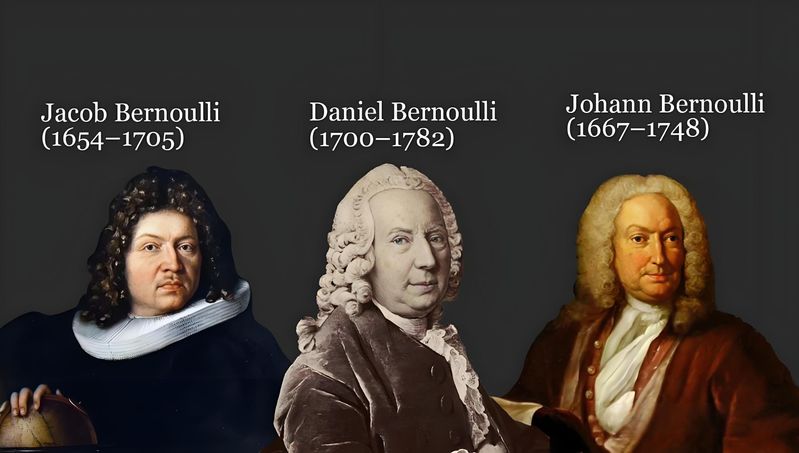
In the late 17th century of mathematics, a swiss scholar from basel secretly unleashed the potential revolution — jakob bernoulli. As one of the founders of the great family of mathematics, the bernouli family, jacob not only left an ink-stained sum in the areas of infinity, calculus and snails, but also was hailed as the “father of mathematical statistics” for his systematic development of probabilities. In that age of probabilities, opportunities and destinies, jacob gave the world the landmark book ars conjectandi with rare rigour and philosophy. For the first time, he made clear the mathematical expression of the rule of large numbers, so that the rule behind “random” could reveal — reason finally found its place in uncertainty。
"natural order is deep, and mathematics is the language that reveals its laws."
— jacob bernoulli
Table of contents i. Introduction: probability foundation covered by time
Jacob bernoulli is a thinker who is blinded by time and very fundamental in the history of mathematics. As an important member of the bernouli family in switzerland, he is neither known for teaching and teaching, nor does he establish merit in physics and engineering as his nephew daniel. But jacob laid a solid foundation for the birth and development of probabilistic theory with his deep theoretical insight and logic. His whole life-formation, " ars conjectandi " , not only systematized and expanded the combination of mathematics for the first time, but also introduced for the first time the central idea of the probabilistic theory。
In the seventeenth century, when a modern system of statistics and probabilities had not yet been established, jacob bernoully tried to incorporate the eventuality into the rational framework of mathematics with an advanced vision and a rigorous logic. The questions he raised, the models he developed, the methods used, were far-reaching and inspired not only by the subsequent la plas and goss, but also by the theoretical basis of the bayesian inference and mathematical statistics. From his life, the paper will systematically analyse his main contribution to probabilistic theory and review the long-term impact of these results on the academic, scientific and social practices of future generations, rereading the “undervalued titan”。
Ii. Life cycle: from theological youth to mathematical pioneer 2. 1 origin and growth: children of a reformist family
Jacob bernoulli was born in 1654 in basel, switzerland, as a prominent reformed family. Formerly a member of the huguenots of france, the benouli family was persecuted for their protestant faith and had to flee france to more tolerant switzerland. His father, a pharmacist and municipal councillor, wanted his son to become a clergyman, so he was assigned to study theology. However, since childhood, jacob has shown curiosity about natural phenomena, particularly about mathematics and natural philosophy。
While the family expected him to go on the theological path, benuli gradually turned to science and mathematics in the academic process. He completed his degree in theology and philosophy at the university of basel, but during the rest of the course he was immersed in reading the natural science works of galileo, kepler and others, as well as studying the geometry of euclid and cartesian. This commitment to mathematics ultimately led him out of the traditional theology and to the scientific path of world truth。
2. 2 experiences and self-learning: he's walking the european path to knowledge
In 1676, he began a years-long academic tour to the netherlands, france and the united kingdom, where he had extensive access to natural philosophy and mathematics at the forefront. He has studied the diccal philosophy in the netherlands and studied in depth the huygens clockwork theory; in paris, he studied the probabilities of ferma and pascal; and in london, he focused on the spread of newton mechanics and on the calculus theory of lebnitz。
Benuli, although he did not have a formal math instructor, quickly accumulated mathematical literacy through self-study and correspondence with then-renowned mathematicians. His communication with liebnitz was particularly important, and it greatly facilitated his understanding and promotion of calculus. At the same time, he brought back to basel the knowledge he had learned during his trip, affecting future teaching and research directions。
2. 3 basel forum: the roots of mathematical research
In 1687, benuli was appointed professor of mathematics at the university of basel, thus opening his most productive period in mathematics. Although courses such as astronomy and ethics were still required, he had devoted much of his energy to exploring areas such as infinity, curve geometry, mutation and probabilities。
In addition to the teaching, benuli has published a large number of papers, including in-depth studies on the logarithmic screws, equivalent curves and wiring. Not only did he introduce for the first time the name "relative screw" and call it "the curve of god" but he also displayed a profound distortion in "the question of time". These studies mark the birthplace of modern mathematical analysis. What he has more far-reaching implications for future generations is that he has set up a systematic mathematics teaching system at the university of basel, and has inspired the research of his brother, john bernoully, to usher in the golden age of mathematics in the bernouli family。
Iii. Probability: from gambling to ars conjectandi 3. 1
Jacob benoli's interest in probabilistic theory stems from his deep-seated thinking about an old gambling problem. In the middle of the 17th century, pascal and ferma exchanged communications to discuss “the issue of gambling” (i. E., how the two players should reasonably allocate the bets when they end the game in the middle of the day) and created a seed of mathematical probabilities. The essence of the problem is how to deal with uncertainty mathematically. Bernouli was inspired by his reading of the relevant statements. He realized that many “accidents” were not random, but contained quantifiable structures。
He then proceeded to systematize the underlying theory of sequencing and grouping, proposing generic combination formulas and factoring symbols (although markings had not yet been finalized). In dealing with issues, he was no longer satisfied with empirical judgement, but developed mathematical models to predict the incidence of probabilistic events, thus providing an analytical paradigm for subsequent probabilistic modelling。
3. 2 the art of probability: book of foundations and key formulas
Jacob's most important probabilistic achievement is concentrated in his legacy, " ars conjectandi " . Eight years after his death, in 1713, his brother, john, compiled and published this book as a foundation for probabilistic theory。
The book is divided into four sections, which are extensive and profound:
Not only is the book rich in mathematical tools, but it combines “reasonable speculation” with “realistic behaviour” and gives an initial picture of the prototype of the science of future games and decision-making. Until today, ars conjectandi was considered one of the most influential probabilities of the eighteenth century。
3. 3 the birth of the benuli test and the law of large numbers
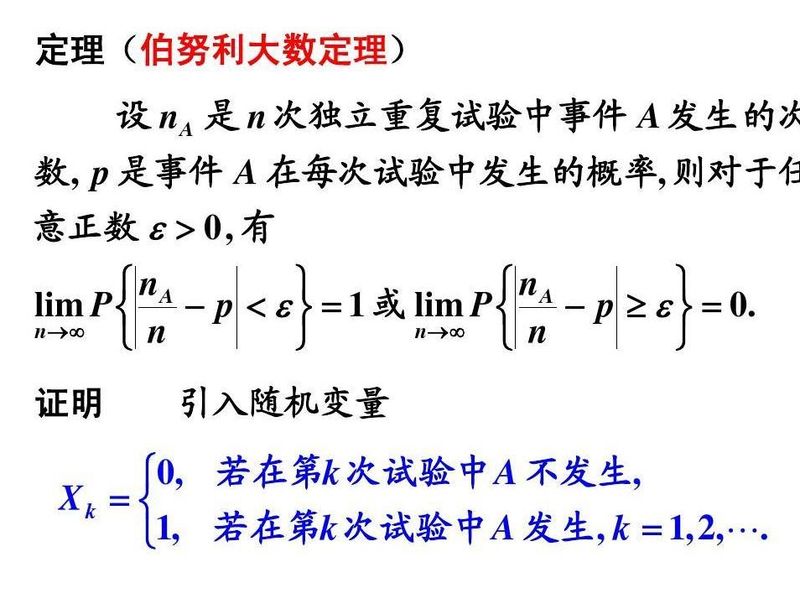
For the first time in ars conjectandi, the concept of the benoli experiment was put forward by jacob bernouli: in one test, only “success (1)” or “failure (0)” are possible, each test being independent and probabilistic. This “0-1 variable” scenario paves the way for a later separation of the whole probability theory。
More importantly, he proved the famous law of large numbers: when the number of independent repeat tests for an event is closer to infinite, the frequency of the event actually observed is closer to theoretical probability. For the first time, this theory states that probability is not purely subjective, but can be brought closer to certainty through long-term repetition. This marks a turning point in the transition from “subjective speculation” to “objective statistics”。
The law of big numbers has become the theoretical pillar of modern statistics. It not only provides a basis for probabilistic interpretation of frequency schools, but is also widely applied in a wide range of areas, such as insurance actuarial, sampling theory, statistical extrapolation, etc. It can be said that, starting with jacob, the probability is no longer superstition at the gambling table, but rather a light of reason in science。
Iv. Other mathematical contributions: development of the theory of grade, logarithmic screw and bernoulian 4. 1 infinite grade numbers
In the age of jacob benuli, where analytical science is still in its infancy, he has shown a strong interest in infinity, particularly in the proliferation and concentration of issues such as reconciliation. He conducted research on the relationship between the sum of the hierarchical numbers and their incisoration, and tried to explain the deep link between the arrays and the function by decomposition. Although he was unable to solve the basel problem, he paved the way for the later eurasia. Jacob also promoted the rationalization of the infinity of the small scale approach, and his understanding of “how grades are approaching the limit” was revolutionary at that time. He proposed multi-summation and tried to construct a general structure of cascades, laying the methodological foundation for later theories such as the proximity of functions, taylor's expansion, and became a pioneer in lehman and cosy's further development of the concept of variable function analysis。
4. 2 logarithmic screws and differential geometry
Jacob bernouli has also made a great contribution to geometry, particularly in his obsession with an elegant curve — a logarithmic spiral — in the form of polar coordinates. He called it “spira mirabilis” (the screw of miracles) and lamented its “self-similarity”: the curve remained unchanged regardless of rotation or scaling. In his view, this curve reflects the dialectic unity between constant change in nature and eternal order, even as a symbol of a perfect combination of philosophy and mathematics. Jacob used this curve as a symbol of the spirituality of life, leaving a famous phrase: “like this curve, i would like to live in death” (eadem mutata resurgo), and asked that it be carved on my gravestone. This is not only an expression of his intellectual spirit of a high degree of integration between science and life vision, but also an early attempt to combine micro-species with form aesthetics。
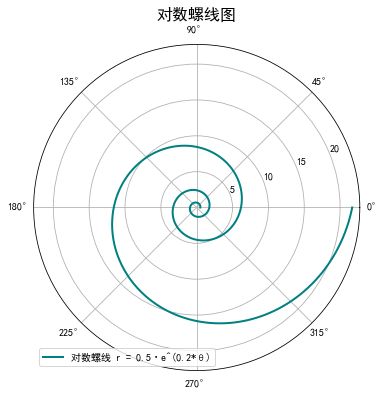
II'm sorry. II'm sorry, mate.
# chinese display settings
plt. Rcparams ['font. Sans-serif'] = ['sim hei'] # supporting chinese labels
plt. Rcparams ['axes. Unicode minus'] = false # correct negative sign
# set screw parameters
a = 0. 5 # control starting point size
b = 0. 2 # control the spiral speed
# theta from 0 to 6 # to form an extra circle
theta = np. Linspace (0,6 * np. Pi, 1000)
r = a *np. Exp (b * theta)
# polar coordinates
fig = plt. Figure
ax = fig. Add subplot(111, pol =true)
ax. Plot (theta, r, label=' logarithmic screw r = 0. 5 e^ (0. 2*), color='teal', linewidth=2)
# add title and legend
ax. Set title(' logarithmic spiral', foI'm sorry. Ax. Legend. Plt. Show()
4. 3 introduction and future application of benuli
In exploring the formula of a high-end equation, eura introduced an important set of constants -- – bernoulli numbers, originally proposed by jacob bernoulli, but the system was used and promoted thanks to eurasia. He's made peace by generating functions
== sync, corrected by elderman == @elder man
Of which (() is the number of benuli. These constants are used not only to deal with the sum of multiples, but also, more widely, in several core analytical and numerical domains, such as taylor-system extension, the eura-mclaurin formula, and the special value calculations of the riemann ζ function. The introduction of the benuli number is an example of the integration of algebra, combinations and analyses, with far-reaching implications for the development of modern mathematics。
Ideological impact: promotion of probability, statistics and education
Jacob bernouli not only influenced future generations with his mathematical achievements, but also contributed profoundly to the evolution of probabilities, statistics and even educational methods at the ideological level。
5. 1 foundation of probabilistic logic and methodological innovations
Jacob first narrowly defined the concept of “mathematical expectations” and laid the theoretical foundation for subsequent quantitative indicators such as statistical expectations, differences, etc. From a long-term frequency, he proposed the early idea of frequency schools through the creation of “a large number of repeat experiments”. This interpretation, which emphasizes the objectivity and probabilities of probabilities, contrasts sharply with the system of probabilities of subjective beliefs in later bayesian schools。
In art of probability (ars conjectandi), he submits: “in a sufficient number of repeated experiments, the rate of occurrence is closer to its real probability”. This “certifiable assumption” becomes one of the structural assumptions of modern probabilistic theory, and its effects extend to statistical extrapolation and experimental design methods。
5. 2 education and inheritance: affecting john, ora, la plas
Jacob is not only an intellectual founder, but also an excellent educator. His brother, john bernouli, has been purified in his family's “benueli family school” and has been running alongside lebnitz in his history of micronutrient development. Jacob ii, a jacob student, also continued to disseminate his statistical ideas to the european community in the eighteenth century。
Jacob's approach to functions and limit questions inspired eurasia's methodological path in conducting functions, generating functions, and so forth, while eurasia followed bernoulian thinking in later theories of statistical expectations, error dissemination. In its landmark book, philosophy analysis of probabilities, la plass not only quotes the model framework of bernouli's law, but also raises its idea in abstraction to beyas probability and astronomical error modelling。
5. 3 the projection of benuli thinking in modern statistics
Bernuli law is the theoretical starting point for the theory of random sampling: if we take independent random sampling of the total, the sample ratio is closer to the overall parameter. This idea forms the basis of modern statistical practice such as public opinion surveys, quality tests, medical experiments, etc。
In the monte carlo simulation, the principle of “independent re-testing” highlighted by bernuli remains at the core of modelling. The simulation of precision in relation to the size of the sample is also echoing his idea of a “big math”。
In addition, jacob was a pioneer in insurance actuarials, which, through a gambling and risk-benefit analysis, produced early mathematical modelling of “expected benefits from event outcomes”, laying the theoretical foundation for future risk management, life-risk product design, etc。
Not only is he the founder of probabilistic theory, but he is also the multidimensional founder of statistical logic, methodology and educational practice, with far-reaching and multilayered implications that remain active in the modern system of statistical analysis and mathematics。
Vi. Family relations: academy in brotherhood promotes 6. 1 cooperation and conflict with brother john
Jacob's relationship with his brother john bernouli was a dramatic chapter in the scientific history of the seventeenth century. Both of them have great talent and a close youth relationship, working together to explore the dawn of calculus. Together, they studied the papers of lehman and lebnitz and prepared a lecture to promote calculus thinking, one of the first mathematicians in europe to teach calculus and calculus. Jacob also helped john to emerge from early mathematical confusion and to guide his progress personally, and the brothers inspired and complemented each other。
However, this close cooperation has also buried subsequent disagreements. As their academic status rose, they gradually became in competition for honour and priority. The most famous of these is the dispute over the solution to the problem of the “fast-track landing line”. The question was publicly drafted by john benuli in 1696, and jacob also answered it and was commended for its elegance. On the face of the competition, physical mathematics issues were addressed, and it became a trigger for the open breakdown of brotherhood。
Since then, the exchanges of letters between the two men have been characterized by sarcasm and hostility, and even by mutual attacks over the attribution of academic results. However, it is in this sense of “competition-cooperation” that the multi-dimensional development of the calculus principle has been promoted, and that the benuli family has become one of the brightest mathematicians of the enlightenment。
6. 2 transmission of family culture and mathematics traditions
The benuli family became a legend in mathematical history not only because jacob and john were brothers, but also because they created an academic tradition that continued to affect generations. According to statistics, eight outstanding mathematicians emerged in the family, either astronomers or physicists, spanning almost two centuries, leaving a trail in different branches。
John's son, daniel benuli, has made groundbreaking achievements in hydrodynamics and probabilistic modelling, and the proposed “benouli doctrine” remains the core law of aviation and fluid engineering. Daniel himself was taught by his father and uncle, from which he inherited a great deal of mathematics and logic。
In addition, john taught young leonhad orra, who was considered one of the greatest mathematicians in history. Not only did eura complete a systematic construction in analyticals, but the idea of "generative function" "infinity" "micro-equipment equations" had traces of jacob and john's mathematical vision。
This mathematical spectrum, from jacob to ora, shows that the bernouli family has not only created knowledge but also created mechanisms to transmit it. As in the case of the micro-chain, the generation has continued to shine the light of reason, lighting the golden age of mathematics in europe in the eighteenth to nineteenth centuries。
Future evolution: from big digital rule to artificial intelligence age, benuli shadow 7. 1, from random testing to big data
One of the core contributions of jacob benuli is to systematize uncertainty and make it predictable over the long term. Today, this ideology is deeply embedded in the backbone logic of modern data science. For example, in the context of big data, we are often concerned about how to extract overall trends from incomplete data. This is the scene of the benuli experiment and the application of the rule of large numbers。
In day-to-day searches, referrals and advertising optimization, the frequency of “hits” can be stabilized through millions of repetitions of a benuli test (outcome 0 or 1) for each user to click or not to click. This logic of large-scale repeat sampling of independence is precisely the mathematical paradigm that bernouli has set in motion。
In the case of data modelling and experimental design, the independence and repetitive assumptions of sampling remain the basis for analysis of credibility, which stems from his deep insight into the stability of random events。
7. 2 large-digit rule and machine learning model stability
In the assessment of machine learning models, especially cross-validation (cross-validation) techniques, this is an extension of the philosophy of big digital law. Through the training and testing of multiple groups of data, we would like to assess the average of the indicators to be closer to their true properties. The rationale for this “expectation convergence” is the same as the understanding of the benuli test of probability stability。
In addition, the active function - sigmoid - that is used behind many of the sub-models (e. G., grammatical review) has a shape that is highly consistent with the expectations (between 0 and 1). In the nervous network, this distribution is used to describe the probability of “activation” and can also be understood as the modelling of bernuli on “whether an event has occurred”。
It can be said that benuli is spread over artificial intelligence and machine learning and “re-emerge” in different faces as one of the bottom metaphors of the probability model。
7. 3 interdisciplinary re-enactment of bernouli thinking
After entering the twenty-first century, benuli's mathematical thinking was extensively re-used across disciplines. His “probability + independence + containment” model framework supports the following areas:
Future trends are even clearer: combining the benoli idea with the bayesian approach and developing the “dynamic bernouli model” to accommodate the real needs of data mobility and the non-stable nature of the model. This is not only a succession to classical probabilities, but also a recasting of mathematical thinking in the ai wave。
Viii. Conclusion: beautiful scientific and digital light
Jacob burnoully is not the most well-known mathematician, but one of the founders of the most profound understanding of the relationship between uncertainty and certainty. He had not seen the official publication of " ars conjectandi " , but had already lit up the dawn of a new discipline of probability with pen ink and logic。
His math is not just a tool, but a combination of philosophy and aesthetics. His love of a logarithmic screw, in his view, is a symbol of unity between constant and eternality in the universe. His motto — “like this curve, i would like to live in death” — is not just a beautiful poetic expression, but a scientific declaration。
The models that we see today in big data, machine learning, risk decision-making can all be traced back to the image of the world's uncertainty — jacob bernouli — that we tried to understand mathematically at the basel forum in the early seventeenth century. His thoughts are still spinning in time as if the immortal screw had never stopped。
References and recommended revisions for jacob bernoulli, ars conjectandi, 1713
For the first time in this great post-mortem book, benuli has systematically built a mathematical framework for probabilistic theory, introducing important concepts such as large-digit law, which provides a solid foundation for the development of the entire probabilistic discipline. Ian hacking, the equality of production, cambridge university press, 1975
From a philosophical and historical point of view, the book explores the evolution of probabilistic ideas from medieval to modern times, detailing the context of the benuli era and the importance of its contribution. Gerd gigerenzer and others, the empire of chance, cambridge university press, 1990
A book on probabilities, statistics and their relationship to modern decision-making science covers the theory of multiple key figures and milestones from bernouli to bayes. Mathshistory. St-andrews. Ac. Uk
The mathematic history database provided by the university of st. Andrews includes jacob bernouli's life, the yearbook and its contribution to probabilistic theory. The encyclopedia of england, jacob bernoulli
An overview of the main research directions, academic influence and position of bernouli in the benouli family was provided. Contor, the evolution of probability
The book presents, from the historical perspective, the path of probabilistic evolution from pascal to pema to bernuli, and is an important literature for understanding probabilistic developments. It's a math topic for characters. Com/haohai9309
A series of mathematical characters in chinese written by the blogger, which is very shallow and well written, is unique, especially in terms of probabilities, such as benuli and la plas, and suitable for wider reading by readers interested in mathematical history。
From the probability of gambling to scientific reasoning, bernoully has not only opened the uncertain world of mathematics, but has laid the foundation for rational decision-making. Through three centuries, his thoughts have flourished in statistical and data science, guiding us in the search for order in complexity。