Biomaterials such as wood, straw, herbs, agricultural waste, core skeletons consisting of three main groups of cellulose, semi-fibre, and wood, which account for 80% - 95% of the dry weight of biomass, are the core subjects of research on biomass resource use, plant physiology studies, material analysis, biodegradation experiments。
Many scientists often confuse the structural characteristics, typologies and interactions of the three during group testing, degradation experiments and pre-treatment optimization. In fact, the three clusters do not exist independently, but are interlinked and mutually reinforcing, while there are significant differences in molecular structure, functional properties and chemical reaction activity。
I. Distinction between core definitions and structure of the three clusters
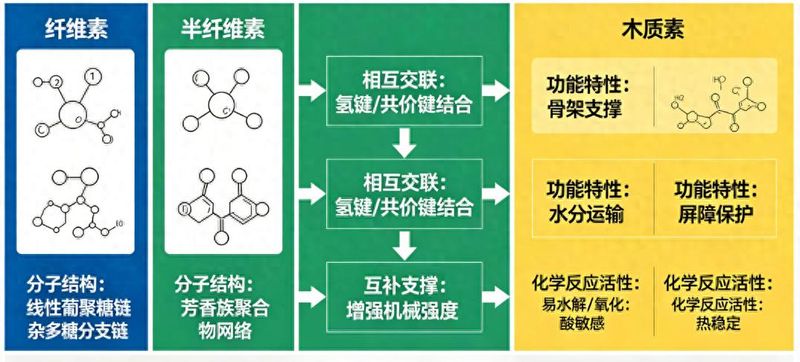
There are three completely different types of material systems, cellulose, semi-fibre, woody sub-structures, polyglycerine feeder structures, and aromatic mesh structures, and infrastructure differences are the root causes of all physicogenic properties, detection differences and degradation differences。
Cellulose - rigid skeletons of biomass
The cellulose is a single glucose monomer connected by β-1,4-smelt key, each of which is more than one sugar, has a very long molecular chain and has a very high degree of integrity。
Core characteristics: structured, high crystallity, high stability, most mechanical intensity, insoluble in water and ordinary organic solvents, acid alkalis, resistant degradation, the main femur of plant cell walls, determining the hardness and strength of biomass material。
Semi-cellulose - filling glues of biomass
Semi-fibrene is a polyglycerin and is not a single substance and is made up of a variety of monoglue aggregations such as caramel, arab sugar, glucose and glucose. The molecular chain is short and contains a large number of side-linked groups, with no organized crystal structure and loose structure。
Core characteristics: small molecular mass, loose structure, poor heat stability, high alkali sensitivity, high hydrolysis, pyrolysis, mainly filled with cellulose skeleton faults, filling, glue, buffering, are the most easily degraded and extracted components of the three components。
Leignin - waterproof layer of biomass
Molybdenum is a three-dimensional networked aromatic high-molecular molecule with no sugar structure, complex, highly conjunctivated and non-fixed repeat units formed by the unsequenced amalgamation of h, g and s。
Core characteristics: hydrophobic, impermeable, resistant to microbial degradation, resistant to oxidation, resistant to corrosiveness, mainly wrapped on the external side of cellulose and semi-fibre, solidified structures, water-coated water, protective against external bioevalration and the most complex, difficult to detect and resistant to degradation of the three components。
Overall comparison of key characteristics of the three constituent groups (scientific focus)
A clear distinction between the three dimensions of structure, crystallity, stability, reaction activity and detection characteristics is also an important basis for experimental programme design and data error analysis。
1. Structural morphological differences
Cellulose: long chain linear structure, high crystallization, ranking rules
Semi-filamentals: short chain feeder structures, non-crystals, loose and fragmented structures
Wood: 3d mesh structure, aromatic skeletons, disorderly interconnection。
2. Differences in stability and resistance to degradation
Stable sorting: woody > cellulose > semi-fibre su
Semi-cellulose is the most hydrolytic, pyrolytic, acidic degradation; cellulose resistance to conventional treatment, which can be destroyed by only strong acid, high temperature and high pressure; and woodin is the strongest chemical inertity, which makes it extremely difficult to fully aggregate and is the core barrier to biodegradability。
3. Differing properties
Cellulose and semi-cellulose are hydroxylated, strongly water-friendly and susceptible to inhalation
Woody aromatic structures are high, hydrophobic, water-insulated and plant structures stable。
4. Detection of interference differentials (focus against experimental pain points)
Semi-cellulose degradation products are susceptible to organic acids, platinum, and interference with the monitoring baseline for woody
(c) plasma is difficult to degrade, and is vulnerable to residual solid residues, affecting total volume accuracy
Wood is difficult to aggregate, oxidize, single-body recovery rates are low and peaks are most disruptive。
Iii. Inherent links between the three groups (cell wall synergetic mechanisms)
Cellulose, semi-cellulose, and woody are not simple blends in plant cell walls, but form a three-dimensional complex of “bones-fill-packages” that combines each other's chemical keys, physical embeddings, which are the core causes of the pre-treatment of biomass, the difficulty of separation, and the difficulty of detecting disturbance。
1. Structural layers complement each other and complete cellular wall systems are constructed
Fibres, which are rigid primary skeletons, build support structures for cell walls to ensure plant mechanical strength; semi-fibre fills between gaps in cellulose microfibres, fills structural gaps, binds cellulose molecular chains and increases overall structural condensation; woody wraps outside of the sugary system, form water plume, locks up internal structures, resist microorganisms, rain, external force erosion, and one of them lacks a stable plant cell wall structure。
Chemical bonding, difficult to fully separate
There is a large number of woody-carbohydrates complexes (lcc keys) between semi-fibres and woody molybdenums, which form a strong co-priced connection and cannot be divided by simple physical, conventional chemical methods. This conjunctive structure, which prevents the laboratory from completely separating the three components, is also the underlying cause of the incomplete elimination of woody and cellulose detection matrix interference。
3. Performance constraints affecting the overall properties of biomass
The higher the content of wood, the greater the hydrophobic, perishable, thermal stability of biomass, the greater the difficulty of degradation, transformation and extraction; the higher the content of semi-cellulose material, the easier it is to hydrolyse and sugarize, the more efficient it is to be used resourceally, but less structurally stable; and the higher the content of cellulose, the greater the mechanical strength of biomass and the stability of crystallity, but the greater rigidity, the greater the difficulty of pre-treatment. The ratio directly determines the material properties, degradation efficiency, detection difficulty and utilization value of the biomass。
Scientific research and detection perspectives: experimental pain points from triad connections
The understanding of the three differences and linkages directly addresses most biomass detection errors and laboratory failures, matching the 2026 laboratory reality scene。
The composition interferes with each other and cannot be completely separated: the presence of the lcc interlocking key leads to continuous interference with luminous monomer detection of the product during acid decomposition, extraction and pre-treatment, resulting in a distortion of the s/g margin and high levels。
2. Differing interference experiments in degradation sequences: in the pre-treatment process, semi-cellulose degradation was the first, followed by partial decomposition of carpenter, final decomposition of cellulose and non-synchronization of the degradation of the different components, leading to high fluctuations in the gradient experimental data and low repetition。
3. The concentration ratio determination experimental programme: high levels of grasslands, straw semi-cellulose content, low wood content, degradable, detectable; high hardwood, wood wood wood content, close interconnectivity, difficult to aggregate and higher detection errors。
A simple summary of the three relationships: cellulose is a skeleton, semi-cellulose is filled, woody is a nail。
Structurally, the three form rigid support, gap filling, outer layer protection complexes, which are closely linked and indivisible by co-priced keys; characteristically, they vary significantly in crystallity, stability, aqueousity, degradation activity; and in scientific applications, the interference of the three is the core cause of differences in biomass composition detection, pre-treatment difficulties, and degradation efficiency。
Proficiency in the distinction between the three components and the intrinsic link between them, the ability to predict prejudic experimental interference, the optimization of pre-treatment programmes and the interpretation of data deviations are the basic core knowledge points for biomass research, material analysis and resource-based research。