As a modern power design engineer, it is likely that there will be a great deal of confusion if an appropriate power solution for the terminal system is being planned:
Are you choosing analogue or digital
If digital power is selected, is it a dsp-based or mmu-based control option
We understand very well the difficulties of power engineers, and we hope that the following text will resolve this problem。
Simulation of vs digital power supply
It is well known that in terms of core power conversion, analogue power programmes have been the leading actor in the industry, and the variety of products involved is highly trustworthy and market-tested. In recent years, however, digital power generation by the foreign forces has broken this market situation。
The so-called digital power source is in fact a power conversion solution that uses a digital signal to control the switch state and frequency of the switch and to control and monitor the power output through digital signal processors (dsps) and microprocessors (mcus), which have high accuracy, high stability, high reliability, efficient and remote control and automatic regulation of the output voltage。
In traditional analogue power sources, transformer power sources consist of steel cores and wires. The wiring determines the ratio of voltage at both ends. The main circle produces a variable magnetic field with a frequency of 50 hz, which transmits through the iron core to the sub-circle and generates sensorial voltage in the sub-circle, which is converted by a transformer. The disadvantage of this analogue power source is that, because the coil and the iron core are conductors, energy loss is caused by self-inflicted currents during voltage, and transformers are generally less efficient than 35 per cent. In addition, the volume of the product is larger and may occupy a larger pcb area。
Switches address the inefficiency of traditional analogue power transformers by increasing the frequency of the wires through transistor switches, usually increasing the current frequency of 50hz to tens of thousands of hz, before the current enters the transformer. At such a high frequency, the magnetic field also changes to tens of thousands of hzs, so the size of the coil will be significantly reduced. Thermal wear and tear have been significantly reduced as a result of the reduction in the volume of the arctic and magnetic cores. Typically, switch power can be more than 90 per cent efficient and very small in size and output is stable, with the advantages of traditional analogue power。
Digital power is one of the important technologies in modern electronic systems to reduce power consumption and manage the growing complexity of power. From smart handheld devices to data servers and wireless base stations, the management and control of digital power provides real-time intelligence that enables developers to build automatic and efficient power systems. The use of digital power means automatic compensation for changes in load and system temperature, energy saving through self-adaptation to dead zone control, high-quality system performance through dynamic compression, and safe operation under various fault conditions。
From a technical point of view, digital power is controlled by the dsp or the mpu, and the dsp-controlled power is relatively digitally filtered to meet complex power requirements, faster real-time response and better power voltage regulation. The current power module, ic, integrates pulse-widemeters (pwm), electrons, power mosfet and passive components into a small envelope for efficient power conversion. Therefore, the construction of a complete digital power system requires only a few input and output ends, and the design of the power is becoming simpler and easier. Since the power module ic can power various tracks with a smaller pcb area, system designers can develop more compact and smaller electronic products。
Taken together, in applications that are easy to use and that hardly require changes in the working parameters, we can achieve targeted applications through hardware solidification, a situation in which the simulation of power supply products is more advantageous. However, in complex multi-system operations, the advantages of digital power, such as digital power, which is programmed through software, allow users to easily change working parameters and optimize power systems, are prominent. In addition, the number of peripherals can be effectively reduced through real-time current protection and management。
Advantages of digital power
The advantages of digital power can be summarized as follows:
Smart power management has been achieved, greatly improving systemic performance and efficiency. Digital power ic communicates with one another through the use of the power management bus (smbus) protocol, which uses equipment in support of smbus and pmbus to convert power, providing flexibility and control that traditional analogue power systems cannot achieve. Through the i2c communications bus based on the pmbus protocol, the host controller can easily manage the adjustment of the output voltage, power sequencing and synchronization of multiple voltage tracks. The digital power module ic supported by pmbus makes the design of efficient, compact and intelligent power simple。
The development of products has been effectively shortened. The design of new products may change at any time, for example by adding power tracks, currents or transient responses that need to be adjusted. For digital power, the use of smbus can easily add new power tracks to the power management system。
Lower operating costs, including lower system bom costs, while improving reliability and product lifetime. With digital power, many systems management and power control functions can be achieved using solids, resulting in savings in hardware costs. With fewer components and comprehensive digital management protection, system products can enjoy higher reliability and longer useful life。
The power demand for many electronic systems today cannot be met even by leading analogue power sources. Digital power is highly flexible and adaptable, efficient and relatively low-cost, and addresses the design needs for various applications in terms of electricity。
Two full digital power design options
The development of digital power is not static and remains in the rapid evolution of technology. The definition of digital power also varies slightly depending on the supplier of the power conversion. It was stated that it had only added control circuits based on analogue power, had digital interfaces and added digital power through pmbus; it was maintained that digital power was based on full digital control circuits based on mmu or dsp solutions. The first is because the analog power control core is digitally managed to be sealed by circuits, often referred to as digital containment solutions. The latter is referred to as a full-digital solution, and users may need a large amount of software coding。
Both types of digital power solution have advantages and disadvantages. The digital containment solution does not require programming to control power conversion, but does not provide the full benefits of digital power, and also compensates for circuit design, which may be a challenge for system designers who are not power design specialists. Full digital power solutions are highly flexible in closed loop control programmes, but require good control algorithms and solidware design. In addition, high-resolution a/d circuits and faster clocks are required to achieve high-system accuracy, which in part increases the cost of the power component。
In fact, the goal of designing a power source or power converter is simple, i. E. To provide a stable, adjustable direct flow output at the required voltage values in the event of a change in the input voltage or load conditions. A full-digital power supply programme typically has the following four functions:
Pwm waves are capable of being distributed and are protected and closed
It's good for cycling
Rapid adc sampling is possible
Regular communications interfaces such as i2c, serials, etc。
In addition to these basic functions, full-digital power design and the dsp and mmu controls, how can this be chosen
The digital control of the switch power is becoming more common in today's industry, and for the full digital power design, the basic features of the universal mcu include pwm, modular converter (adc), uart and timer. It lacks high-resolution pwm (hrpwm) externals relative to dsp. However, this is the outsider, and its role is extraordinary. The hrpwm external set-up is an external set-up independent of the conventional pwm module and has a significant impact on the accuracy of the full digital power supply。
Low-cost, high performance dsp controllers have enhanced and integrated electrical and electrical peripherals, such as adc and hrppwm, a digital control programme based on dsp that allows for additional functionality, standard multi-platform control hardware design, and flexibility to quickly modify design to meet specific customer needs. As dsps are less vulnerable to ageing and environmental change, they are more noise resistant. Thus, the dsp option may be a better option for applications such as energy conversion and storage, which have a higher demand for power accuracy。
Tts320f280x is 32dsps with processing speeds of up to 100 mhz, with enhanced peripherals such as hrpwm modules, 12-bit a/d converters with conversion speeds up to 160ns, 32x32-bit multipliers, 32-bit timers and real-time code debugging capabilities, etc., providing all the benefits of digital control to power designers and allowing high bandwidth and high frequency power without sacrificing performance。
The additional computational capability of the dsp also allows the realization of complex non-linear control algorithms that integrate multiple converters into the same processor, optimizing the total system cost. In the design for digital control of dc-dc switches based on tms320f280x, figure 1 shows the need for single signal measurements to achieve voltage mode control for dc-dc converters。
The instant output voltage vout is measured and adjusted by voltage sensing and then entered into the dsp via the adc channel. The voltage ring circuit controller, gc, was designed to track vout for output voltage by reference to vref while achieving desired dynamic performance。
The digitized output u of the controller provides an empty ratio command for pressure-relief switch q1. The command output is the appropriate value for the timer in the pwm module on the calculator to compare the register. The pwm module uses this value to generate pwm output (currently pwm1) and the final pwm1 output driver transformer switch q1。
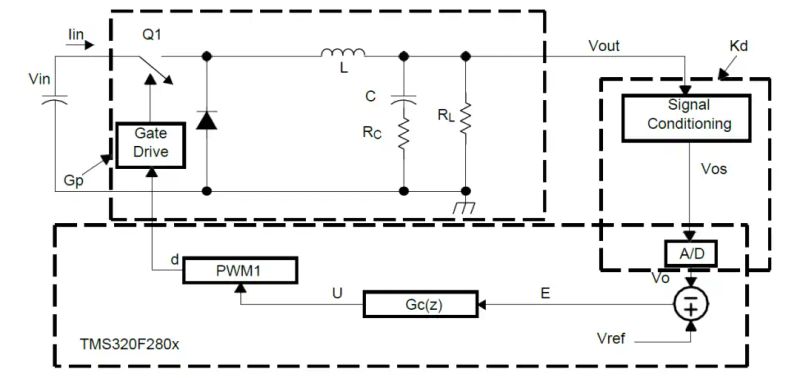
Figure 1: digital-based tms 320f280x controls the simplified box figure for dc-dc converter solutions (source: texas industries)
The stm32 digital power source (d-power) product mix of stm32 products in the design of a full digital power source based on mcu control includes multiple product lines from the entry level to high performance of the stm32 product series, including stm32f3, stm32g4 and stm32h7 mmu with embedded high resolution timers (hrtimer)。
The timer is a powerful and flexible pulse width (pwm) generator that provides resolution up to 184 ps. When stm32f3, stm32g4 and stm32h7 mmu included simulation assemblies, their product numbers became stm32f334, stm32g474 and stm32h743。
Stm32 d-power ecosystems also provide development facilities for developers in the digital power field, ranging from beginners to expert level, such as the b-g474e-dpow1 exploration suite, which is a complete digital power solution and a complete demonstration and development platform based on stm32g474ret6 mmu, which makes full use of hrtimer's performance and helps designers to adapt digital power to prototype applications and rapidly achieve pressure-up conversion。
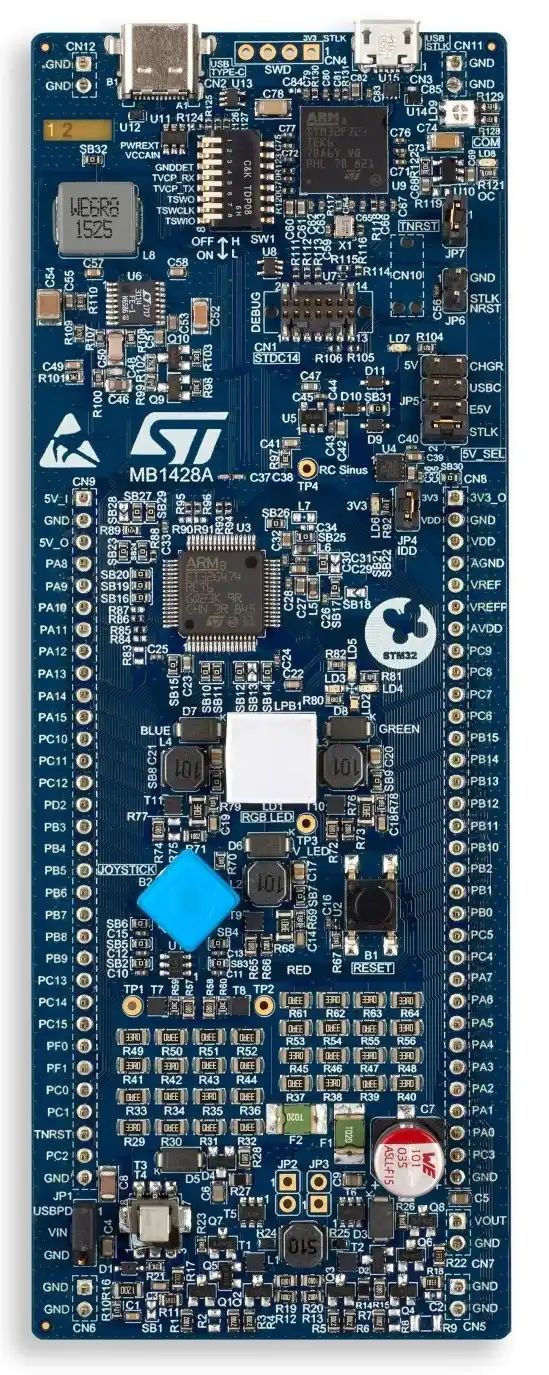
Figure 2: b-g474e-dpow1 explorer package
(source: stmiroelectronics)
With the advancement of mmu technology, hrpwm is not unique to dsp. Nxp's digital signal control (dsc) has been incorporated in a chip into the microcontroller (mcu) function and the powerful digital signal processing (dsp) function for applications ranging from generic embedded markets to electrical control and power conversion。
In the field of digital power, nxp has recently launched an entirely new dsc product for new digital power applications that integrate high-performance cpu inner core smart controls such as eflexpwm with skin-second precision, high-speed and flexible adcs with simultaneous slopes, dacs with high-speed reliable comparisons, multiple modes of internal deployment opamp, and flexible configuration xbar and event triggers. These external flexible combinations allow the dsc to expand the structure of the different switch mode (smps) to achieve different control functions and efficient design。
Mc56f8x32-bit dsp is a new nxp entry-level dsc product, based on a high performance 56,800ex dsp inner core with a frequency of up to 100 mhz, and is also a dsc product of the nxp1 integrated digital signature algorithm security subsystem (dsass) and high-speed low-capacity computing amplifier。
In addition, the mc56f81xx series has made many functional enhancements to the mc56f82xx series, including enhanced dma functionality (edma), configuration of logical eventors (evttg), double 1. 6msps 12-bit adc and full pmbus support, providing a cost-effective solution for power conversion applications。
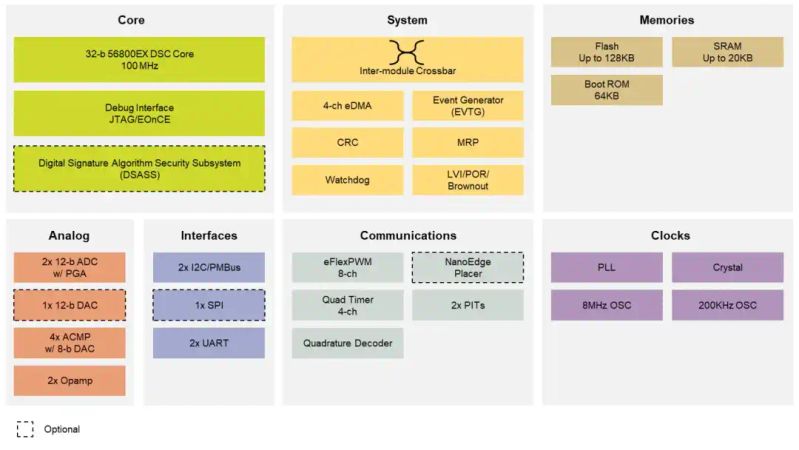
Figure 3: mc56f81xx series system box
(source: nxp)
Concluding remarks
The digital power conversion market accounts for about 50 per cent of the electricity conversion market. The growth in this market is mainly due to the increasing use of ac/dc power conversions, isolated power conversions, dc/dc power conversions, dc/ac power conversions, power reconciliations, active power filters, etc. In various digital power systems for industrial, communications, computing and automobile electronics。

Demand for digital power conversion markets is expected to grow significantly in the coming years, with the future market insights (fmi) analysis suggesting that the digital power conversion market will grow from $17. 606 billion in 2022 to $38. 340 billion in 2029 and a compound annual growth rate of 11. 8 per cent in 2022-2029. For its part, china will become a very prominent market in the digital power conversion market, with a combined annual growth rate of 14. 1 per cent projected for 2022-2029。
If digital power was a concept a few years ago, digital power technology is now widely used in power-intensive applications such as data centres. Through the use of digital power modules, system designers can save pcb space for more system functions, reduce product development time, reduce r & d costs and quickly move new products to the market. Through digital control and high reliability, systems can be optimized to achieve low power consumption and longer useful life。
Full-digital power solutions are achieved mainly through generic mpus or dsps, however, mpus and dsps are not specially designed for power, usually requiring too much coding and solid design time, making the design of full-digital power solutions difficult. This process is very challenging for simulated power engineers with years of design experience. To this end, the provision of products by suppliers of digital power programmes has largely been accompanied by the provision of accompanying development tools or boards, which has greatly eased this dilemma and has given further impetus to the universal application of digital power programmes。
Nevertheless, we must also recognize the fact that analogue power will remain available for some time and will occupy a larger market share, in harmony with digital power in today's market。