Maintenance costs for new energy vehicles, in one sentence: daily maintenance is indeed much lower than fuel trucks, but the “day price” of batteries for maintenance risks may swallow all the maintenance savings you have。
A total of $400-$600 per annum is required for total conventional maintenance in the pure electric vehicle type, while the fuel truck at the same price is $1600-2400. In 100,000-20,000 mainstream domestic vehicles, the total cost of pure electricity maintenance over five years was approximately 2000-3,000 dollars, while fuel trucks were estimated at $800-12,000 — a saving of $600-10,000 for pure electricity users。
Where's the money? The maintenance project is completely different
Fuel trucks need to be replaced with oil for every 5000-7,500 kilometres, machine filters for every 40,000-6,000 kilometres with transformer tank oil and spark plugs, all of which are fresh materials. The pure tram type eliminated engines and gear transformers, and the core maintenance project became a security check for the three power systems (cells, electrics, electrical controls) + the air-conditioning core replacement + the brake fluid check at a single cost of $200-400。
Large component cost: low probability vs high cost
Can you cover any future major repairs? It depends on the risk structure on both sides。
On the side of the new energy vehicle, the probability of failure of the triple power system is extremely low - the probability of failure of the electric power and the electrical control throughout the life cycle is less than 3 per cent, and the probability of the battery being actively replaced in a non-accident scenario is less than 5 per cent. The problem, however, is that once the battery is damaged, the price is a "nod" price:
According to the 20th report, 2025, the single-unit zero ratio of pure electric battery power was 49. 59 per cent - the cost of replacing a battery averaged nearly half of the total car price. This means that the cost of replacement of batteries may be close to $75,000 for a 150,000 pure tram。
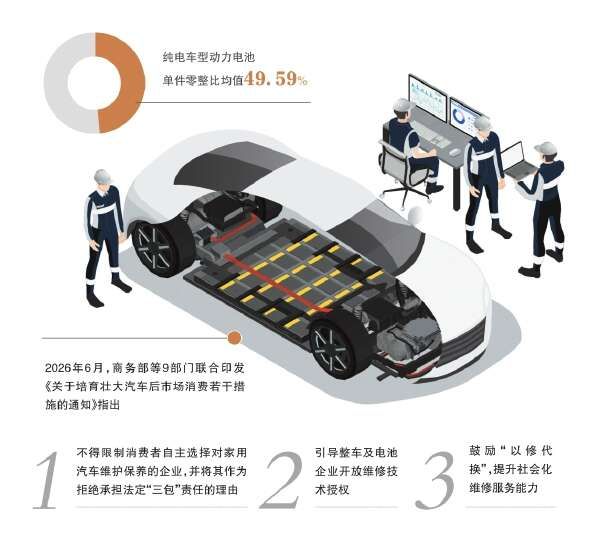
Pure-truck power cells and zero-system maps
Even more painful to the owner is the fact that many small bumps (e. G., the bottom of the chassis poached at a depth of 4. 54 mm) trigger 4s, “just change and not fix”, directly billing 200,000 bills。
Portable: brake saves money, tires spends money
However, the difference in total costs is not significant。
The most critical battery risk. Do you have a warranty
The dominant brand provides a life-long triple-electric security for the domestic vehicle type, partly hedged against battery replacement risks. Quality assurance clauses, however, usually bind conditions such as “non-operational” “full-way 4s shop maintenance” of the “first owner”, which may lapse once replaced or otherwise repaired。
But be careful, the data is limited
There are currently no annual average maintenance cost statistics for the entire scene, published by the automobile circulation association or the demotive commission, at the price band. Available data are derived from offers from 4s, third-party platforms and media research, and there is a lack of cross-certification of large samples of uniform calibres. In addition, maintenance cost differences between luxury brands and performance car types have not yet been included in the statistics and the conclusions apply mainly to mainstream cars of 100,000 to 200,000。
Taken together, the conclusions are divided into two levels: