Reviser
We're always worried that the shoelaces will split automatically while walking. No matter how tight they are, the shoelaces are like the "cosmopolitan law" that "freedom" when we don't look at it, and sometimes we fall off our heads。
In 2006, the american mathematics society published a 100-page shoelace book () which assessed the best and worst way to wear a shoelace from a mathematical perspective. At the end of the book, the author, burkard roister, mentioned that with a small change, most of the shoelaces would become more rigid。
The proper way to tie a shoelace
Terry moore gave a speech at the ted conference in 2005. He said that it was not until midlife that people knew that they had been wearing the wrong shoelaces for the past 50 years. He had always tied his shoelaces in a “weak knot”, which was very easy to disperse. A slight change based on a “weak knot” would produce a “strength”. Unfortunately, most people from childhood to university are in the form of “weak knots”。
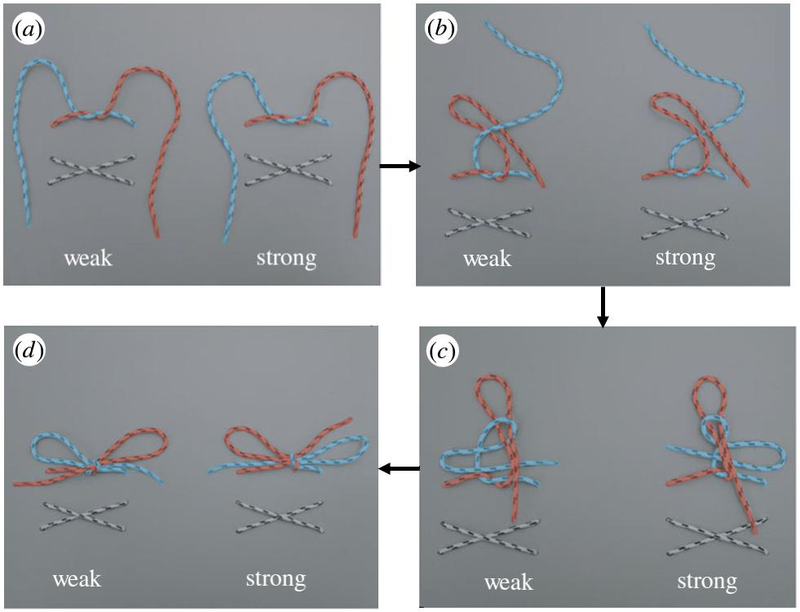
The law of “weak knot” (left) and “strength” (right) (photo source: original paper)
We usually tie our shoes twice. If the first layer is the second, a “weak knot” is obtained. For example, at the top of the first layer, the left line (the upper orange line) and at the bottom of the right line (the upper blue line) and at the second level, the rope on the left side (the upper blue line) remains above the rope on the right side (the upper orange line)。
In this case, as the spiral direction of the first and second layers coincides, distortions occur when the “weak knot” is tightened by external force. On the shoelaces, the direction of the knot parallels the long axes of the shoes。
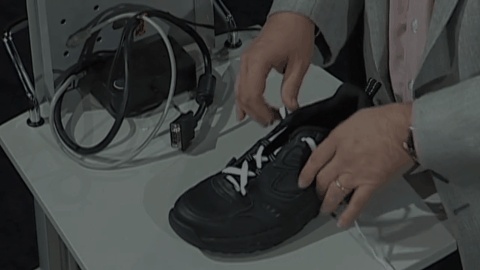
Weak knots (photo source: ted)
But if we make a slight change in the pattern of “weak knots”, a “strength” can emerge when the first layer is completed and the second layer in the opposite direction. Unlike “weak knots”, “strengths” tightened by external forces do not rotate direction, but are kept vertically to the long axes of shoes。
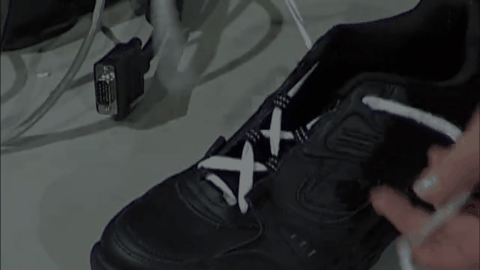
"strength" (photo source: ted)
Inspired by terry, a group of scientists began to study loose shoelaces. Under high-speed cameras, they carefully observed the break-up process of “weak” and found that the spread of the original shoe belt was not slow, even, but rather a sudden, catastrophic process. In many of the steps that have been taken, the “weak knots” seem to have changed little until a moment has passed. But soon after that, within one or two steps, the shoelace was completely dispersed。
On the contrary, “strength” would not be so. Even under simulated tests with heavy loads on both ends of the shoelace, the “strength” has not been fully dispersed, while the “weak” rate has reached 100 per cent。
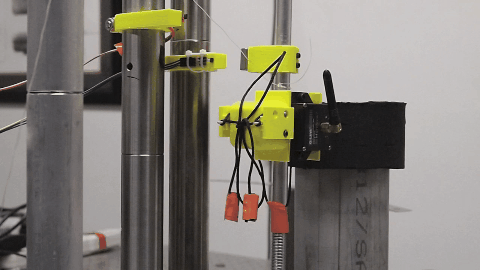
Simulation tests (photo source: original paper)
Track the loose shoelaces
Every step we take goes through two phases -- swinging phase and support phase. For example, when we want to take a left foot, we first move the left foot forward from behind, then accelerate the lifting and slowing down, which is the swing picture, and then move the centre of gravity gradually from the left to the whole left foot, with the last left foot moving forward and driving forward the right foot, which is the support. When the left foot is in a supporting phase, the right foot is in a swing phase。
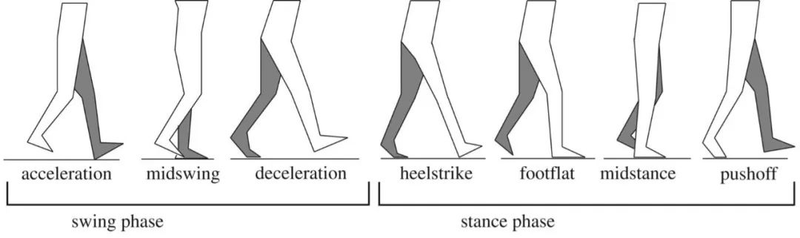
Swing and support phase (photo source: original paper)
Scientists have found that “weak knots” are not easily dispersed, whether they keep shaking their feet (only swinging) or stomping their feet (only support). Therefore, only the interaction between the swing and support phases can produce the effect of dispersing the shoe belt。
In order to gain a better understanding of what happened to the shoelaces, researchers have installed wireless accelerometers on the tie knots of different types of shoes (general running shoes, mountain climbers, sneakers, barefooters). They found an alarmingly similar acceleration in the knots of their shoes, regardless of their type. This acceleration is pulsive and strong, with a shock intensity of 6-8 times the acceleration of gravity。
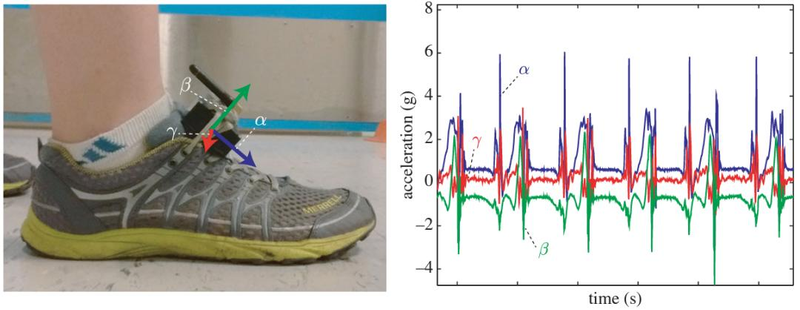
Speed of shoelace experience (photo source: original paper)
In one simulation test, researchers observed that the soles of the shoe are essentially “pull through”. In other words, the inertia of the end of the shoelace (freedom end) is the “principal of the break-up”。
When our legs move forward and then we move back a little bit to impact the ground, due to inertia, both rings and two free ends of the bow tie move forward in relation to the centre of the knot. This relative movement can lead to a slight opening of the centre and a larger space. Then, at the moment when the heel hits the ground, this powerful force of multiple degrees is transmitted to the end, leading to a deformation of the centre and a gradual relaxation under a secondary shock。
Originally, the length of the bow rings and the end of the freedom was roughly the same and the knots were very tight. In this case, the inertia of the free end and ring is somewhat comparable. At the same time, the presence of friction will also reduce the inertial imbalance between the two。
However, with repeated shocks, there was less friction at loose centres and a slight slide at the end of freedom. Initially, the process was slow, but as the end of freedom grew longer and the rings became smaller, the inertial imbalance between the two became magnified and further exacerbated the slide of the end of freedom。
Ultimately, the end of freedom will be long enough. Within one or two steps, the inertia associated with freedom exceeds the inertia associated with the ring altogether. When the free end of the shoelaces is fully cut through the centre of the knot (i. E. The “wings” of the butterfly knots completely disappear), the knots are suddenly completely dispersed. So long as one of the free ends completes the process, the other ring will spread。
Dispersion of shoelaces under high-speed cameras (photo source: original paper)
Scientists have not been able to prove by experiment why “strength” is stronger than “weak”. They assume, however, that this difference may, to a certain extent, result from the two opposite distortions mentioned above. “strength” can still be tightened horizontally, but tightening “weak knots” requires a reversal of structures. In the course of spreading the shoelaces, subsequent steps may occur only if the transformation of the centre helps to open rather than tighten。
The world of laces
The basic form of “weak knot” (the form after pulling out of the ring) corresponds to the “false knot” in the base knot, sometimes referred to as “grandmother's knot”. The basic form of “strength” is, on the other hand, “tiggered”, or “tighten sail”. This is because it is flat and easy to open and used by seafarers to tie sails. It is now often used in first aid to fix bandages。
However, although it is many times stronger than the false knots, the sequestering can only work in these weak stress scenarios. It could still be deformed and loosed if it was given a strong external force. Therefore, if you want to connect two ropes to a heavy load, you should choose a stronger system, such as double or triple。
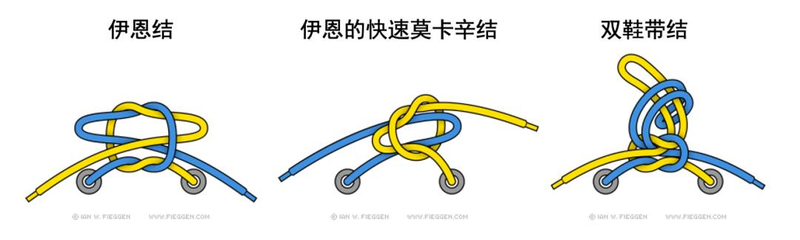
In addition, in addition to standard law, there are many trophies of shoelaces. For example, if you want to save time, you can use the fastest shoe tie in the world - ian knot. If you don't want a two-tier solution, you can choose lan's fast mokasin's fast moccasin knot) but this knot is decorative and very unreliable。
If only you wanted to keep the shoelaces as they were, then ian fieggen, the inventor of ian fieggen, recommended "double shoelace knot," which is an addition to the standard shoelace tie. Apart from the fact that it's really hard to untangle, there's nothing wrong with this. You can even rate ian's shoelaces。