Welcome, teachers, parents
Click on the bottom card, focus on the second grade math language
Zenium
The search pattern is a common theme in the o number of subjects, divided mainly into the search patterns and the search patterns. We have already touched on this type of subject in our previous courses, and this statement continues to deepen our understanding and understanding of this type of subject. Kids, look carefully, look courageously at the pattern and believe that you can find the number of vacancies。
Precise case
Example 1: find a regular number。
(1) 1, 3, 5, 7, ( ), ( )。
(2) 65, 60, 55, 50, ( ), ( )。
(3) 1, 10, 100, 1000,( ),( )。
(4) 1, 2, 4, 7, 11,( ),( )。
(5) 1, 2, 4, 8,(),()。
(6) 1, 3, 4, 7, 11, ( ), ( ), ( ), ( )。
Think about it
Question (1), increase from left to right ( )
Question (2) decreases from left to right ()
Question (3), add one () from left to right at the end, or multiply it consecutively ()
Question (4) from left to right, with a difference of 1, 2, 3, 4
In question (5), 1 x 2 = 2, 2 = 4, 4 x 2 = 8, so 8 x 2 =( ) ..
In question (6), starting with the third number, each number equals the sum of the first two。
Imitation practice
Find a regular number。
(1) 2, 4, 6, 8,( ),( )。
(2) 1, 5, 9, 13,( ),( )。
(3) 2,20,200, 2000,(),()。
(4) 1, 2, 2, 4, 3, 6, 4, 8,( ),( )。
(5) 49, 42, 35,(),(),(),()。
(6) 4, 6, 9, 13,( ), 24,( )。
(7) 100, 81, 64, ( ) 36, 25, ( ) 9, 4, 1
Example 2: take a closer look at the following group figure and fill in the appropriate number in the "?" for each group。
(1)

(2)
(3)

(4)
(5)

Think about it
In question (1), 3+4+8=15
In question (2), 2x3+1=7
In question (3), 3x4+5=17
4x5-5=20 in question (4)
In question (5), 5+3+7=15, 15+15=30。
Imitation practice
Carefully observe the pattern of each set and fill out the appropriate number in the blank。
(1)
(2)

Example 3: fill in the appropriate number at the empty。

Think about it
Analysis of the numbers in the table shows that 12+6 = 18, 8+7 = 15 by row, i. E. The number at the middle of each line equals the sum of two on both sides. This pattern allows you to fill out the number of spaces。
Imitation practice
Fill in the appropriate number in the empty according to the sequence in the table below。
(1)

(2)

It'll work
Level a
1. Carefully observe the pattern for each group and fill the appropriate number in brackets。
(1)2, 6, 10, 14,( ), 22, 26
(2)3, 6, 9, 12,( ), 18, 21
(3)33,28,23,(),13,(),3
(4) 55, 49, 43, ( ), 31, ( ), 19
2. Carefully observe the pattern for each group and fill in brackets the appropriate number。
(1) 1, 2, 4, 7, ( ), 16, 22
(2) 10, 11, 13, 16, 20, ( ), 31
(3)9, 11, 15, 21, 29, ( ), 51
(4)3, 4, 6, 10, 18, ( ), 66
3. Find regular fillouts。
(1) 1, 5, 9, 13, ( ), 21, ( ), ( )
(2) 21, 4, 18, 5, 15, 6, ( ), ( )
(3) 2, 3, 8, 8, 14, 13, 20, ( ), ( )
(4)( ), ( ), 49, 36, 25, 16, ( )
Level b
4. Fill in the appropriate number in the spaces according to the relationship of the numbers in the graphic。
(1)

(2)

5. Find a pattern and fill it out。
(1)
(2)
Level c
6. Enter the appropriate number in the "? " of the following graphic according to the order of the preceding graphic。
(1)

(2)

Check the regular count
Examples
Case presentations: complete the chart by pattern。
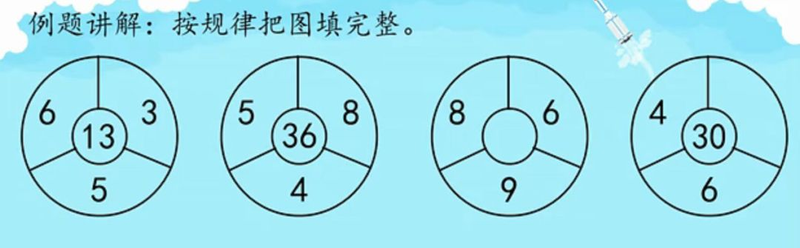
Think
(i) count it out
6x3-5 = 5x8-4 = 8x6-9 =
(ii) what is the pattern of the three numbers and the one in the middle
The sum of the two numbers above multiplied - the number below = the number in the middle
Conclusions
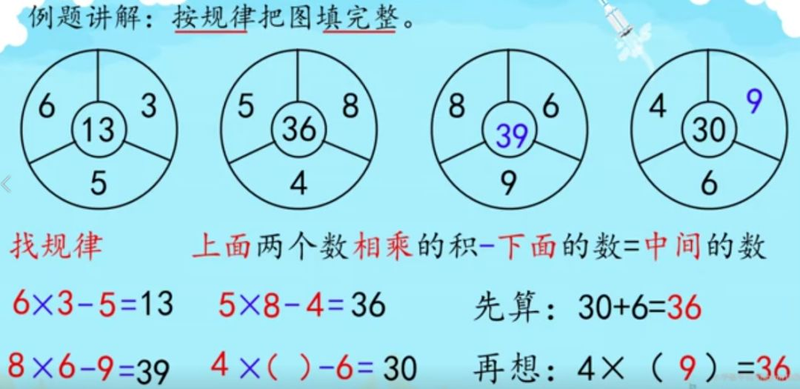
Hint
Key:
In general, not only do you look at patterns between numbers in individual graphics, but sometimes you take into account patterns of digital variations between graphics。

Language of mathematics in second grade
Long images to recognize concerns
Free learning materials