Economic reporter for the 21st century
The year is approaching, and the long-awaited end-of-year awards for the world of work continue to be paid。
“the end-of-year prize is about to be awarded and would have been fully used to repay the mortgage, but i would have considered it if there were investment channels on the market that were higher than the interest rate on the mortgage.” mr. Lee, who worked in beijing, told economic reporters for the twenty-first century. The loan details page he presented to the press showed that the current annual interest rate was 3. 2 per cent, i. E. Lpr-30bp。
Mr. Lee also informed journalists that attention had recently been paid to the intensive end-of-year financial management activities of the mobile phone bank ap, some of which were attractive, and that the annualized rate of return on some medium- and long-term products was considerable and indeed a bit moving。
Journalists found that many banks have targeted their end-of-year financial services. Among them, the transport bank app introduced the theme “end-of-year awards, with funding for `pay-for-work' schemes', which includes diversified product services such as deposit, treasury, fund, insurance, precious metals, etc., to allow investors flexibility between different holding periods, rates of return and risk ratings. The end-of-year award dedicated to financial management shows more than 10 items of property of varying duration, all of which are “2rs robust”. The end-of-year award premium premium page presents six insurance products, including two individual pension insurances, with a risk rating of “1r-conservative” and “2r-stable”。
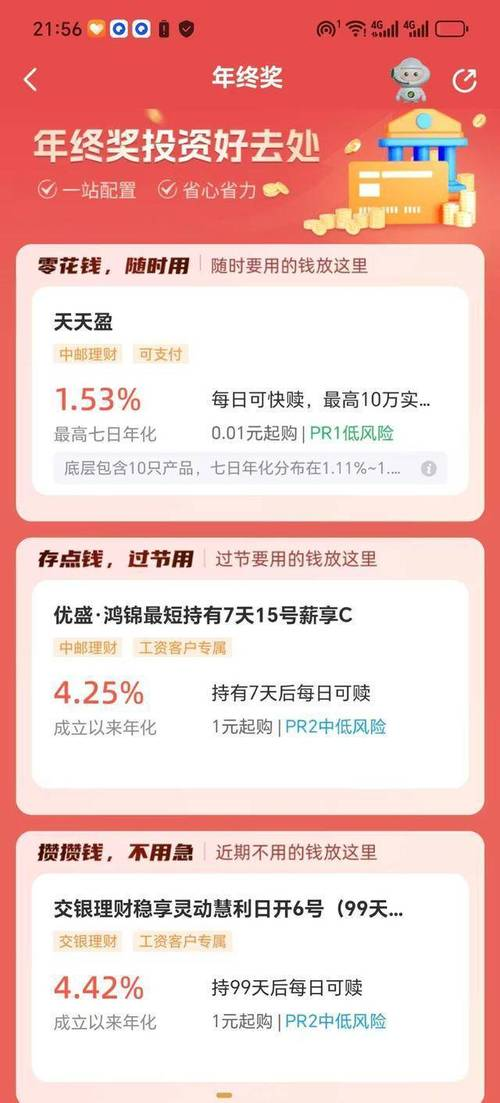
The postal bank app also has an end-of-year financial column with three low-risk or medium-risk products with flexible design -- - covers daily foreclosure, 7 days daily foreclosure and 99 days daily foreclosure. The postal bank has made it clear that clients with high liquidity needs can choose to buy their products daily; customers with robust value added and short-term no-money are eligible to hold their products daily after seven days; and short- and long-term idle funds can consider holding their products daily after 99 days in exchange for higher returns through modest lock-in periods. Of these, the annualized rate of return since the establishment of the seven-day daily foreclosure product and the 99-day daily foreclosure product was over 4 per cent。
The construction bank's guangdong branch, in turn, came in from an asset allocation perspective, proposing an annual end-of-year “four moneys” smart split: 10 per cent - 20 per cent for day-to-day expenses and contingencies, appropriate cash or monetary funds; 5 per cent - 10 per cent for risk security, with commercial health insurance, contingency insurance, etc.; 40 per cent - 60 per cent as a definitive target reserve for stable products such as time deposits, large bills, etc.; and 10 per cent - 20 per cent of idle funds can be invested in capital markets, such as fof funds, equity-based hybrid funds, etc。
Chase consulting chief analyst wang poebo told journalists that the transformation of bank end-of-year award marketing to integrated product services such as deposit, finance, fund etc. Was essentially a response to the needs of clients for integrated wealth management in low interest rate environments. “a bank can help aum (asset management scale) to stabilize growth and become more adhesive to customers by prolonging the stay of the customer's assets and increasing the cross-possession rate by consolidating multiple items.” the model coincides with investors' claims for “dispersion of risk and modestly higher returns” in the next cycle of returns, and with the long-term direction of banks' transition from product sales to asset allocation services。
It is worth noting that, in order to increase the retention of funds, state-owned and equity companies have launched asset upgrading programmes to attract users by offering credits, giving micro-credits, and throwing down gold eggs. On social platforms such as the little red book, a “sweety-sweety-sweety strategy” for major commercial banks' asset upgrading schemes is also emerging。
A beijing correspondent shared that in february this year the beijing branch of the construction bank launched a monthly win-off plan for asset upgrades, with a monthly average of 10,000 to 50,000 (excluding) micro-credit reduction of 10 yuan, and a monthly average of 200,000 to 500,000 (excluding) micro-trust reduction of 150 yuan, with an opportunity to receive up to 4,000 yuan based on the increase. There are also a number of internet users who have posted that banks have different levels of asset enhancement activities, which allow them to move funds between banks every month, obtain the corresponding concessions and list the tables for comparison。
From 1 january to 31 march 2026, the governor of the department of the bank of agriculture, anhui, showed that a banker with an emhum bank debit card had registered to participate in the event, and that the average aum on that date had been upgraded to the corresponding level compared to the average aum on december 2025, thereby providing an opportunity to obtain a corresponding award for the order of compliance. For example, the completed asset upgrades of 10,000 (excluding) to 30,000 (excluding) and of 1800 (not including); the completed asset upgrades of 30,000 (excluding) to 50,000 (excluding) and of 2,800 (excluding); and the completed asset upgrades of 50,000 (excluding) to 100,000 (excluding) and of 3,800 (excluding). Gin can be used to convert consumption credits, gifts to exchange entities and participation in exclusive activities。
The director-general of the bank of zimbabwe announced the launch of the “false savings” campaign in the first half of 2026, with up to $168 or 84,000 retail credits for asset upgrades for subscribers whose average assets were less than $200,000 on the previous month's average, and up to $518 or 259,000 for debit card users whose average assets were greater or equal to $200,000 on the previous month's average to perform asset upgrades。
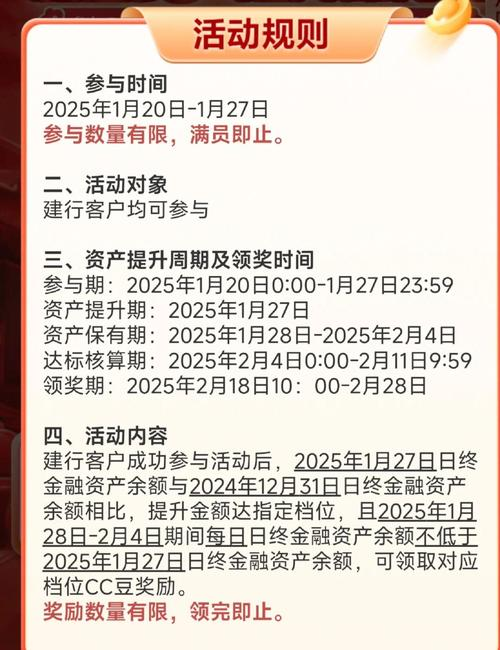
The bank also issued an exclusive “pay” end-of-year award, and prior to 13 february, the average daily assets of its payroll clients increased by $10,000 or more than in december 2025, to participate in a gold-throwing campaign and earn a consumption reduction。
In response to banks ' enthusiasm for end-of-year award-specific marketing and asset-upgrading activities, wang bobo explains that similar activities help banks to replenish their increased liability funds, replenish their deposit reserves and expand their assets, while at the same time boosting middle-business growth, such as finance management, insurance, etc., by increasing client activity and retention rates and reducing the cost of acquiring customers. The bank's focus is due to the fact that the end-of-year awards are centralized and more stable idle funds that match the current needs of the bank to optimize the debt structure, ease the interest-rate burden and increase the client's willingness to allocate its assets at that point in time to achieve efficient business growth。
Yang haiping, a member of the beijing association of wealth management industries, told journalists that commercial banks are now actively promoting asset upgrading programmes, closely related to the overall context of the industry's traditional marketing boom. As the key node of the bank's annual operations, the core objective during the “open-door red” period was to sprint operational indicators, and the personal asset upgrading initiative was an important initiative under this objective。
According to yang haiping, using the monthly average financial assets as a core appraisal indicator, the operation, through a series of highly targeted marketing initiatives, focuses on effective clients and high net value customer groups. The aim is to continuously expand quality customer size, enhance the overall contribution of clients and build a solid foundation for the subsequent business of regularized clients, thus guaranteeing the smooth achievement of overall business objectives。
How should the end-of-year “players” choose for themselves in the face of all kinds of marketing initiatives by lin-ling financial products and commercial banks
In the face of the various marketing activities of banks for end-of-year awards, the key to investors ' rational decision-making lies in returning to their own needs and the nature of their products, and the following four levels of focus are recommended。
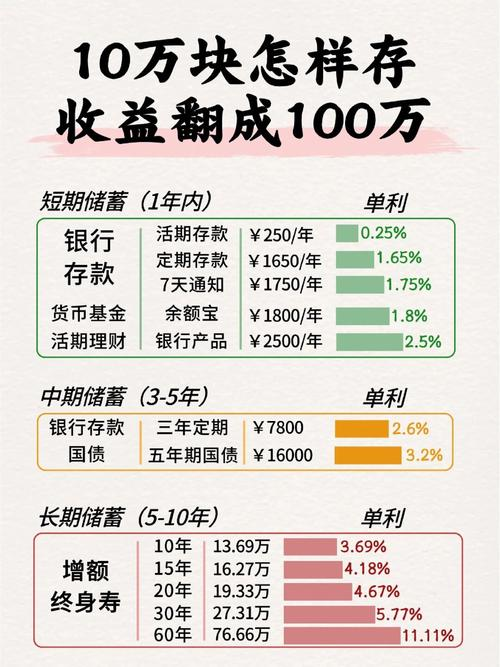
First, it would clarify its financial position and financial planning. Investors should first specify the specific purpose and the duration of the investment. For example, the part that is planned for short-term consumption or contingency reserves is suitable for the allocation of highly liquid products such as the imf, cash management, etc., and, for long-term inactive funds, fixed-term deposits, closed finance, etc., can be considered for more robust returns。
Second, an objective assessment of an individual's real risk tolerance. Prior to investment, decisions should be made in the context of their own risk preferences, and risk assessment through formal channels can help to identify the levels of risk appropriate to their own products. Typically, investors tend to be robust, and their asset allocation should be dominated by low- and medium-risk products。
Thirdly, the year-end awards are integrated into the overall wealth allocation. The end-of-year award investments should be planned in a holistic manner, taking into account the existing asset structure of an individual or household, the debt situation and other financial management objectives, so as to avoid excessive concentration on a particular type of asset or product in order to preserve the health and balance of wealth structures。
Finally, independent judgement is maintained and marketing promotion is viewed with caution. Faced with a variety of outreach messages, investors need to be rationally identified, with a clear understanding of indicators such as “performance comparison benchmarks” as reference rather than as a promise of return, and real returns will fluctuate with markets. It is important that product clauses be carefully read, focusing on interest start-up times, investment cycles, buy-back rules and cost statements to ensure that the product's liquidity arrangements are compatible with its own funds utilization plans。
Wang pombo reminds us that the end-of-year award requires clarity about the timing and risk tolerance of the funds: short-term money needs to be prioritized for short-term, liquid fixed revenue management, avoiding long-term lock-down fixed-term products; medium- and long-term idle finance can be deployed with a small amount of “solid +” products, but the bottom asset and institutional ability to invest needs to be ascertained and high returns not blindly pursued. At the same time, it is important to select the compliance products of licensed financial institutions and to pay attention to the tariff and foreclosure rules, to integrate the end-of-year award configuration into overall financial planning, not to follow the wind to buy explosive products and to balance risk and liquidity。