Web-based online news from the chinese daily newspaper: children's reading and writing barriers are not common in china, and many believe that the problem is mainly in europe, the united states and australia. However, recent studies by scientists suggest that these observations are not entirely accurate。
Catherine clingbil found an interesting phenomenon. This psychological student from vienna, the capital of austria, focuses on “labour and writing barriers” and regularly views forums on the subject online. In some cases, she found that there were many parents from china who sought help online, “because there were no relevant counselling units in china. People have to face it on their own. Those kids are considered stupid or lazy. And some of the parents i met said that their children could not be stupid because they were good in mathematics and geography and could only read and write. Actually, it's just that there's no one there to study the dyslexia, and there's no such subject.”
Reading and writing barriers are taboo topics in china. Many parents are reluctant to face reality when children experience difficulties in reading and writing in complex chinese. Both parents and children deal with the problem with a “don't worry about medicine”. “i think that the problem in china is that only very good people have access to universities and good opportunities. Because there are too many people. And those who have difficulty reading and writing lose many good opportunities.”
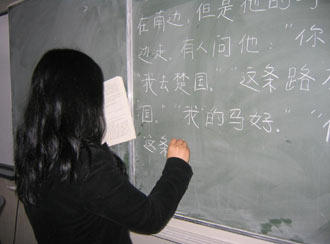
Most teachers in china are also unaware of “reading and writing barriers”. A survey conducted by professor vicks at the university of sussex in the united kingdom in the recent past among over 10,000 primary school students in beijing found that the proportion of children with “reading and writing barriers” reached 5 per cent, close to european or united states figures. Professor vickers was very surprised at the result. Because he had previously agreed that there was no problem with reading and writing barriers for chinese children. The reason for this is that chinese children are able to read and write in chinese characters in the same way as drawings, a process in which the pronunciation of words has little effect. Thus far, according to relevant theories, reading and writing barriers are the result of problems with the pronunciation of children, according to professor vickers: “most of the theories on reading and writing barriers are those with reading and writing disabilities, especially children, who learn to pronunciate when they learn to read and write, before linking pronunciation to alphabets. And the people with reading and writing disabilities are precisely having difficulties in pronouncing. This is a psychological problem and has nothing to do with illiteracy. But if someone has a problem with pronunciation, they're in trouble with literacy.”
Then why do chinese children have problems with reading and writing? The first thing they learn at school is to write. A psychologist, klingbil, felt that a completely new theory of dyslexia was needed to explain the phenomenon. This will also be the subject of her dissertation, “i am very interested in this subject, but further research is needed, because basic research is still lacking”
Although the reasons are not clear, the fact remains that there are reading and writing barriers in china. A number of chinese scholars are also visiting places to help children with reading and writing difficulties. Klingbier considers this to be a good phenomenon, but she is not convinced that all parents are open to the issue, “those who know about it are educated. They also made an appeal in that regard. But of course this is only a very small part. Most ordinary families are not aware of this. This is also a special issue for china.”
Professor vickers of the university of sussex in the united kingdom believed that the development of science and technology in china gave new hope to children. According to the neuropsychologist, children with dyslexia can more easily read and write with the help of a computer. "some computer keyboards have commonly used chinese text. This will benefit chinese children with reading and writing barriers. Another possibility is to change teaching methods and teach pleasure. Bibliography could be introduced to replace simple copying. I think it would be helpful if you could learn to read and write in the game and use the beautiful chinese word as the centre of learning.”
Professor vickers hopes that his theory will convince chinese teachers. Because it is only with their support that children with dyslexia can be helped so that they can better face competition in their future careers. (source: german voice website)