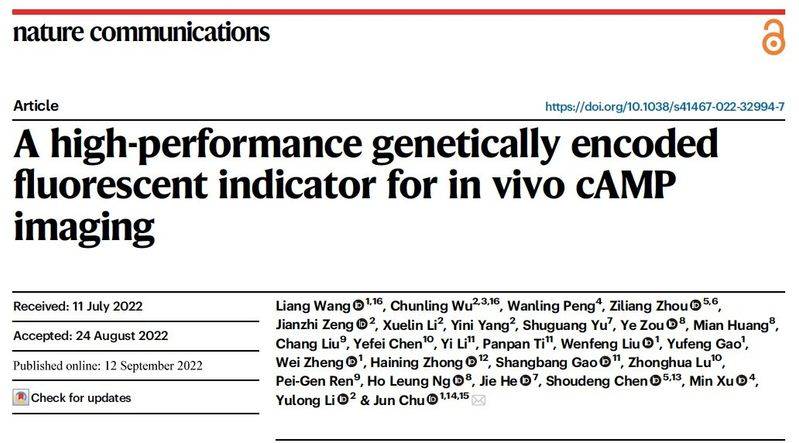
On 23 september, journalists learned from the shenzhen institute of advanced technology of the chinese academy of sciences (the shenzhen advanced institute) that the latest results of the unit of the reserve forces of the center for optical and molecular image research in biomedicine at the institute of medical research were published in nature newsletter。
Researchers have developed a camp green fluorescent probe (named g-flamp1) with a high-performance genetic code of 12 times fluorescent changes in living cells. The study, combined with techniques such as micro-imaging and fibre-optic records, monitored changes in the temporal and spatial dynamics of the cmp signals of specific neurons in the course of a given behaviour of model organisms, such as fruit flies and mice, and explored the interrelationship between cmap dynamics and animal behaviour。
The paper was co-authored by dr. Wang zheng, assistant researcher at shenzhen advanced institute, and dr. Xian chun ling, post-doctor, beijing university。
Paper on line。
Cells are the basic unit of the structure and function of the vast majority of life forms, including human beings. Cells continuously receive signals from the surrounding environment and transform them into changes in the number, distribution and active state of corresponding molecules within the cell (e. G. Proteins, organic small molecules, ion, dna and rna, etc.), thereby altering the form and biological function of the cell. The anomaly of the process is related to the development of the disease. As a result, scientists often understand cell functions by detecting temporal and spatial changes in the above-mentioned key molecules and clarifying the mechanisms for the occurrence of related diseases。
In the study, researchers selected camp, which is an important second courier in the cell, as the research target. Camp can transmit information on multiple gpcrs on the surface of cells and play an important role in learning and memory, drug addiction, motor control, immunization, tumors, metabolism, etc。
“the high-time and space-resolution fluorescent formation of changes in camp molecular concentrations at both the living cell and the living level is an important basis for the resolution of camp signal traffic and its biological function. Therefore, the development of sensitive camp fluorescent probes becomes the key to the study of complex biological processes.” the reserve army indicates。
Compared to non-genetic coded probes (screene and material types), the gene coded probes, like normal proteins, can be located in specific cells or cell sub-structures of organisms with low toxicity, low background, genetic properties and unparalleled advantages in basic research on life sciences. However, the existing more than 50 gene-coded camp fluorescent probes either have a low sensitivity (only 1. 5 times the maximum fluorescent change) or are darker, making it difficult to monitor the slight internal camp changes in the living body, significantly limiting research into the mechanics and functions of camp molecules in physiological and pathological conditions。
In order to develop high-sensitivity probes suitable for active detection, researchers inserted cycling green fluorescent proteins (cpgfp) into the camp combined structure area (mlcnbd) of the bacteria molotik1 channel proteins. High-performance gene code camp green fluorescent probe g-flamp1 with high-light, high-sensitivity, appropriate proxies and fast response speeds was obtained through placement-point screening, connectivity optimization, fluorescent protein and induction module optimization. This probe can change 12 times more fluorescent in active cells than is currently one of the few fluorescent probes over 10 times more。
Subsequently, researchers applied the g-flamp1 probe to the fruit fly model. The camp signal circuit in the mushroom body of the fruit fly's brain plays a key role in the smell-related memory. Researchers first acquired a genetically modified fruit fly in kenyon cells expressing the g-flamp1 probe, and then, using a double photo imaging, found that when the fly was irritated by the smell or electric shocks, the different sub-regions of mushrooms showed different temporal and temporal changes in the camp signals, implying that different sub-regions might play a relatively independent role in associated learning。
To verify the usefulness of the g-flamp1 probe in detecting camp dynamics in living animals, researchers used gland-related viruses to express the green g-flamp1 probe and the red jrgeco1a calcium probe in the mice ' motion cortex. The living bi-photo imaging reveals cell-specific cmp signals in the running movement and has no apparent relevance to calcium signals. This reflects the heterogeneity of the neurons reaction of the cortex m1 during the movement of mice。
Finally, researchers express the g-flamp1 probe in the deep nucleus (nac) brain of mice, and use fibre-optics to record changes in the camp signal of pavlov conditions in that brain. The results show that, as a result of the training, the amount of cmp signal is decreasing when mice are rewarded, while the level of cmp signal is increasing when corresponding acoustic signals are heard; this characteristic is similar to the dopamine signal, suggesting that dopamine releases give rise to the cmp signal. Thus, the high-intelligence noise ratio and high-time resolution of the g-flamp1 probe detect the dynamics of internal cmp signals in live mice。
Based on the above, the study developed a cmp fluorescent probe suitable for living detection and initially revealed patterns of changes in the camp signal of specific neurons in the course of specific behaviour, such as fruit flies and mice, which provide a basis for further understanding of the control and function of the camp signal。
“g-flamp1 is only the beginning compared to the widely used calcium ion probe gcamp, dozens of domestic and foreign laboratories are now using g-flamp1 and more will be using g-flamp1 to study complex biological problems in the future.” according to the reserve。
It is understood that the research team will further improve probe performance in future research, develop the next generation of sensitive camp probes for different applications and use them to reveal the patterns, regulatory mechanisms and biological functions of camp signals in living cells and living organisms. At the same time, new probes developed by the research team in conjunction with the high-intensity drug screening platform will also be used in drug screening for gpcr receptors, with a view to detecting more gpcr drugs of clinical value。
This work has received strong support from a number of partners, including the li zhonglong project group of beijing university, the xu min group of the institute of neural sciences of the chinese academy of sciences and the ho jie group, the chen jingdong group of the fifth hospital attached to the university of nakayama, the ho leung ng group of the university of kansas, the china road project group of the shenzhen advanced college, the bacon group and the cheng jing group of the university of science and technology of china。
[reporter] mavonne
Marv
[source] southern media group southern + client