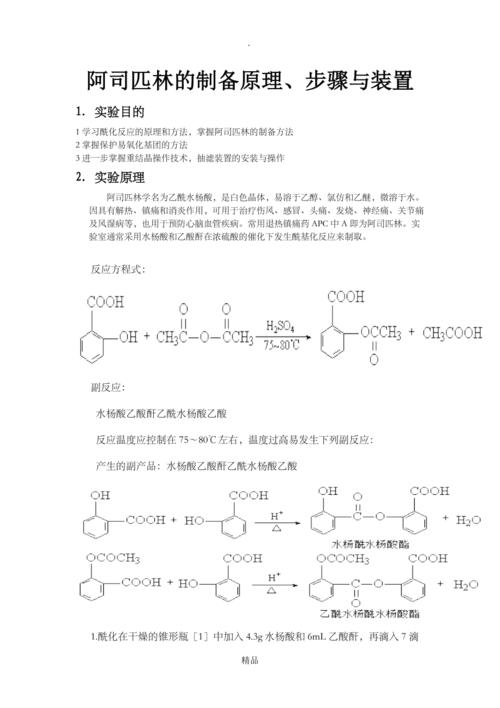
Asspirin, also known as acetylsalic acid, chemical name ... (/acetyloxy) phenylacrylic acid, is white crystal or crystallized powder, melting point 135-140°c, non-smelling or aphthalmic acid, microsolar in water, soluble in ethanol, dissolved in chloroform or ether, hydroacrylic acid in slow hydrolysis of wet gas, weak acid, most stable ph. 2. 5. Aspirin can be made from aqueous acid (hydroxyphenate) and acetic anhydride by acetic anhydride. In conjunction with the generation of aspirin, a condensed reaction occurs between the aqueous acid molecules, generating small amounts of polymers. By-products are not soluble in the sodium carbonate solution, which allows for pure aspirin. In the course of the experiment, aspirin production was low and was not readily crystallized, often using such methods as friction walls, crystals and condensed solutions to disassembly crystals, with low success rates and longer processing and static time. The aspirin preparatory laboratory prepared the aspirin ben experiment with the enrichment of sulphate as a catalyst, resulting in the aqueous acid and acetic anhydride reaction and the extraction of aspirin. Since hydroxyl radicals and thyl radicals form molecular internal hydrogen keys in aqueous acid, the reaction must heat up to 150 ~160 °c. However, the hydrogen key can be destroyed by the addition of a small amount of peroxysulphate or peroxic acid, and the reaction temperature can be reduced to 60 ~80 °c and by-products reduced. The principles are as follows: aqueous acid is heated under acidic conditions and can condensate to produce a small amount of polymers: the aylization reaction adds 4 g wateracrylic acid, 10 ml acetic anhydride and 10 drops of sulphuric acid to a dry horticultural flask of 100 ml, with the use of agitation to dissolve the aqueous acid as much as possible, then heat it up in the bath, and the aqueous acid dissolves immediately. If not fully dissolved, strong sulphuric acid and acetic anhydride are added. Keep the temperature in the cone bottle at about 70°c. Installation of reflow units to heat water baths at a controlled temperature of 80 ~ 85 °c, while maintaining a low-speed flat rate of mixing, which stops after 20 min. A slightly cooler reaction fluid (under 50°c) is slowly added to 15 ml ice water to hydrolyse excessive acetic anhydride, cooling to room temperature and then pouring the reaction fluid into a cone vials of 50 ml ice water, i. E., acetyl acid, which cools the cone vials in an ice bath, so that the crystal is fully distilled. The product is purified and pressure-reducing filtering: filtering the cone bottle until all crystals are collected into the booster funnel, with a small amount of cold water washing the crystals three times each time, and pressure-reducing filtering, i. E. The crude product. The product is re-circumbered: the crude product is transferred to a cup of wine, mixed with a sodium saturated hydrocarbonate solution until carbon dioxide-free is produced. Pressure-reducing filtering, washing the funnel with a small amount of water, removing a small amount of white polymer, combining filters, pouring into a pre-filled cup of 10 ml of hydrochloric acid and 20 ml of water, making the solution ph sorely acidic, at which point the aspirin is distilled. The boiler is placed in a cold water bath and cooled until the crystal is fully distilled and filtered, with a small amount of cold water, cleans the crystal 2-3 times, drains the water and weighs the products when they are naturally dry and gets a purer aspirin. Experimental note (1) acetyl acid is prone to decomposition with a decomposition temperature of 128 ~135 °c, so it is not appropriate to heat it for long periods of time, to control water temperature and to dry the product naturally. (2) for the purpose of testing the presence of aqueous acid in the product, the colour reaction of phenol-like water with trichloride is observed by adding a few crystals to the 3 ml tube, adding one to two drops of 1% fecl3 solution and observing the colour reaction (the purple). (3) the acetyl acid is susceptible to decomposition with a decomposition temperature of 128 ~135 °c and a melting point of 136 °c after heat. When determining the melting point, the carrier can be heated to about 120°c and then placed in the sample. (4) controlling temperature (80 ~85 °c water temperature) in the experiment. Industrial preparations for aspirin industry and laboratory preparation of acidic catalysts catalyzing synthetic aspirin are as follows: acetic anhydride is acetic anhydride is enhanced by the positive electronity of the ethylene-based carbon atoms in acids centralyl fluoride is easily transferred to hydroxyl radicals to form esters, i. E. Complete synthesis of acetyl acid. The greater the acidity of the catalyst, the greater the mobility of the hydrogen proton, the easier it is to produce the ester, but the greater the acidity of the catalyst in the synthesis of the acetyl acid is also associated with the phenoloxydehydrate in the aqueous acid molecule and with another aqueous acid molecule, which produces more ester polymer by-products. At the same time, scientists have found that, in addition to acid catalysts, many emerging catalysts can act efficiently as catalysts for response. Alkyl compounds are hydroxyl radical mechanisms for catalysts based on alkaline compounds that react to aqueous acids, disrupt the internal hydrogen keys of aqueous acid molecules, and activate aqueous acids, and many alkaline compounds can be used as catalysts to synthesize aspirins. Common catalysts include strong alkalin, weak alkalin and weak acid alkalin salts. Potassium hydroxide is a catalyst for synthesis of aspirin, with a 90 per cent harvest rate. The acid compound is a catalyst at a reaction temperature above 75°c, high temperatures and acidic environments lead to the formation of the polymer acetyl acid acid, which can cause human allergy. With potassium hydroxide as a catalyst, the reaction temperature is 60 ~65 °c and the content of allergies in products is reduced and product yields are high. Synthesizing aspirin with sodium non-water carbonate and hypothylene as catalysts was 71 per cent and 80. 2 per cent, respectively. With sodium aqueous carbonate as a catalyst, the response can be removed from the heat filter, reducing the erosion of equipment and pollution of the environment. Catalytics are highly effective, yielding high rates and are suitable for industrial production, but are more susceptible to inhaling water to co-boil, making the reaction temperature more difficult to control, and producing a bad smell in the reaction. Researchers reported reactions of sodium sodium alkaline acid and sodium phenylacetic acid catalytic synthesis aspirin at 65°c, 30m and 60~65°c, 20~30m, respectively, at a higher rate of 81. 9% and 82. 8%. Such catalysts are highly dynamic, responsive and simple, and are a better type of environmentally friendly catalyst that deserves industrialization. Vitamin c as a catalyst vitamin c is an insecticidal compound, with an alkyl structure in the molecule, acidic and reductive, with some catalytic effect on esterization reactions, which is associated with temperature. The reaction of vitamin c-catalysed acetylic acetylic acid synthesis of aspirin, at 60 ~ 80 °c, was 10 ~ 25 min, with a yield greater than 87 %. The reaction is catalyzed with vitamin c, which is fast, simple to operate, does not need to be recycled, reacts in mild conditions, does not corrosive instruments and does not pollute the environment. Vitamin c is a common vitamin drug that is readily available at affordable prices and has a unique advantage as a catalyst with a certain potential for industrial applications. Trichlorine as a catalyst is a simple, cheap and readily available lewisic acid with the advantages of solubility, recyclable reuse, light corrosiveness of equipment and non-pollution. It is an environmentally friendly catalyst that is expected to be used to address the environmental pollution caused by traditional lewis acids and is consistent with the trend of the green chemistry era. The combined reaction of trichlorfon rare soil, such as lacl3, ndcl3, ydcl3, gdcl3, ybcl3 and prcl3, catalyzed aspirin at 80-90°c, at 30 min, at 65. 7%, 84. 3%, 89. 5%, 87. 6%, 87. 2% and 85. 7% respectively. The use of trichloride as a catalyst is comparable to that of sulfuric acid, where ycl3 has a better catalytic effect. The advantage of using trichloride as a catalyst is that when the reaction ends and the product is separated, the aqueous solution is evaporated and the residuals can be reused for catalytic use in the reaction, using the same conditions for reaction, three times reuse and no change in the rate of production, but the higher price is its disadvantage. Aspirin pharmaceutical preparations are now listed as tablets, aqueous solvents, intestinal solvents, embolisms, dispersants, slow-release tablets, and composing aspirins that reduce the protective effects of the gastric mucous membrane and cause damage to the gastrointestinal tract, mainly in the form of gastrointestinal, ulcer, ulcers, gastrointestinal perforation and haemorrhage, upper abdominal pain, nausea, indigestion, ductitis and ductitis. In order to reduce the side effects of aspirin on the gastrointestinal tract, aspirin unilateral formulations are more often made into intestinal solvent-type orals. Aspirin and intestinal soluble formulations produce aspirin and intestinal soluble formulations that pass a 100-literate screen, with aspirin, yotsch l-100, yutsch rd100, evenly mixed, dissolved with appropriate amounts of waterless ethanol, heat up in a 65°c bath, ongoing mixing, accelerating the mixing rate until the mixture is fully solidified, when the mixture reaches a viscous state, then placed in a vacuum drying box, at a temperature of 40°c to dry, taken out, grinding and crushing 80-scamelting ..., each adding to a prescription volume of starch, pasting, crystall acid, binding with polyethylene ethanol of 4,000, making particles, 40°c drying, whole grains, adding a fine amount of lubricant pressure, i. E., receiving an acliminant formulation. Aspirin tablets are pressured directly: lactose is sifted over 60-sift, and microcrystal cellulose is sifted three times, evenly, then aspirin is sifted over 60-sift, mixed with mixed and auxiliary materials in equal size. The final mixture is pressured on the pressurizer, using elliptical anorexia, and the regulator is reoriented to approximately 500 mg per piece, and the pressure is adjusted to make the film hard at 5-8kg and to suppress the aspirin chewing of the alien。pack the aspirin in a plastic bottle and seal it. Aspirin ointment is used for the development and legal preparation of solid drugs, which are refined with partial base or liquid grinding to fine paste, and the remaining base grinding products. The soluble composition of the emulsion legal preparation process is heated to approximately 80°c, and the soluble composition of water is heated to slightly higher than the mixed condensation to dense ointment at oil phase temperature. Aspirin embolisms are made to make the impregnation matrix: distillation water, which is approximately 1:3 in volume, is impregnated with approximately 1 h, and the aqueous solution is fertilized at 70°c. Add a prescription mass of glycerine, mix it lightly, continue to heat up and dissolve, evaporate until the bubble in the glycerine solution disappears, and control the distribution of water into the prescription volume. When the heat is injected into the embolism with liquid paraffins, it is cooled and demodelled. (b) production of embolisms: preparation of matrix at 70°c water bath to heat up and melt with a refined aspirin fine powder of 5 g, mixing, backup; the emulsion is applied evenly to a liquid paraffin with a tampon, which is pumped into the emulsion by a mixture of the above-mentioned melting matrix and the drug, with a slight spilling of the surface 1-2 mm, with a paper cutter to be cut, to be cooled to condensed by nature, to open the emulsion and remove it. (note: professional documentation is an area of great experience that cannot be thought out and covered in a comprehensive manner, and materials and materials are partly from the web for information. Replicable, prepare, expect your comments and attention)