As we enter a high-prevalence season for respiratory infections, children become vulnerable because of their lower immune capacity, some parents suffer from miscalculation of their children with adult drugs, and children still use “dosage-to-challenge” drugs。
Journalists visited paediatric clinics and pharmacies in multi-hospital hospitals and found that the irregular use of medicines had led to adverse effects on children and even delayed treatment and aggravated cases. According to interviewees, behind these apparently “facilitative” drug practices, the gap between the type of drug used by children and clinical needs is reflected. Children's access to medication is limited by a variety of factors, including scarcity of specialized medicines, inadequate production and equipment, and long clinical trial cycles. It is recommended that further policy guidance be provided and that the development and safeguarding of medicines for children be increased and that the knowledge of children's medicines be strengthened。
The risk of “disassembly human drugs”
Recently, the demand for various types of anti-influenza drugs, cold deheating drugs and respiratory testing services has increased rapidly. In the influenza season, children are at the forefront of “victims” due to the premature development of the immune system. Journalists were informed that the number of single-day visits to a children's hospital in a northern location reached a peak of 13,000。
In practice, doctors have found that there are more cases of children being converted to medication by adults. The director of the department of pharmacy at tianjin hospital in tianjin city, feng qian, said that there had been cases where parents had given their children medication on the basis of experience and even the use of adult medicine had led to adverse reactions. For example, during the high-prevalence flu season, many parents are rushing to use ostave when they see their children with fever, but blind use of anti-influenza drugs is not only ineffective, but may also cover up the real situation and delay treatment。
In shenzhen city, a 10-month-old baby girl was admitted to the maternal and child health care facility. The baby's parents were given more than five times the recommended standard for an acetaminophenol drip, rapidly increasing from a common fever to acute liver failure, accompanied by coagulation disorders and neurological symptoms. After eight days of emergency treatment, his liver function was restored。
Some experts, such as liu xuan, director of pharmacology, jaia hospital, central south university, have indicated that children are not “downscaling” for adults, and that their absorption, distribution, metabolic and excretion processes differ significantly from those of adults. Simple reductions in the use of adult medicines not only fail to ensure safety and effectiveness, but may sometimes also affect the development of children。
“there is a gap in pharmacokinetics between ages, with children under the age of 3 more suitable for dripping, children between the ages of 6 and 12 more suitable for chewing, and with regard to the use of safety, the child's liver enzyme system is underdeveloped and the incidence of adverse effects is high.” pharmacist zhou, deputy director, pharmacist, hospital attached to the medical institute of tianjin city。
Behind the irregular use of medicines is also the reality of children's limited access to medicines, and industry has indicated that there is a limited number of specialized drugs that are actually developed according to the biological characteristics of children, especially in the areas of respiratory, nervous and rare diseases。
“the use of children's medicines is also a clinical problem, and in terms of children's drug varieties, the number of approvals for children's specific medicines is relatively low.” according to feng xin, children suffer from fewer diseases than adults: “many of the cardiovascular diseases, diabetes, etc. That we think adults receive, are not very low in children. Due to over-ingestion and insufficient exercise in nutrition, there are more emerging diseases among children.”
The vice-president of the institute of medicine and medicines of zin dachun province, chen chang, believed that super-description drugs were not strictly medically prohibited, provided that they were supported by sufficient scientific evidence, that the risks were manageable and that they were informed. “the problem is that long-term reliance on this approach can also lead to chronic deficiencies in the construction of a drug system for children.”
Shortage of drugs for children exposed
The fundamental challenge for children is understood to be the shortage of specialized drugs. Changes in the number of children's populations also create new needs and challenges for access to medicines。
First, there is a gap between the type of drug used and the need for disease. Chen barracks said that less than 10 per cent of the thousands of chemical preparations that have been listed in our country are child-specific, and more than 90 per cent of children use drugs that are not. This means that more than 90 per cent of the country's children use drugs that are not customized for children, and that most depend on adult drugs to adjust their dose use. The experts interviewed indicated that specialized drugs in such areas as tumours, hypertension, diabetes and epilepsy were particularly scarce。
The second is that a single specification of the formulation leads to inconvenient treatment. A number of clinical experts have informed journalists that the drug-type design of existing drugs for children does not adequately take into account the characteristics of young children. For example, children need more precise doses and suitable formulation types (e. G. Oral solutions, suspensions, oral avulsions, etc.), but the current market is dominated by adult commonly used formulations such as tablets, injections, etc., and the scarcity of formulations and small-spectrum products suitable for younger children leads to the need for “counting” of drugs, which increases risks. Some dosage specifications are too large to require a piece or estimate; others are not suitable for children to swallow, such as common tablets, capsules. In contrast, multi-dose gradient specifications, granular agents, oral solutions, etc. Are still inadequate。
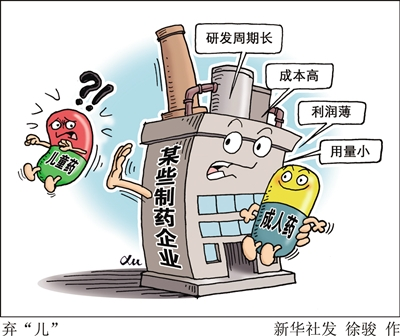
Interviewees indicated that behind this was a reflection of the long-standing difficulties faced by children with low economic returns and a limited group of patients. “if specific medications are developed for children, what dosages should be used during the foetal period and what should be done during the neonatal period, it is difficult for pharmaceutical enterprises to achieve this breakdown and the cost of research and development is higher.” feng xin said that the development of children's medicines required a dose design and dose adjustment tailored to the specific physiological characteristics of children, which affected productivity incentives, low commercialized returns and insufficient pharmaceutical power。
Child medicine clinical trials are relatively longer and more difficult. “many medicines are not available for collection of corresponding clinical drug data because they do not recruit children for testing.” feng zhen indicates. From the point of view of r & d and the end of production, chen camp stated that the ethical requirements of the group of children were higher, that the recruitment of the testees was difficult, and that there were significant differences in the use of drugs between the ages of newborns, infants and children, school-age children and adolescents, which increased the cost of r & d, the time cycle and uncertainty in the recovery of investments, and that insufficient entrepreneurial motivation ultimately affected market supplies。
Improved research and development systems
In recent years, the state has promoted the development of children's medicines through a policy of priority review and approval, encouragement of research and development inventories, and preferential health insurance. The number of children who have been admitted to the market has increased every year, but the overall shortage of medicines still requires attention. Respondents indicated that policy support could be further strengthened, the r & d environment optimized and production incentives enhanced to meet the needs of children for medication。
• clear legal and regulatory support.” from the experience of some state practice, its children's medications are not entirely dependent on spontaneous market behaviour, but rather are legislated to force or motivate businesses to conduct research on children's medicine.” chen bian said that in some developed countries children's medicines can benefit from “priority review, cost relief and public financial support”. The institutional constraints and incentives of our existing policies can still be further enhanced, such as the simultaneous development of research on children's medicines once new drugs have been forced on the market, with the possibility of granting an extension of patent or market monopoly。
• increasing policy incentives to increase business motivation. Chen barracks and others recommended encouraging the gradual transformation of mature and safe uses into formal childhood adaptation through real-world research. The authorities can take the lead in the development of guidelines for children's medications, focusing on effective guidance to enterprises in research and development, such as clinical programmes, alternative programmes, etc. (c) increased corporate involvement in the development of children's medicines through priority review and approval, tax incentives, research and development subsidies, and health-care support。
• application of new technologies to improve r & d efficiency. Feng zheng et al. Indicate that ai intelligence can enable the development of medicines. “the former use of computers in lieu of artificially screened molecular structures has accelerated the development of medicines. Today, in the ai era, child medicine development can predict the efficacy and safety of children's medications by building smart models, using historical clinical trial data, back-to-date world research and evidence-based evidence.” she said that with ai technology, clinical testing programmes could be optimized, r & d efficiency and safety could be improved, r & d costs reduced, and a more scientific basis could be provided for the registration of children's medicines。
• strengthening family-oriented pharmacology. Zhou zhou and others indicated that parents were required to check strictly the name of the drug, its type and age of application before giving it to their children, and that the reduction of the use of the adult drug was strictly prohibited; the dose should follow medical instructions or instructions as a matter of priority and avoid a simple age conversion. (reporter liu yunjie, yang wen, liran)