During the two national conferences in 2026, children's dietary health and food safety regulations were again a matter of concern to the commissioner. The national political consultative council member, tuo ruefen, proposed the establishment of national food standards for children in the 0-18 age bracket, strict regulation of sugar, salt, oil and food additives, and the strengthening of food regulation for red children in the vicinity of schools and on the net, to strike directly at the current child food market。
What's the food preferences of the students now? How do parents feel and think about how their children's diet is being developed? A survey of 1335 parents of minors conducted by the joint questionnaire centre of the chinese youth press (wenjuan. Com) revealed that children were the only ones favoured by fried foods (70. 2 per cent), followed by food that smelled attractive (55. 1 per cent) and coloured (54. 8 per cent). Eighty-six per cent of the parents interviewed considered it important to educate their children about food and nutrition。
Children prefer fried, sweet, and healthy cooking
In qingdao, shandong, there are two children, their daughters in the sixth grade of primary school and their sons in kindergarten classes. He stated that children had a special preference for all kinds of snacks, and that chocolate and cheese sticks were “good minds” and “baskets for children could almost be of interest to them”。
Liu xiaohong, a private accountant in gansuland state, has two daughters who say that 11-year-olds have recently fallen in love with candy, expansionary foods sold by a small store in the vicinity of the school, and have been in love with fried chickens. “it is true that the family has long had snacks that we carefully screened for her, but she will still have to buy some heavy food”。
What kind of food do the interviewed parents feel they prefer? According to the survey, the oil boomers (70. 2 per cent) ranked first, followed by the smelling (55. 1 per cent) and the colouring (54. 8 per cent), sweet (54. 5 per cent) and taste preference (45. 1 per cent) ranked third, fourth and fifth, respectively. It is worth noting that the selection rate of low sugar, low salt and low oil foods, represented by healthy cooking, is only 20 per cent (21. 3 per cent) and that the rate of return to food content is 15. 5 per cent. In addition, the selection rate for simple food was only 6. 9 per cent。
More than 60 percent of the parents interviewed felt that the concept of healthy diet was not yet widely developed in primary and secondary schools
Chengning, who has more than 20 years of teaching experience and is now serving in the logistics department of a primary school in lanzhou, suggests that children's eating habits are shaped by the influence of family eating habits and educational concepts. Particularly for young children, there is no clear ability to judge whether food is healthy or not。
Liang hongjun also stated that the penis in kindergarten is not yet capable of discerning whether food is healthy or not, and that, in the child's perception, food is only “good” and “not good”, “i often tell him when choosing to buy snacks which are unhealthy, but my son always contradicts me with `i love' `i want'”。
Liu xiaohong, on the other hand, stated that while 11-year-old daughters already know what is unhealthy, they do not limit their own consciousness and do not seem to care much about “absorption” and that “the choice of diet is usually difficult for children to learn about it without adult constraints”。
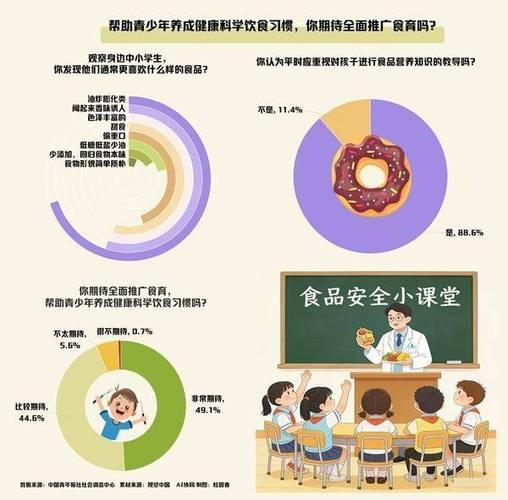
In the survey, more than 60 per cent of the parents interviewed (65. 5 per cent) felt that students in primary and secondary schools generally did not develop a sound diet of science. It is a matter of concern that the proportion of parents in the towns or counties interviewed is relatively high at 75. 0 per cent, followed by those in the second-line cities (70. 2 per cent)。
Parents interviewed: the primary level is the best time to educate children about diet
Chengning noted that parents play an important role in the development of children's eating habits and habits. Parents who value dietary education are able to build their children's initial dietary awareness through daily dietary arrangements and indoctrination. Some parents, however, are under-invested in this area because of their busy work, or because they “can't help the child”, which is not conducive to healthy eating habits。
"i'll tell the children which food is healthy and which ingredients are not. At home, too, every effort is made to give children a healthy diet. Liang hongsang believes that the primary school stage is the best time for children to be educated about their diets, allowing them to build up basic food safety judgements。
Liu xiaohong also agrees with the importance of parents' feeding their children. "i don't usually buy `three zero' food, and i usually remind children to eat less of junk food, but sometimes it is adjusted to the actual situation."
In the survey, 88. 6 per cent of the parents interviewed considered it important to teach their children about food nutrition. Cross-analysis shows that the highest percentage of parents in the first-line municipalities is 94. 1 per cent; among parents of different age groups, the highest percentage of parents of primary and secondary school pupils is 92. 3 per cent, followed by parents of pre-school children (87. 1 per cent)。
According to china’s food industry analyst, one of the major challenges facing some parents with regard to children’s dietary education is health awareness, but lack of matching health knowledge, which has given children’s food enterprises a chance to “show their sheep and dogs.” “the food problems of children exposed every year by ‘3/15’ will further exacerbate parents’ anxiety.” he stated that children's food security was linked to the future development of the country and that children's dietary health and food market norms needed to be continuously increased。
Of the parents interviewed, 14. 8 per cent were infants (up to the age of 3 years), 34. 8 per cent were pre-school (3-6 years), 40. 7 per cent were primary and 9. 7 per cent were secondary. 37. 8 per cent live in first-line cities, 35. 9 per cent in second-line cities, 21. 5 per cent in third-line cities, 4. 2 per cent in towns or counties and 0. 6 per cent in rural areas。
Liang zhiqiang has also contributed to this article