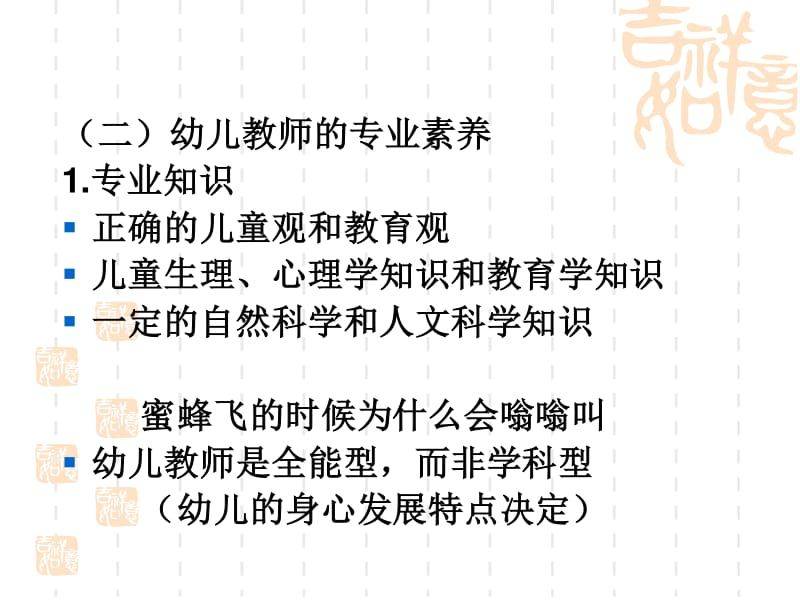
(i) early childhood education must follow the physical and mental development patterns of young children; early childhood education is a combination of education: protection and life care; teaching; teaching; combining knowledge in life care with the protection of the physical health of young children; promoting mental health; coordinating mental health; learning of young children, i. E. The “troika” of early childhood education; interaction of young children with the environment; lack of an environment; lack of learning and development (which is different from the learning of books for primary and secondary school students); the physical and mental development of young children determines the physical and mental development of an environment-dependent mind; the role of the environment in supporting the development of young children (smoothing, behavioural strengthening, cognitive) should be highlighted; the interaction between young children and the environment is an activity that is the foundation and source of early childhood development, and there is no development without activities. Young children's activities take place in one day, including exploration, performance, interaction, etc., and are characterized by hands-on and brain-active behaviour. Young children's lives are education. The process by which young children understand and gain experience is carried out in a holistic way, and no single way of feeling can constitute their understanding. What did you learn today in kindergarten? - mom, i got a butterfly. It's fun. Regularity: sequence (irreversible), universality, inequality differentity: (iii) early childhood learning (the process of gaining experience) the process of acquiring experience through formalization is non-academic: the process of gaining experience in life, exploration, interaction, play. Young children's physical and mental development is an integral whole. Children always change the state of toys by their own actions in play; the characteristics and behaviour of the children themselves influence the mental and attitude of the people around them.” the child's potential should be maximized in appropriate environments and educational conditions. Early childhood vulnerability and sensitivity, as well as the irreversibility of its physical and mental development, require that children be given absolute priority. These findings have led to an increased awareness of the great potential of children and to a change in the traditional belief that children have long been neglected and that they are “incompetent”. Assuming a level of intellectual development of 100 at the age of 17, then it has grown to 50 by the age of four, to 80 by the age of eight and the remaining 20 by the age of eight to 17. (amire, 91)