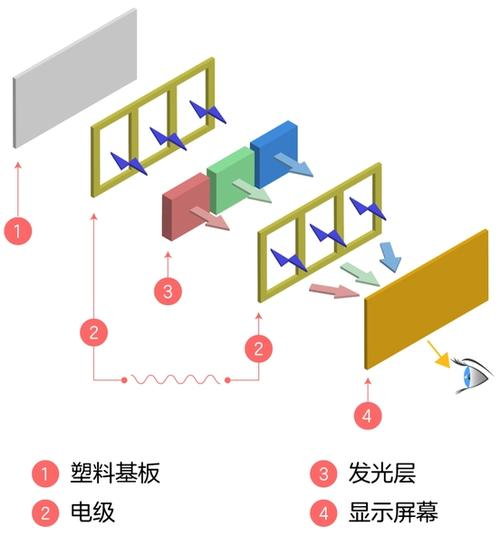
Display screen working principles:
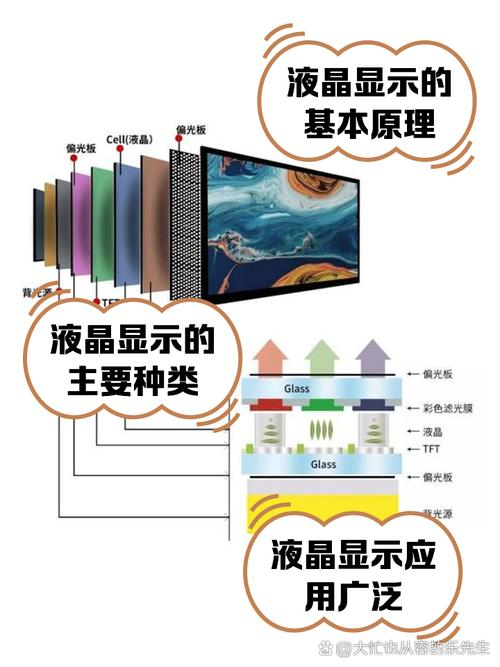
Lcd is a very special substance. It flows like a liquid and has some optical properties of crystals. Lcd was discovered in 1888 by the austrian plant scholar reinitzer as an organic compound between solids and liquids with a rule-based molecular order in which lcd molecules are sequenced and sensitive to external conditions such as temperature, electromagnetic field changes. The array of liquid crystal molecules can change as a result of the power field, affecting its optical nature, a phenomenon known as the electro-photo effect。
The liquid crystals tend to follow the grooves, usually fitted with directional membranes on two glass panels, and the molecules in the liquid crystals are sorted in the same plane, as if they were blinds, and the molecules' rows are gradually reversed at 90° as they transition from one liquid to another, i. E., the rows of the two layers vary by 90°. The most commonly used liquid crystal type is liquid crystals in the direction column (nem displays of different types) with a fine long bar shape and approximately 1-10 nm (1nm = 10 am) long width. Under different current electric fields, liquid crystal molecules rotate by 90 degrees, creating a difference in luminometry, so as to create a dark distinction between power switches and switches, thus controlling each pixel and forming the desired image。
Common types of display screen:
Crt
It is a monitor using cathode raytube, which consists of five main components: electronic guns (electron gun), deflection coils, shades (shadowmask), fluorescent powder (phosphoor) and glass casings. It is one of the most widely applied monitors, and the crt pure flat displays have the advantages of a wide visual angle, no bad points, high colour reduction, even colour, tromboble multi-resolution mode, extremely short response time, and very difficult to exceed. Crt monitors can be divided into different types according to different criteria。
Lcd
The advantage of the lcd monitor, i. E. The lcd monitor, is that it is thin, small, irradiated and gives a healthy product an image. However, the lcd screen does not necessarily protect the eyes, which requires that the usage of computers be observed。
The lcd crystal monitor works with many liquid crystal particles inside the monitor, which are regularly organized in a certain shape and each side of them has different colours: red, green, blue. The three original colours are reduced to any other colour, and when the monitor receives the computer's display data, it controls each liquid crystal particle moving to different colours to form different colours and images. And because the disadvantage of this liquid crystal screen is that it is not colourful enough to look at it from a very high angle。
Led
Led display screen (ledpanel): led is the lightening diode, short of led. It is a display of lighted diodes by control of semiconductors and is used to display a variety of information, such as text, graphics, images, animation, pedestrians, videos and video signals。
3d

The 3d monitors have been recognized as the ultimate dream of demonstrating technological development, and many enterprises and research institutions have been engaged in research in this area for many years. Developed countries and regions such as japan, europe, the united states and the republic of korea, which had been involved in the research and development of 3d display technology since the 1980s, began to obtain varying degrees of research in the 1990s and have developed two major 3d display systems that require 3d glasses and no 3d glasses. Traditional 3d films have two sets of images on screen (from two cameras from the perspective of each other at the time of filming), and viewers have to wear a optic lens to remove the reflection (which leaves one eye with only one set of images), form a vision (parallax) and create a stereo feeling。
Main application of display screen:
The concept of the monitor is not yet uniform, but it is largely the same, and by definition it should be a display tool for displaying certain electronic files through specific transmission devices and reflecting them on the screen。
Broadly speaking, the display screens of large screens, television sets, bsv liquid crystal collages, mobile phones and fast-translation, which are visible on the street, are all part of the display system and generally refer to display devices connected to computer hosts。
Its application is very wide, ranging from satellite monitoring to looking at vcds, and it can be said that in modern society it is everywhere, with a structure that is generally rounded to the bottom, with displays of other shapes emerging as colour technology evolves, but with little application。
As a person who has frequent contact with a computer, the monitor must be his long-term, and everyone has the feeling that when looking at an object for a long time, the eye is particularly tired, as is the monitor, which, because it produces images through a series of circuit designs, is bound to produce radiation, thus causing greater damage to the eye。
It is often said that the three elements of the computer that directly affect human health are keyboards, mouse, monitors. Traditional one-word keyboards require that hands be placed in the middle of the letter when they are used, so users have to tighten their shoulders, hold their arms tight, use them to fatigue, and use them for long periods of time to cause harm, as is the case with the mouse, which is seen by intelligent traders, and the introduction of various human engineering keyboards and mouses is very popular。
Iii. Distinction between touch screens and display screens
Touch screens are touch screens, which do not themselves have the functionality to display images, which are transparent and look like a glass; and display screens (the screens used in conjunction with touch screens, typically liquid crystal screens, i. E. Lcds) are used to display images and cannot sense them. The general touch screen is used to display images on the lower side of the lcd screen, covering the user's experience with a touch screen。
Simplely speaking, the touch screen is the outer screen, which is the signal when we touch the screen and is transmitted to the cpu for processing, and the screen is the same as our computer screen, and the inner screen is primarily imaged. Touch screen is what you can recognize when you point your finger on the screen. The screen does not necessarily recognize it, but it shows the image。