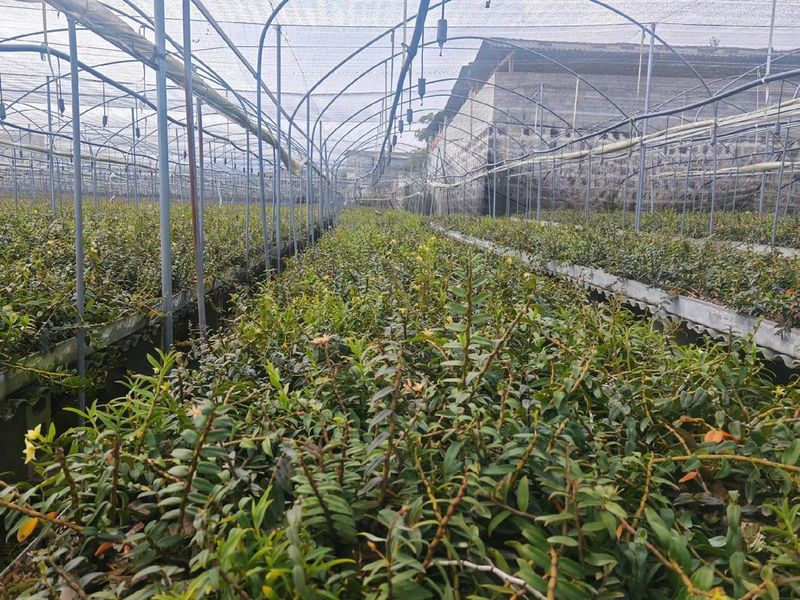
Autumn is an acacia herbs plant, rich in nutrients such as fruit glue, proteins, cellulose, sugary and food fibres, and a high-end vegetable with a health function, with better economic benefits. With yellow
Cultivation and fertilization of acorns has been increasing year by year. Irrigation and fertilization are two important management measures in the autumn cultivation process and are important components of production costs. The scarcity of water resources in hebei province, which is also a major fertilizer-consumption province, and the traditional separation of irrigation and fertilization, not only involve significant labour costs, but also lead to waste of water resources, imbalanced soil nutrients, disruption of micro-ecological balance, and frequent pests and diseases, which adversely affect the growth and development of vegetables。
In response to these problems, the yellow autumn unit of the institute of agroforestry and forestry sciences of shijia has been conducting several years of experiments on integrated water fertilization, which have resulted in the formation of an integrated yellow autumn fertilization technique centred on drip fertilization, with a production of approximately 2,200 kg per acre, with a value of $12,000, representing an increase of $175. 6 per acre over traditional cultivation patterns。
01
Environmental requirements
1. 1 environment of origin
Land should be chosen for deep-seated, loose, fertile, well-lighted, easily drained, and water-preserving soil, with a pre-eminence of a root or leafy dish, and a lack of connection to aish crop such as cotton. The environmental conditions of the place of production should meet the requirements of ny/t 5010-2016 (environmental conditions of the land where agricultural production is not hazardous)。
1. 2 water requirements
Water sources such as clean, non-polluted groundwater, running water, river water, etc。
1. 3 fertilizers
The selection of full-water soluble fertilizers that do not cause drastic changes in the ph value of irrigated water, which is less corrosive, such as fully nutritious water soluble fertilizers in raleigh, united states of america, and so forth. Fertilizer selection shall meet the requirements of ny/t 496-2010 (general guidelines for the rational use of fertilizers) and ny/t 1107-2020 (many elemental water solution fertilizers)。
02
Analysis of the costs and benefits of an integrated water fertilizer system
An integrated water fertilizer system typically costs 2000 to 3,000 dollars per acre. Through a cost-effective accounting of four demonstration hydro-fertilizers in the quarmis area, using integrated management techniques for acreage, an additional 220 kg per acre could be produced throughout the growing season compared with the traditional cultivation model and an additional $1320 per acre; compared to the traditional cultivation model, integrated management techniques could save 120 m3 per acre and 40 kg per acre, at a cost of $155. 6 per acre. In addition, more traditional patterns of cultivation, integrated water fertilizer management techniques have been effective in reducing labour usage, with an average of $500 per acre. In summary, the use of integrated management techniques for the management of acreage fertilizers can increase farmers ' income by $175. 6 per acre over traditional cultivation patterns。
03
Plantation techniques
3. 1 varieties selection
Selecting varieties that are resistant to disease, highly resistant, of high quality, high-yielding, good-commodity, and suited to market demand, such as the autumn 2, topaz, fukushima, etc. Seeds are required to be 95 per cent pure, 97 per cent pure, 85 per cent budding and 8 per cent hydrologic, and quality meets national requirements。
3. 2 fertilization of whole areas
Fertilizer use is performed according to ny/t 496-2010. Prior to planting, 3-4 m3 of manure per acre, 25 kg of compound fertilizer (15-15) and 15 kg of potassium sulfate were distributed. The land is then ploughed to about 30 cm and flatted. Growing in size, 80cm, 40cm. A membrane pump was used once to complete the membrane, drip irrigation and herbicide spraying. For herbicides, 33 per cent of the field is used for cream and 100-120 ml/acre is sprayed after water has been diluted by 30 kg。
3. 3 seed treatment
Seeds need to be immersed in warm soup before sowing, with seeds immersed in hot water at about 55°c from 15 to 20°c and then continued to immerse at about 12°c。
3. 4 seeding
In mid-april, the area of the ishiko estate is normally seeded live, using a 40-cm line and 25-30-cm range on the film, at a depth of 5 cm and 2-3 seeds per cave, with an acre of 0. 8-1. 0 kg。
3. 5 sapling
The first leaf spreads with a seedling, removing the sick, disabled and weak; and the third to the fourth leaf spreads with a sapling in each den。
04
Integrated manure management techniques
4. 1 fertilization system selection
The application system is generally chosen for drip irrigation, the fertilizer in the dunes, the pressure-diffusion jar or the infusion pump, and, where appropriate, the automatic irrigation fertilisation system. The depth, length and size of the irrigation areas of the pipeline system are designed according to basic conditions such as topography, topography, soil cover, planting patterns, water characteristics, etc. Water can be pumped with pressure drip irrigation, gravity drip irrigation, small tube outflows, etc. Quantified fertilization is designed in the field, including the location, capacity, export, fertilization pipes, partition valves, pumps, etc. The fertilization system selection should be consistent with ny/t 2624-2014 (general technical guidelines for the integration of fertilizers)。
4. 2 fertilizer management technologies
4. 2. 1 watering
When seedlings are established, water is watered in a timely manner, and the first flower is properly managed before it opens, in order to prevent it from being extended. The flowering outcome period ensures sufficient moisture, promotes the rapid expansion of nuts, prevents soil overdry, fibrosis of fruit, affects yields and quality, and is followed by the timely discharge of water from fields。
4. 2. 2 following fat
Autumn is long-lived and needs to be fertilized. In order to ensure the nutritional supply of the autumn and to increase production, it is necessary to regularly and repeatedly follow up on the application of base fertilizer. After seeding, a large amount of elemental water soluble 10 kg per acre. Once in the second half of the autumn, 20 kg per acre of high potassium compound fertilizers were applied, followed by two to three times, soluble water from the water soluble composite fertilizers were dissolved in the drums earlier, and the conversion of water and fertilization was completed by regulating the pipe valves. In order to prevent early plant failure and to increase later production throughout the harvest period, boron fertilizers were sprayed on the leaf one per 15d。
4. 2. 3 attention
The application of liquid fertilizers does not require mixing or mixing, and solid fertilizers need to be mixed with water into liquid fertilizers to avoid problems such as deposition. The application should be followed by a drop of 0. 5h clean water and the discharge of all the fertilizers left in the pipes. The key to drip irrigation is containment. Common filters include sandstone separators, media filters, web filters and stack filters. A level-iii filter system is generally used, which is filtered first with a hole diameter of 0. 850 mm stainless steel net, then with a hole diameter of 0. 180 mm and finally with a hole diameter of 0. 125 mm stack filter。
05
Integrated pest management
The main diseases of the autumn are virus, disease, etc., and the pests are mainly ants, aphids, leaf mites, etc. In order to reduce agricultural disability and improve the quality of the acorn, while achieving effective, safe, economic and environmental objectives, the prevention and control of the autumn disease and pests is guided by the “preventive and integrated approach” to plant protection, supported by agricultural, physical and biological control measures。
Agricultural control can reduce the base number of bacteria and insects by choosing resistant varieties, shifting them and keeping the fields clean. Physical control can be induced to kill insects such as palettes, insecticidal lamps, etc. The use of chemical pesticides should be consistent with ny/t 393-2020 (guidelines for the use of green food pesticides). In the early stages of the disease, 20 per cent of the virus can be treated with 400-600 times the humid powder, one spraying every 7-10d and one to two continuous spraying; 72 per cent of the disease can be treated with frost at the early stages the manganese zinc wettable powder 600-800 times liquid spray treatment is administered once every 7-10d and 2-3 times continuously. Forty per cent of thion phorate platters can be used to trap an ant when it occurs; aphids and mites can be treated with 1,000 times the wettable powder of 10 per cent at the beginning of the occurrence, with one application every 7 to 10d and two to three successive sprayings。
06
Collection
At 3-4d after the cut flowers, the nuts grow to 10-15 cm, be careful to harvest with scissors, cut the handles and prevent damage to the branches。
Source: vegetables magazine, 4th issue, "integration of autumn fertilizer technology"