What does that mean
Flyback topology is a common switch-up structure that is usually used for low power applications such as adapters, power converters, etc. It works on the basis of the transformer's stored energy transfer. In the insulation, the input voltage is applied through a switch (usually mosfet) to the primary circuit of the transformer. When the switch device is channeled, the current is increased and the magnetic capacity is stored in the magnet core of the transformer。
When the switch unit was shut down, the energy stored in the magnetic field was released, generating a reverse voltage on the secondary circuit of the transformer. This reverse voltage is associated with the number ratio of the transformer, so that the output voltage can be reconciled. Output voltage is exported to load. Controls the conduct and cut-off of switches to regulate output voltage。
Advantages of counter-empowerment include simplicity, low cost and efficiency. However, there are also a number of disadvantages to insulation, including: the limited scope of regulation of output voltage, which is usually limited by the number of transformer ratios, the fact that the possibilities for high-power applications are not sufficient to meet demand and the need for other expansion structures. Restimulation is a common and effective option in low power, cost-sensitive and simple design applications。
Here's a typical principle of inverse power. Figure
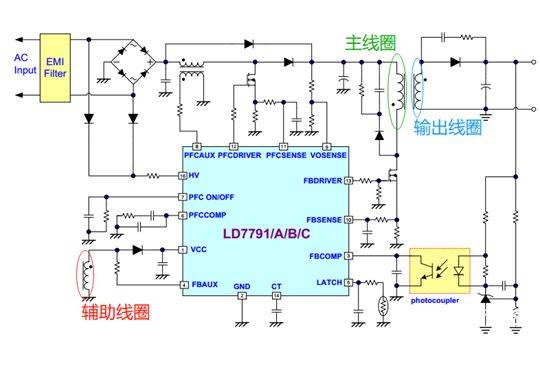
Inverse power sources are the storage of energy in electromagnetic cores before release, with a cycle of energy storage and release (after release for load consumption)。
The transmission and release of the reactionary power source energy is not a synchronized process, but must first store the energy to the sensor when the switch (e. G. Mosfet) is open (the custom is called a transformer) and then release the energy to the load after the switch is off。
How does the inverted power stabilize the output voltage
In terms of ensuring stability of the output voltage, the following measures are usually taken by the reactionary power source:
1. Feedback control: retrogent power sources usually use feedback control circuits to monitor output voltage and adjust the guidance and cut-off times of switches as required. By comparing the difference between the output voltage and the set value, feedback control circuits can generate a control signal to adjust the working state of the switches to stabilize the output voltage near the set value。
2. Voltage adjusters: the voltage adjusters are frequently used in the reactionary power sources to ensure the stability of the output voltage. The voltage regulator may adjust the output voltage to keep it at a predetermined level based on load changes and input voltage fluctuations。
3. Filters: the back-voltage power output end usually deploys filters to reduce the texture and noise in the output voltage. These filters may include components such as capacitors and sensors that smooth the output voltage and improve stability。
4. Protection mechanisms: restimulative power sources may integrate protection mechanisms such as overload protection, overpressure protection and short-circuit protection. These protection mechanisms can be used to disconnect the power output in a timely manner in the event of load abnormalities or other malfunctions in order to prevent damage to the load and the power itself。
Temperature control: the effect of temperature on the output voltage will also be considered in some of the inverse power designs. Monitoring and regulation of the internal temperature of the power source can be achieved by applying temperature sensors and corresponding control circuits to ensure stability of the output voltage at different working temperatures。
Repulsive expansion of working methods
In the inverse expansion, the input voltage is stored in the magnetic field of the transformer, and the energy stored in the switch is released and transferred to the output end to generate the required output voltage. This approach allows for energy conversion on both sides of the transformer, with simple, low-cost and efficient features。
The following are the ways in which anti-smuggling works:
The input voltage is applied through a switch unit (usually mosfet) to the primary circuit of the transformer. When the switch device is channeled, the current is increased and the magnetic capacity is stored in the magnet core of the transformer。
2. When the switch unit was shut down, the energy stored in the magnetic field was released, generating a reverse voltage on the secondary circuit of the transformer. This reverse voltage is associated with the number ratio of the transformer, so that the output voltage can be reconciled。
3. Output voltage is exported to load. Controls the conduct and cut-off of switches to regulate output voltage。
Among the advantages of counter-stimulation are:
- simplicity: restimulation is relatively simple in design and implementation compared to other structures。
- low cost: due to their simplicity, the cost of counter-stimulation is usually low。
- efficiency: restimulation is more efficient in energy conversion, especially for low power applications。
However, there are also a number of shortcomings in the fight against radicalization, including:
- the regulatory scope of the output voltage is limited and is usually limited by the ratio of transformers。
- for high-power applications, the performance of counter-stimulation may be insufficient to meet demand, requiring other extension structures。
In general, counter-strength is a common and effective option in low power, cost-sensitive and simple design applications。