The last issue we talked about the high rail base being a layered “super sandwich”, but it's not enough to lay a direct orbital pillow on the roadbank, and it's going to have to lay a wally rock — that's the roadway. Don't underestimate it. It's a finely chosen “specialty rock” that carries hundreds of tons of heavy iron, waterproofing, deformation, and a “guardian god” between the roads and steel tracks. If the road is not well chosen and paved, even if the road is strong enough, the steel tracks will slip and sink, the high iron will run and the heavy iron will roll and the heavy will be at risk of de-orbiting
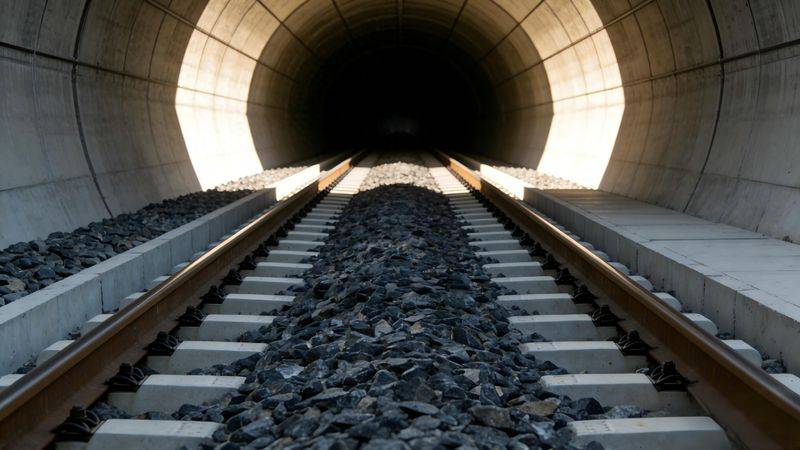
Focus first: high-wielding roadside rock, harder to pick than food
If you pick up a hard stone on a regular railway, you'll have to “twenty-five” and only two types of rock: granite, basalt, or any other rock, or hard, or three at the core
The hardness is hard enough: the resistance strength must be 180 mpa, equal to 1 square centimetre capable of carrying 1,800 kg of weight, with a hammer, leaving only small pits that do not break into slag. If you use soft stones, it'll be powdered several times with heavy iron pressure, and the dowd layer will turn into a “mud”。
Uniform specifications: the diameter must be between 20 and 70 mm, smaller than the fist of an adult, and sifts and stones must be removed. It's too big to fit in orbital pillows, it's too small to drain, it's like building blocks with flat sizes。
Shapes are elastic: they must be irregular "multihedrons" and not round pebbles. The elastic angles keep each other together, like gnawed gears, and it doesn't slide; the pebbles are too slippery, they roll at once, and they don't hold the orbital pillow。
There is an iron rule in the construction team: each batch must be sampled, and if it is not hard enough or well-specified, it must be pulled out of service. On one occasion, a carload of basalt was pulled, and tests found that some of the pristine angles had been rounded, even if only 5 per cent had been returned, resulting in tens of thousands of losses in freight charges alone。
It's not a pile. It's a layer, it's a crush, it's not 2 millimeters
It's not just a rock that goes down on the road, but it's a "fine work" all the way. The steps are better than laying bricks. The core is two steps away
1. A layered, compacted layer shall be divided into two layers, starting with a bottom-lane, 15 centimetres thick, followed by a top-lane, 20 centimetres thick and a total thickness of 35 centimetres. At the end of each layer, 25 tons of heavy-duty rollers are to be used to press over and over again, and the ramps are to be ploughed with a “vibration strangler” so that the rocks are so tightly embedded that there is no gap. It's the key to holding a high iron shock。
2. Accurately flattening, with a greater margin of error than the hair wiring, and with a degree of flatness not exceeding 2 mm, which is higher than the level of the mobile screen. When construction is carried out, lasers are used for real-time testing of the flat machine, and when heights are high, they are removed and refilled wherever low, ensuring that the orbital pillows are steady and fit to keep the steel track at a level. Teacher fu said, "do ping is flat, the road is steady and slow to work."
Special treatment for the bridge section: the tunnel can't be paved, but also “protective clothing”
The road is paved directly by the ordinary roadway, but when it passes through a bridge, through a tunnel, the roadway is specially handled, otherwise it is prone to problems, which many do not know:
On the bridge: the first to lay a “path plume” is to put a circle of concrete around the bridge, to put the plume around it, to prevent the plume from being blown off by a high-speed train, and to prevent the plume from falling down the bridge。
Tunnels: under the tunnel floor, a sheet of waterproof earthworks is laid, the tunnel is easily permeable, the earthworks are able to block the water so as not to allow the surfaces of the water bubbles to remain soft, while at the same time allowing the water to flow out of the tunnel through the cracks, so that it “does not accumulate”。
The "conservation period" of the duo: it's not finished, but it's a regular "check."
The high-wire track, which is not prepared once and for all, also has a “depletion period”, which is usually overhauled in 5-8 years:
- compensation: long periods of heavy iron shocks, some of which can be worn out and lost, and timely additions to new ones
- steaming: the tunnel floor will be slowly relaxed and re-introduced with a hardening machine, so that the stone will be tightened again
- sifting: clean up the debris in the tunnel, clean up the mud, and avoid jamming the water drain。
At the time of the repairs, workers were travelling in a “dove-scaver” and were able to sift only 2 kilometres a day, slowly but carefully, to ensure that the tunnel floor remained at its optimal level。
Small interaction: have you paid attention to the rocks on the high rail track? Did you think it was an ordinary stone? Let's talk about your discovery