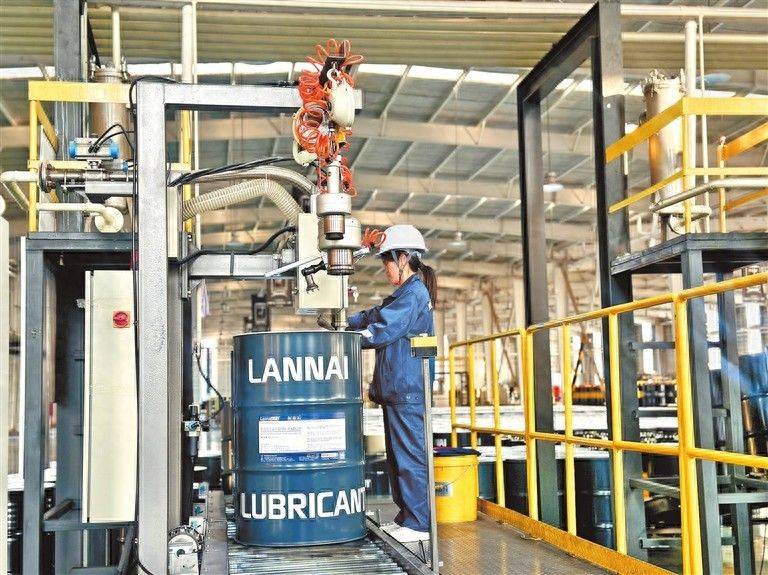
The industrial lubricant oil production line is operating at full speed in the henan blueness technologies ltd. Production workshop. Jiang xiaofang
This newspaper's full of reporters
Industrial lubricant oils have been dubbed “blood flowing in machines”, high-end markets have long been monopolized by international giants, and large domestic firms have been easily deterred from changing their brands because of the huge loss of stoppages. In the tsukura county, a company called blue-stight technologies broke the monopoly by developing its own system of lubricant additives and “breeding hands” with international giants。
On 10 april, he walked into the production workshop of henan blueness technologies ltd. And saw only a row of large oil storage tanks in a row, with cross-cutting pipelines. In the middle control rooms, technicians are focused on the screen, parameters are jumpin' in real time, from base oil ratio to additive input, each chain is controlled, and smart control systems ensure that each barrel of industrial lubricating oil is accurate。
“our smart industrial lubricating oil storage centres combine the internationally leading dcs control systems with plc to increase the precision of the formula, reduce process errors and ensure the uniformity and stability of products.” zhang zhang zhang, the general manager of the company, informed journalists that the workshop had 10 of the country's advanced plc fully self-filled production lines, with products including eight major series of industrial oils, oil for ships, special lubricants and lubricants, over 150 varieties and over 300 models, of which more than 30 high-quality products filled the national gap。
However, the breakthrough in blue-resistant technology is not an instant. In 2015, the area of conventional industrial lubricating oils had become a red sea, with low-end markets caught in a devastating price war and profit space being reduced. In the face of the difficulties, 24 years of conventional industrial lubricant production experience had been successful in setting up a blue-resistant technology in the county and deciding to focus on the high-end industrial lubricant sector. But it is not easy to divide the “cake” — the high-end industrial lubricant market has long been dominated by foreign brands and high technical barriers. Blue-resistant technology is determined to rely on technology for a breakthrough。
Industrial lubricant needs to operate for thousands of, if not tens of thousands of hours under extreme conditions of high temperature, pressure and load simultaneously to provide for lubrication, cooling, rustproofing, cleaning, sealing and buffering functions. The hot-rolling production line of a large steel plant, once shut down by the failure of lubricating oil, lost millions of dollars per hour. “many enterprises are afraid to easily replace their lubricant suppliers because they cannot afford to gamble.” zhang zhang zhang zhang zhang zhang said that blue-doing technology was about making customers “can afford to gamble”。
At the r & d centre for blue-resistant technology, dozens of reagent bottles were placed in full code, each of which corresponded to a well-organized set of additive formulations. “the core technology for lubricating oil is the additive. The difference of 0. 1% is likely to vary from one another.” the r & d team leader, yande, recalled that the team had taken five months to capture a gas oil formulation and had conducted hundreds of experiments to analyze each of its properties, such as antioxidation, foam resistance, emulsion and fluid erosion。
"on one occasion we felt that it had worked, and as a result, the corrosive properties of the liquid began to decay in a stand test. We'll have to push it back and look at the mix of additives one by one." yangde told journalists that, in the end, the product had been successfully introduced and that it had been imported at 70 per cent of the price。
The technology's broken. How do we get clients to use it? The choice of lubricants by large industrial enterprises is extremely conservative, and blue-resistant technology begins with clients who have established long-term stable partnerships in the field of conventional industrial lubricants. In 2019, the coronese group was preparing to replace engine lubricant, and blue-resistant technology was one of the candidates. Rather than rushing to market, the company's team first gained insight into the performance of the client's equipment and provided customized programmes. This was followed by a months-long on-site application experiment, where technicians were stationed on a 24-hour basis and promised to pay in full if machine failure resulted from the use of blue-resistant lubricants。
After more than a year of “testing”, blue-resistant products have reached or even exceeded imported brands on core indicators such as oxidation resistance, wear resistance and oil change cycles, and blue-resistant technologies have successfully placed orders. From this single point of departure, blue-resistant technology continues to penetrate the supply chain of large steel and chemical enterprises. As markets gradually opened up, companies took another important step — making industrial lubricant for their clients。
The same equipment requires different indicators of lubricant resistance to oxidation, grinding and viscerality in different conditions. In order to serve clients more precisely, the technical team went into the production line and detailed key information on the operation of the equipment, load characteristics, ambient temperature, etc., on the basis of which the formulation was readjusted over time to “specify” the enterprise。
“breaking a monopoly is only the first step.” zhang zhang zhang kung indicated that the national industrial lubricant was to be prepared ahead of schedule on new tracks such as special lubrication, green environment etc. Currently, blue-resistant technologies are targeting areas such as degradable lubricants, moving towards greening and sustainable development。