Medical information engineering
Professional profile

Professional introduction
Medical information engineering is an emerging and integrated multidisciplinary cross-cutting and integrated discipline, dominated by information and life sciences; it is the application and integration of electronics, computers, communications, smart instruments, sensory testing, medical instruments and biology, modern medicine, etc. In life sciences. Development of specialized, practical, knowledge-based and integrated applications for the collection, transmission, processing, analysis, storage and development of new biomedical electronics and information devices。
Aiming
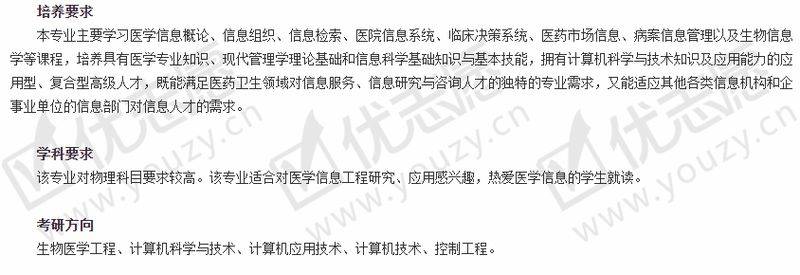
The medical information engineering profession develops engineering skills in the fields of moral, intellectual, physical and general development, basic knowledge of computer science and technology and medicine, basic theoretical and basic skills, basic capabilities in the use of information technology for medical research, and software engineering skills capable of developing, maintaining and evaluating information systems in the field of medicine。
Main courses
Circuits, analogue electronics, digital electronics, digital signal processing, data structure, operating systems, micromechanical principles and applications, bioanalyses, medical information, medical sensor testing, medical instruments, medical signals and images, biological systems and modelling, multimedia technology, system analysis and design, computer algorithms, artificial intelligence and applications。
Employment orientation
There are good prospects for employment in the medical information engineering profession, where graduates can work in various applications, design, development, maintenance and evaluation of information systems and computer software systems in the health sector, medical equipment design and production sectors and other enterprises, as well as in medical research and teaching at medical research institutions and institutions of higher learning. Graduates are mainly in research institutes in the fields of electronic and medical information, medical health units, biomedicine electronic information enterprises, scientific research, development, applied design manufacturing and equipment management and marketing, as well as in high-technology enterprises in the fields of biomedical information engineering, the development of medical instruments and equipment, as well as in other high-technology enterprises in the fields of electronics, computers, information, biology, higher education institutions, scientific research units, commercial inspection, etc. The profession is suitable for advanced studies。
Employment prospects
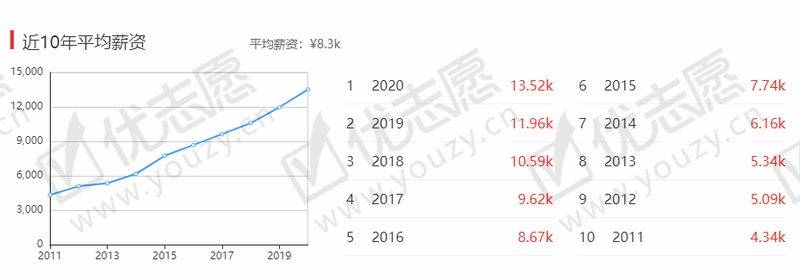
Main occupations, industries, employment areas
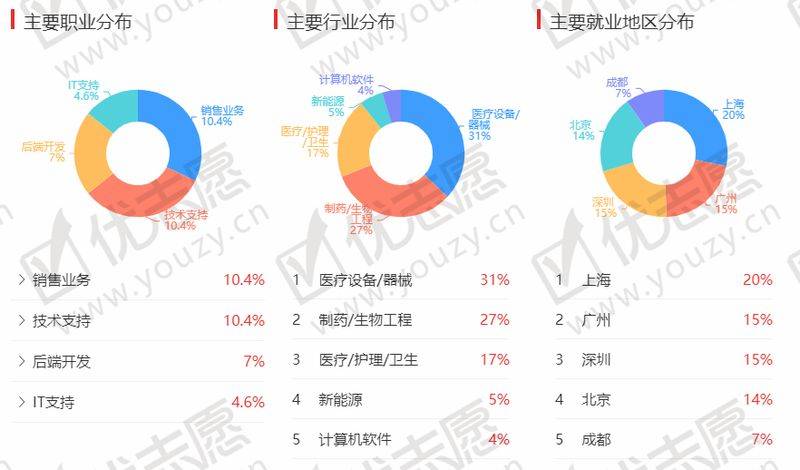
The above data are taken from the china education online (gkxx. Eol. Cn) for information purposes only。
Knowledge capacity
1. Broader basic engineering and general medical knowledge
2. Basic theory, basic knowledge and basic operational skills in electronics, computer science and hardware
3. Basic theory, basic knowledge and basic skills in medical video equipment and technology
4. Acquiring skills in the collection, analysis and processing of biomedical information and initial capabilities for medical information gathering and processing research
5. Proficiency in the application, maintenance and management of other medical instruments in the application, maintenance and management of medical imaging equipment
6. Knowledge of various imaging diagnostic techniques, such as radiodiagnostics, ultrasound diagnostics, nuclide diagnostics, for disease diagnosis and basic theories, methods and techniques。