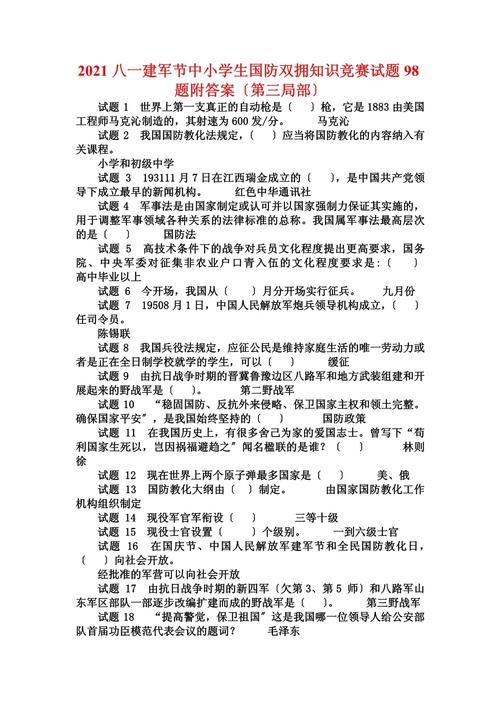
1. The length of our land boundary line is () a. About 18,000 km b. About 22,000 km c. About 28,000 km d. About 32,000 km answer: b resolve: our land boundary line is about 22,000 km and our coastline is about 18,000 km. 2. Which of the following states is not our land neighbour (). A. B. B. Thailand, c. India, d. Mongolia's answer: b. Analysis: thailand does not border with my country, and russia, india and mongolia are our land neighbours. 3. The chinese people's liberation army navy was established. A. Answer dated 23 april 1949 from b. C. Of 1 october 1949 and d. Of 5 september 1954: a resolution: on 23 april 1949, the chinese people's liberation army navy was inaugurated at the white horse temple in jiangsutai county. 4. Our first carrier is (). A. Answers from b. Shandong, c. Fu, d. Guangdong: a: the liaoning is our first carrier, the shandong is our first national carrier, and the fujian is our first carrier, a fully autonomous carrier. The following types of missiles are our own anti-aircraft missiles. A. The answer to the red flag of 21db. Red flag 9c. Eagle with 18d. Long sword10: b is the interpretation: red flag 9 is an anti-aircraft missile developed by our country; east wind 21d is an anti-ship ballistic missile; eagle with 18 is an anti-ship missile; and long sword 10 is a cruise missile. 6. The duration of service of our compulsory military service is (). A. 1 year b. 2 year c. 3 year d. 4 answer: b analysis: our compulsory military service is 2 years old. The first mine inventor in the world is (). A. The answer to b. Yue fei c. Cheng is: a: the first mines in the world were invented in the anti-fouling operation. 8. The main subject of defence mobilization is usually (). A. Army b. Government c. Political party d. Social groups answer: b analysis: the main subject of defence mobilization is usually the government, which organizes and implements defence mobilization through administrative means. Our national defence education day is observed in september of each year. A. First saturday b. Second saturday c. Third saturday d. Fourth saturday answer: c: our national defence education day is the third saturday of september each year. 10. The following are not part of our ancient military books. A. The sun tzu law b. The qimin order c. The six-year-old d. The answer is: " the qimin order " , a comprehensive agronomy book, and the sun tzu law " the six-year-old zi nii " the zimin army book " . 11. The chinese people's liberation army (cpla) rocket army was formally established. A. Answer dated 1 february 2016, dated 1 february 2016, from b., dated 31 december 2015 and from c., dated 1 february 2016, from d., dated 1 march 2016: a resolution: on 31 december 2015, the rpg of the people's liberation army of china was officially established. The great wall, the representative of our ancient border construction, was built. A. Answers from b. Qin to c. Han to d. Tang dynasty during the state of war: a: the great wall was built during the war against the country and was extensively repaired and connected by the qin dynasty. 13. The defence type of our country belongs to (). A. Extension b. Alliance c. Self-defence d. Neutral answer: c. Analysis: our country maintains an independent and peaceful foreign policy, and the type of defence is self-defence. The following weapons are not nuclear weapons. A. Answers to atomic bomb b. Hydrogen bomb c. D. The atomic bombs, hydrogen bombs, and medium bombs are all nuclear weapons, and cruise missiles are missiles that rely on the thrust of jet engines and the aerodynamics of their wings, mainly travelling in dense atmospheres. In modern warfare, what is called the “god of war” is (). A. Response of infantry b. Gunner c. Armoured d. Marines: b analysis: artillery with a strong firepower in modern warfare, capable of causing extensive injury and destruction to the enemy, is dubbed the “god of war”. 16. The symbol of our ancient military maturity is (...). A. The answer to the question of the sun zhu act: " the sun zheng war act " , by the name of b. Of the military policy " , the sun zhu law, is: " the sun zzu law is a sign of the maturity of our ancient military thinking, and it is a systematic elaboration of various aspects of military strategy and tactics. The “tripleization” of construction by the chinese people's liberation army means (). Revolutionary, modern, formalized b. Revolution, rejuvenation, intellectual c. Modernization, rejuvenation, specialization d. Modernization, regularization and specialization: analysis a: the “tripleization” of the people's liberation army of china refers to revolutionization, modernization and regularization. 18. Our maritime territory is approximately () 10,000 square kilometres. A. 200b. 300c. 400d. 500 answer: b resolution: our maritime area is about 3 million square kilometres. 19. Which of the following battles is the largest of the chinese army active against the japanese army during the japanese war (). A. Answers to the call for battles: c. Analysis: the centrist war was the largest battle of the chinese army during the japanese war against the japanese army. The first victory of the chinese army since the national resistance was carried out by the chinese army; the battle of tai jia hak was the biggest victory in china's front war since the fighting; and the war of the chinese army shattered japan's pretentious attempt to “destroy china for three months.” 20. Under our national defence law, the armed forces of the people's republic of china belong (). A. Party b. Government c. People's d. National answer: c. Analysis: our national defence law stipulates that the armed forces of the people's republic of china belong to the people. Ii. Multiple choices (3 points each, 30 points) 1. The basic elements of national defence include () the main subject of national defence, b., is the subject of national defence. 2. The following are among the achievements in defence construction in our country (). The chinese people's liberation army has made a breakthrough in the modernization, regularization and revolutionary construction of its armed forces, b. The chinese people's liberation army, c. Has developed a comprehensive and integrated national defence science and technology industrial system, d. The defence reserve has developed a great deal: abcd has been deciphered: the above options represent the achievements of our national defence. 3. The basic characteristics of an information war are () a. Information resources dominate c. Multi-dimensional d. Pacing answers to c. Operational space: abcd analysis: the basic characteristics of an information-based war with information resources, the informationization of weapons equipment, the multidimensionalization of operational space, the rapidisation of operational rhythms, the integration of operational elements, the flat levelling of operational command and the precision of operational operations. 4. The following belong to the ranks of our army: a. Infantry b. Artillery c. Army air force answer: abcd analysis: our army corps includes infantry, artillery, armoured personnel, army aviation, engineers, communications, chemical protection, etc. The main elements of defence mobilization include (...). A. The armed forces mobilize b. National economy, c. People's air defence, d. Transportation readiness, answer: abcd analysis: the main elements of defence mobilization include armed forces mobilization, national economy mobilization, people's air defence, transport preparedness, etc. 6. The following is the correct version of our ancient military doctrine (). Our ancient military thought, which first appeared during the period of slavery, was an outstanding representative of our ancient military thought, c. Our ancient military thought, which emphasized “war by war”, “war by war” and d. Our ancient military thought had no answer to modern military doctrine: abc analysis: my country's ancient military ideology was first found in the slave society, and the grandkids' military ideology was an outstanding representative, emphasizing such things as “no-war war” and “no-war-for-war soldiers”. Our ancient military doctrine has important implications for modern military doctrines, and many concepts and principles are still being applied. 7. The following belong to our naval fleet () a. Answer of the north sea fleet b. East sea fleet c. South sea fleet d. West sea fleet: abc analysis: our navy has the north sea fleet, the east sea fleet and the south sea fleet. 8. In modern warfare, the techniques of surveillance and surveillance are common (). A. Radar reconnaissance b. Photo-radio reconnaissance c. Acoustic reconnaissance d. Network reconnaissance answers: abcd analysis: the technical means of surveillance and surveillance that are common in modern warfare include radar reconnaissance, optical surveillance, acoustic reconnaissance, network surveillance, etc. 9. The following are among the national defence legislation of our country (). A. Answers to the law of the people's republic of china on the protection of military facilities: the defence law of the people's republic of china, the law of the people's republic of china on military service, c. The law of the people's republic of china on defence education, d. The law of the people's republic of china on the protection of military facilities: the defence law of the people's republic of china, the law of the people's republic of china on military service education, and the law of the people's republic of china on the protection of military facilities, are all part of our national defence legislation. 10. Our nuclear policy includes (...)。a. No-first-use of nuclear weapons b. No-use of nuclear weapons against non-nuclear-weapon states c. Development of nuclear weapons only in self-defence d. Advocates the answer to the total prohibition and total elimination of nuclear weapons: abcd explains that our nuclear policy includes no-first-use of nuclear weapons, no-use of nuclear weapons against non-nuclear-weapon states, development of nuclear weapons only in self-defence, and the total prohibition and total elimination of nuclear weapons. 1. National defence is the defence of the state. It refers to military activities carried out by the state to prevent and resist aggression, to deter armed subversion and to defend the sovereignty, unity, territorial integrity and security of the state, as well as to military-related political, economic, diplomatic, scientific and technical, educational activities. Answer: correct interpretation: this is the basic definition of national defence. 2. Our armed forces are composed of active and reserve forces of the chinese people's liberation army and the chinese people's armed police force. () answer: misdialysis: our armed forces consist of active and reserve forces of the chinese people's liberation army, the chinese people's armed police force and militias. 3. In the information war, the right to information became the focus of competition between the two sides. () answer: correct resolution: access, transmission and use of information is crucial in the context of the information war, and the right to make information is the focus of competition between the two sides. 4. The oldest and largest construction time for our ancient defence works was in the city. () answer: correct analysis: in the construction of our ancient defence works, the construction of urban pools is long and numerous. 5. Upon discharge from active service, state civil servants, institutions of higher learning and specialized secondary schools are given preferential treatment in accordance with the relevant provisions. () answer: correct analysis: this is one of our policy of preferential treatment for conscripts after their retirement. 6. In modern warfare, precision-guided weapons have a hit rate of over 80 per cent. () answer: correct resolution: accurately guided weapons have a high hit-point accuracy with a hit rate of over 80 per cent. 7. Our approach to defence education is participatory, sustained and effective. Answer: correct analysis: this is the course of our defence education. 8. The army of the chinese people's liberation army is the main arm of our armed forces and is primarily responsible for land combat tasks. () answer: correct analysis: the army is the main arm of our armed forces and has a land combat mandate. 9. We have a system of military service that combines conscripts with volunteers, militia with reserves. Answer: correct analysis: this is the military service system in force in the country. 10. Defence mobilization can be divided into total and partial mobilization, depending on the scale of mobilization. Answer: correct analysis: defence mobilization is divided into total and local mobilization by scale of mobilization. Iv. Brief answers (10 points per question, 20 points) 1. A brief introduction to the history of our defence. Answer: (1) economic development is a strong foundation for national defence. The economy is the material basis of national defence, which is strongly dependent on economic development. Only a prosperous national economy can provide adequate financing and material security for defence construction. For example, during the tang dynasty, the economy flourished, the state had sufficient resources to develop its military force and its defence was stronger. (2) political clarity is fundamental to the consolidation of national defence. Politics is closely linked to national defence, whose consolidation is essential. The state's political system, policy guidelines, etc., have a direct impact on defence construction. As in the time of the spring and fall wars, the qin state was transformed through commercial changes, its political system was reformed, the country became stronger and eventually it was reunited. (3) the unity of the state and the unity of the nation are key to the strength of defence. The unity of the country and its national unity will allow for strong cohesion and commitment, as well as a common defence against foreign incursions. During the war against japan, for example, the formation of a national unity front enabled the chinese people to unite and win the battle. (4) scientific and technological progress is an important guarantee of strong national defence. Science and technology play a crucial role in the construction of national defence, and advanced science and technology can enhance the performance of weapons equipment and the combat power of the military. In modern warfare, for example, applications of information technology, space technology, etc. Have changed the pattern of war and the way in which it is fought. 2. Briefly describe the requirements of the information war for the construction of national defence. Answer: (1) the idea of an information war for national defence. It is necessary to fully understand the characteristics and patterns of information warfare, to update traditional concepts of national defence, and to develop new ones that are compatible with information war, such as the concept of information winning, the concept of systemic confrontation, etc. (2) increased development of information-based military skills. An informed war requires a large number of high-quality military personnel, including information technology and command. There are a number of ways to train military personnel to adapt to the information war and to improve the information literacy of military personnel. (3) strengthening the information army. To speed up the army