Http redirect load balance
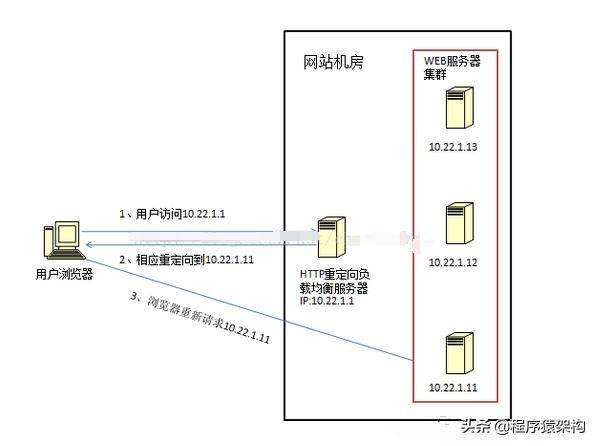
This load equilibrium only suits the web server。
When the user makes a request, the load balance server recalculates the actual web server address in response to the http request and sends it to the user browser through a 302 re-directional response. The user browser then requests the actual web server based on 302 responses。
Http has the advantage of being simpler, with the disadvantage that performance is poor, that two requests are required to return the actual result, and that only http servers are suitable. Redirected servers are also prone to single point failure。
Dns domain name resolution load balance
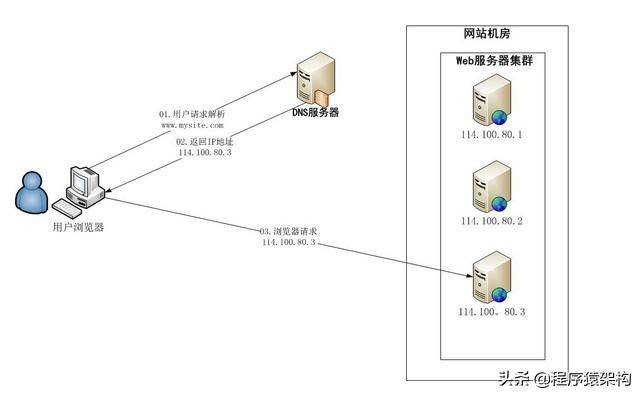
Multiple host addresses of a domain name are stored in dns, and each domain description request returns a different ip address based on a load equilibrium algorithm. Such multiple web servers form a cluster and the dns servers provide load equilibrium services。
The advantage of dns domain-based load balance resolution is that dns do the load balance work and the service itself does not maintain the load balance server。
The disadvantage is also that changes to the server are difficult to reflect in a timely manner because the load balance server is not self-maintained and cannot be carefully controlled, and because the dns often has caches on the client side。
Reverse proxy load balance
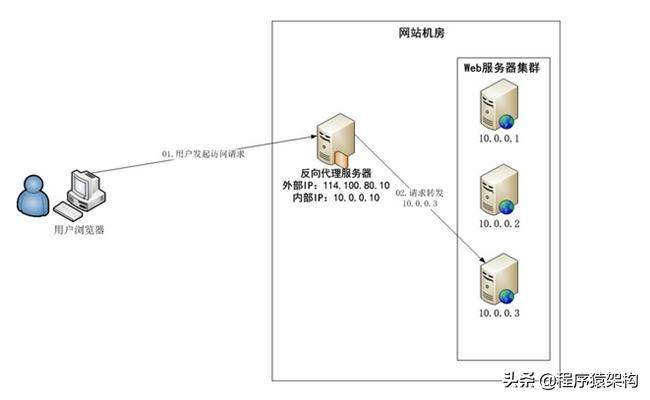
The reverse proxy server was located before the actual server, and he was able to cache the server to respond and speed up access, while at the same time triggering the effects of the load equilibrium server. Reverse proxy decrypts the client request and forwards it to different back-office servers based on a load equilibrium algorithm. There are no direct links between users and back-office servers. Requests, responses are forwarded by a reverse proxy server。
The advantage is that it is integrated with load-balanced services and that it is simple to deploy。
The disadvantage is that all requests and responses require a reverse proxy server. It may itself become a performance bottleneck. The well-known nginx server can be deployed as a reverse proxy server to balance the load of web applications。
The three above are application layers working in the osi network model, which we can call the application layer load balance (seven layers load balance). The solutions described below are also more generic in terms of four layers and below of the osi network model (four layers of load balance)。
Ip load balance
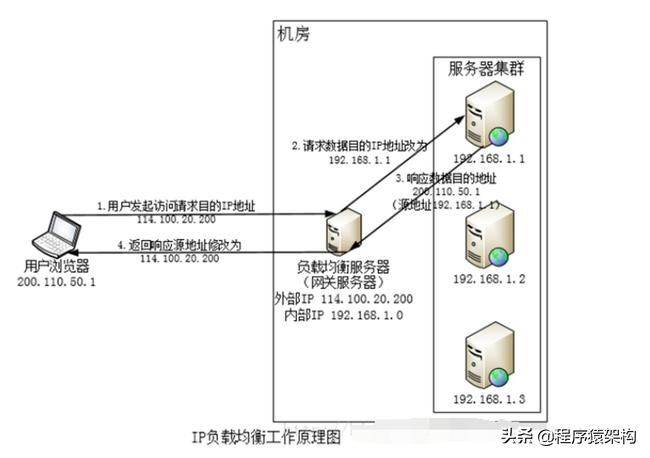
After the user requested the package to reach the load balance server 114. 100. 20. 200, the load balance server obtained the network data package on the nuclear level within the operating system, obtained the real back server address under the load balance algorithm 192. 168. 1. 1, and then changed the target address of the package to 192. 168. 1. 1, which was forwarded to the internal server. The entire process is being handled in the kernel. Upon receipt of the response package, the src ip of the response package is changed and forwarded to the client。
Using the ip layer load equilibrium algorithm, the entire processing process is carried out in the inner kernel (ring0). It has better performance than the seven layer load balance. However, as all response packages pass through the load-balanced server, the bandwidth of the load-balanced server, which can easily become a bottleneck for the system, greatly enhances the service capacity of the whole load-balanced server if the response package is not passed through the load-balanced server. This is the capability of the data chain layer load balance that we are presenting below。
Data chain layer load balance
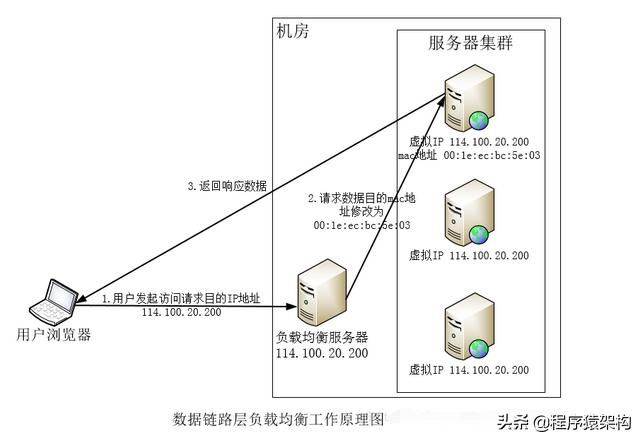
The load balance of the data chain layer is by definition the load balance that works at the bottom of the tcp/ip protocol. In the ethernet, which we often use, communication takes place mainly at this level using data frames, each of which has a unique mac address, which identifies the source and destination of the data。