The cultural revolution's flag-bearers are known for their scolding, whoever they may be, and the cultural celebrities of the nation's time are almost all the same: among those who are scolded, there are those who turn their backs on each other and those who turn their backs on them, and those who turn their backs and never respond to them。
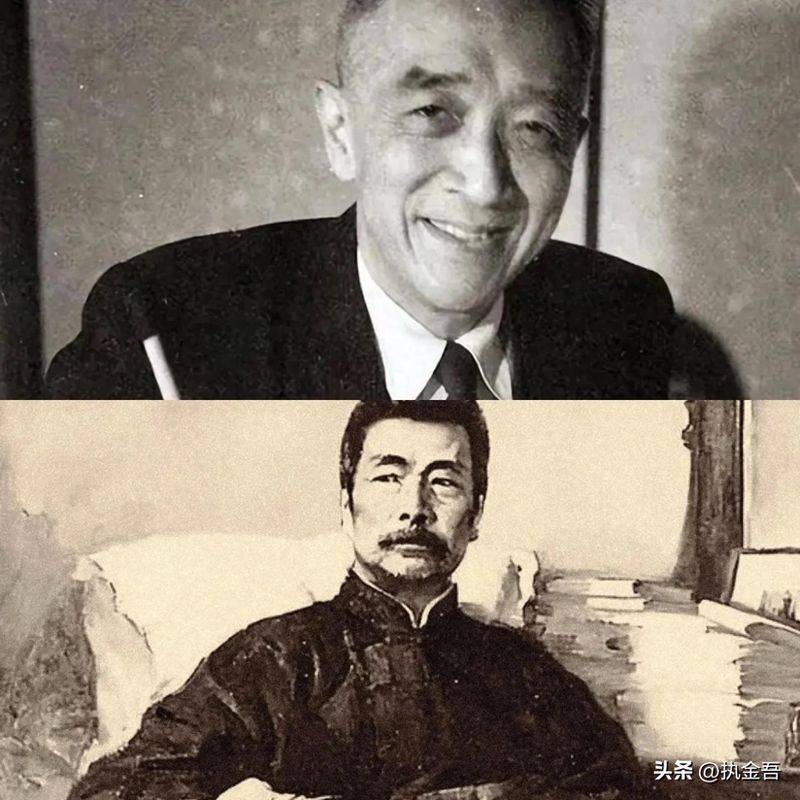
From the mid-1920s to the 1930s, lu xuan repeatedly criticized hu chiu's “good governmentism” and attitude towards japanese aggression, under the guise of “doctor” “new moon” or directly by name. Hu chi, while occasionally expressing his discomfort in his diary or in his private correspondence, rarely responded positively in public。
This is not because of fear, but because of the fundamental difference between the two identities, the philosophy of the conduct and the cultural position。
I. Differing identity: fighters and mentors
• roh-sun considered himself a fighter “showing in the wilderness”, whose grotesque is “the dagger and the shooting”, whose main function is to criticize. He did not like the reformism of seeking “good government” on the margins of the warlord's government, and thought that talking about “human improvement” in the “unhuman age” was almost corrupt. For him, cursing was a “wind of mind” and was intended to draw a line from the “new moon”。
• hu chi sees himself as a “national mentor” and a “social doctor”. His style was “more study of issues, less activism”, with an emphasis on building and tolerance. In his view, the public verbal abuse was unorthodox and not conducive to the “public reason” atmosphere he advocated. He prefers to “stand” by writing articles, conducting education, and doing research, rather than entangling in newspapers。
Ii. Philosophy of practice: evolution and experimentalism
• hu ji believes in dewey's experimentalism and believes that any theory needs to look at its “effects”. He is well aware that lu xuan’s words are so powerful that, if he responds publicly, he will only escalate the debate into an endless “humanist light” that will not help to resolve the real problems that china was facing at the time (such as china-japan relations, education spending, constitutional construction). He has said that “tolerance is more important than freedom”, and even to critics, he tends to maintain his appearance。
• luthor is closer to the “judiciary philosophy of struggle” from the perspective of evolution, who believes that tolerance only condones the spread of evil. His criticism of huixiang was in fact mixed with disappointment at the latter's wavering position in the “female masters” “thirty one and eight” case, as well as anger at huxi's “dominant and” tendencies in the face of japanese aggression in the 1930s。
Iii. Differing political attitudes
By the 1930s, the political divide was clear:
• in the left-wing coalition, rush was firmly critical of the nationalist party government, considering it as a “high-profile liberal” within the system, which objectively played a “funner”。
• hu chi tried to take the “third path” between the national party dictatorship and the left-wing revolution in the hope of promoting enlightened government through persuasion and participation。
This fundamental line of disagreement dictates that lu xuan must take a position by “scolding”, while hu jian believes that differences are more of a business than each other。
Hu chi's “no response” has deeper strategies
Hu chi doesn't care at all. In a diary in 1934, he wrote: “the zhou and the luxhu brothers are all without political opinion. Their thoughts are just three words of "not cooperating." he recognized lu xian's literary talent in private, but did not take it personally。
There are three reasons why he did not respond publicly:
(a) the fowl of love: the public image of him as a “scientific leader” would be undermined if he were publicly verbalized and whether he lost or lost。
Protecting oneself: lu xian was backed by a left-wing cultural community, and lu xian was seen by some forces as “cracking in the eyes” and was reluctant to get involved in unnecessary political vortex。
Ignoring at all: in hu chi's view, lu xuan is a “literate man” and he himself is a “politician” and a “ideologue”. He believed in the judgment of history, not in the swiftness of words。
V. Personal context and cultural context
As the leader of the cultural revolution, the literary and cultural contributions of lu xuan are unquestionable, but with long-standing critical writings, the cynicism and cynicism have developed, with no room for differences of opinion from one's own, and some bitterness and small family。
As a model of chinese intellectuals, hu zhi has shown elegance and extraordinaryness, and has quickly succeeded in personal upbringing。
An interesting detail:
After lu xian's death, hu xian, instead of “failed under the rock”, came out to help contact the business printing house and led to the publication of the entire collection, when xu guangping was in danger of being published. When lu xian was attacked, hu xian also said: “ru xian is a great writer, and his novels and essays are well written. "i'm sorry。
There is also the argument that most radicals who came back from japan from the time of the nation are advocating a violent revolution, while those from europe and the united states are mostly “moderates” who are advocating incremental improvements that may be in the broader context of the different personalities of ruthel and huji。
Hu chi's “no response” does not stem from fear, but from identity-based “downside inclusion” — he has positioned himself at a higher level of institution-building and is reluctant to enter a paper ink with a “professional critic”。
In conclusion, lu was quick to say that he saw the latter's sense of weakness in the face of a cruel reality; he did not respond because he had always believed in the value of “tolerance” and “building” and that the scolding of “cleavers, guns and guns” made no sense to his country。
Neither of them has ever had a real “reconciliation” in their lives, but the tolerance and pragmatism shown by hu xian after roh-hyun, perhaps more profoundly than any verbal response to his interrogation that year。