Topic: wisdom square: a simple periodic problem
Type
New
Teaching objectives:
1. Through a process of autonomous exploration and cooperative exchange, different strategies to solve problems by counting, drawing and counting。
2. The pattern of the cycle is understood by means of observation, comparison, etc., taking into account specific circumstances, and the pattern of the cycle is used to solve problems。
3. In exploring patterns, understand the connection between mathematics and life, and the beauty of the cycle of life。
It's hard to teach
1. Identify patterns of simple cycles and solve problems。
Identification of several objects as a group and how the remaining number can be used to resolve the problem。
Preschool preparation:
Multimedia package; exercise paper。
Course schedule:
1 hour
Teaching process: teacher and student activities
I. Game fun, sense patterns
(i) introduction of norms
1. Men and women compete more than anyone remembers。
First round: male: 3752 female: 2573; second round: male: 8051627305829 female: 257325732573。
Boys shouted unfairly, saying that the figures recorded by girls were regular。
2. In-depth thinking
Teacher: what is the pattern of the number of girls。
(ii) perceptions
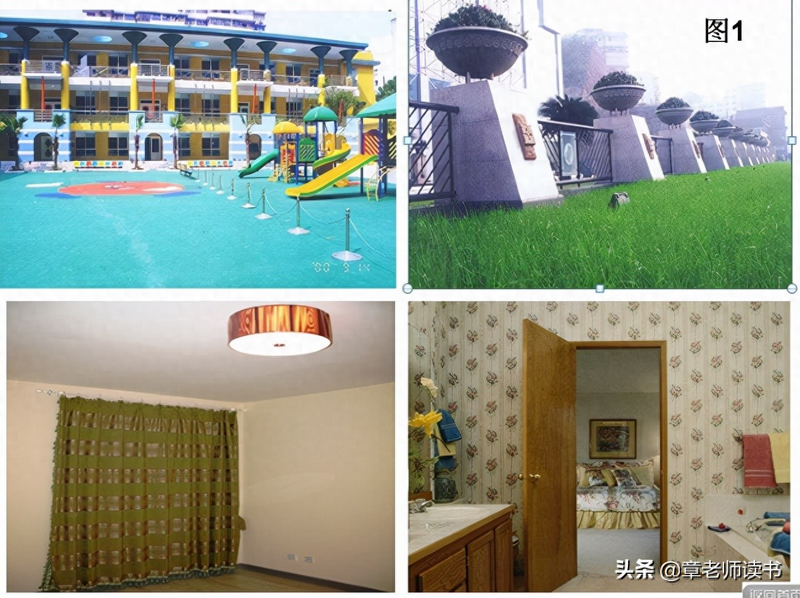
1. What are the following groups of graphics (see figure 1) that present a cyclical pattern? Is it a periodic pattern
2. What are the cycles in everyday life
"the first hammer of the class is to hit the mind of the students, the sparks that inspire them or the magnets that attract them." the game is an activity that students like, through which they are motivated by their desire to participate, their agility and speed, while at the same time giving them an initial sense of the meaning of the “normal” order。
Ii. The application of rules and the question
(i) explore the issue of small flags and understand a variety of problem-solving strategies
1. Situational import
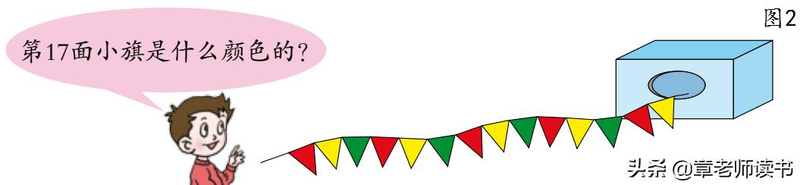
Student: students see pictures (see figure 2), what kind of mathematical information do you know
Preset: small flags of red, yellow and green are regularly arranged。
Division: in such a short period of time, you know the cycle and find their sequencing. So, do you want to study these patterns further? What color is the 17th little flag
2. What color is the 17th flag for students to explore and think independently
3. Teachers visit to collect representative problem-solving strategies to prepare exchanges。
4. Collective exchanges to summarize the pattern of small flags。
Pre-set 1: count: draw 17 circles representing 17 small flags, followed by the number in the order of red and yellow。
Preset 2: draw a picture of 17 vertical lines representing 17 small flags, then divide three into groups, with two remaining, the first red and the second yellow。
Teachers guide students to observe and think: why group three? The pattern of finding small flags exists。
Preset 3: count: 17 ÷3 = 5 (group) 2 sides, the second side of each group is yellow, so the 17th side is yellow。
Teachers guide students to think and understand the meaning of arithmetic in the context of the situation。
[design intent] allows students to look closely at the maps and to solve problems with different strategies, thus discovering that the flags are placed in a certain order, thereby informing students about the pattern. Students think about it in their observations, in their operations, and the mobility of a variety of senses can deepen their understanding of knowledge。
(ii) internalization of the methodology in the context of the flag issue。
1. What colour is the 22nd and 27th flags using the methods just studied
2. Answer: what is the colour of the 7th, 9th and 11th small flags
3. Combining the figure: what is the colour of the flag when the remaining number is one? Why? What color is the last two? Why? What color is the flag when there's no balance? Why
Student exchange (for a presentation, see figure 3)。
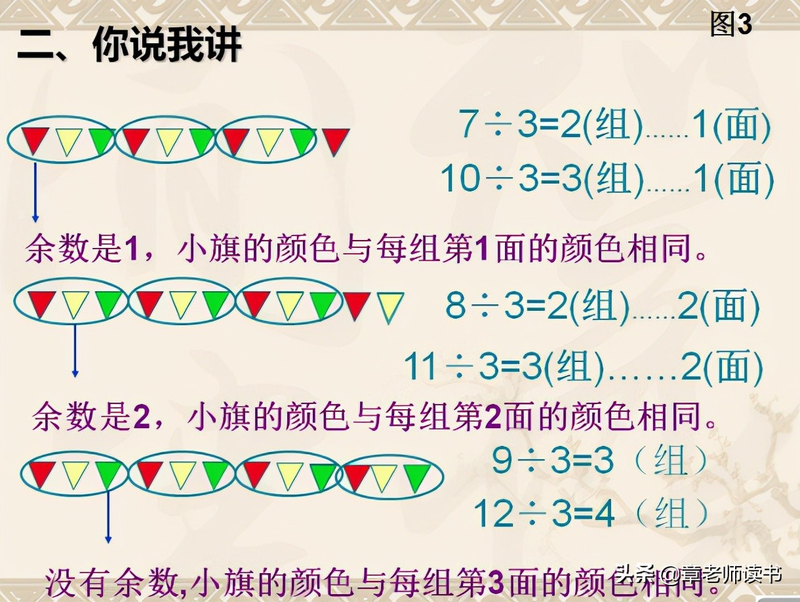
4. Teacher-student co-summation: to see the pattern of the order of things and to ascertain that several objects are a group, thus determining the division and recalculating the calculation. The remaining number is a few, the color of the object is the same as the first in each group, and the colour of the object is the same as the last in each group。
The digital combination of [design intent] enriches students' sense of perception, creates an effective picture of the relationship between the remaining number and the small flag colour of the student, gives students a deeper understanding of the meaning of the rule, and allows students to look for patterns and experience more of the norm。
Iii. Solving problems and understanding patterns
1. What is the 24th figure (see figure 4)
Students calculate the results according to the pattern, and then judge what the graphics are。
2. On the occasion of the children's day, first class students in the second grade held a chess game in which fan and xiaobai played chess, and the game was played using chess, which is part of a graphic set by fan and xiaobai respectively。
Fan: ..
Small: ..
(1) help fan to move on
(2) is the 45th molecule in fan's hands white or black
(3) what color is the sixth molecule that sails? What do you think
Today is tuesday, 14 march. Do you know which day of the month is tuesday
The design layers of [design intent] practice are progressive, “helping fan to keep going” and consolidating knowledge of the law through visual operations, “is the 45th molecule in the hands of a man white or black?” from concrete to abstract, improving understanding of the law in thinking. "what's the colour of the sixth molecule in the sky? What do you think?" in the exchange, you're thinking about patterns. Tuesday, 14 march, and it is assumed which day of the month is tuesday? This practice, which is derived from real life, stimulates both the interest of students to explore and the value of learning mathematics。
Iv. School summits, response
It seems that patterns are everywhere in our lives, and as long as we look at life, we find math around us。
[design intent] uses the law to solve problems in life, to develop students' awareness of the application, and to reflect the idea of a new subject, “mathematics in life, useful mathematics”。
Second class
Operational design:
Practice: on thursday, 1 january 2017, can you try to create a calendar for january 2017
Board design:
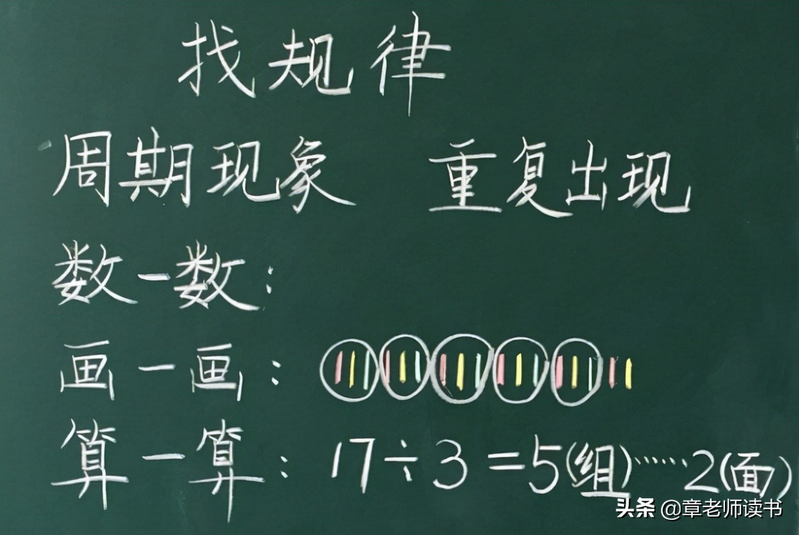
Teaching reflection: