A friend told me today that his company just needed a speed limit network to get a card, open a picture, take about a minute, open a web page more slowly, and be normal when it was off stream。
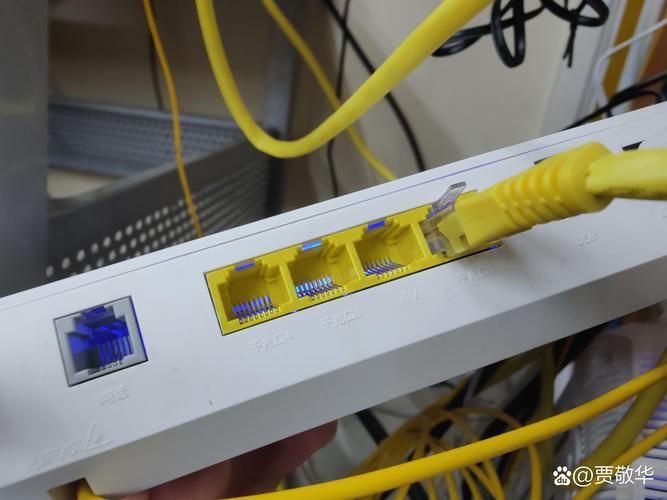
The first feeling was that the flow control was unreasonable, and i asked them what the bandwidth was. He took me a picture of two lines: one for 100 trillion family broadband and two for 50 trillion。
I'm looking at a hundred megabytes of bandwidth. How do i set a down rate of 12. 5 mbps? Shouldn't it be 100 mbps
First of all, 100 mega-broadband down rate is 100 mbps
100m downrate
The key points for understanding this value are:
The unit is mbps: "mocks" here means megabits per second. This is the standard unit of measurement for network bandwidth。
Theoretic max: 100 mbps is the maximum down rate of the theory that operators commit to. This means that under ideal conditions (no network congestion, high equipment performance, good line quality, speed server response), you can download at a maximum of 100 mbps。
The actual download speed (the file download speed): the speed we usually see when downloading files on a computer or mobile phone is mb/s. Here's what needs attention:
1 byte = 8 bits
Therefore, to convert the network bandwidth mbps to the file download speed mb/s, it needs to be divided by 8。
100 mbps ÷ 8 = 12. 5 mb/s
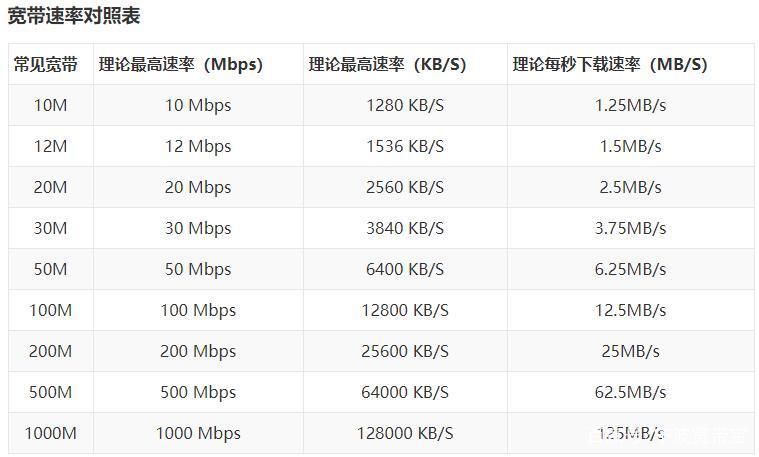
Summary: nominal down speed: 100 mbps theoretical maximum file download speed: about 12. 5 mb/s
Actual file download speed: usually below 12. 5 mb/s. The actual steady speed of downloads is generally between 11 mb/s and 12 mb/s, and may be even lower, owing to the influence of such factors as network costs (agreement costs, transmission losses), peak network congestion, wi-fi signal decay, router performance, network quality, equipment performance, speed server loads, etc。
Common upper speed range
The upper and lower rates of broadband for 100 trillion households are generally well below the lower rates, which are commonly used for asymmetric designs (i. E., different download and upload rates) for household broadband in the country
Currently, the three main domestic operators (telecommunications, connectivity, mobility) provide a typical up-to-date rate of a 100-m diet in most areas. For example:
- down 100 mbps, up 20 mbps
- down 100 mbps, up 30 mbps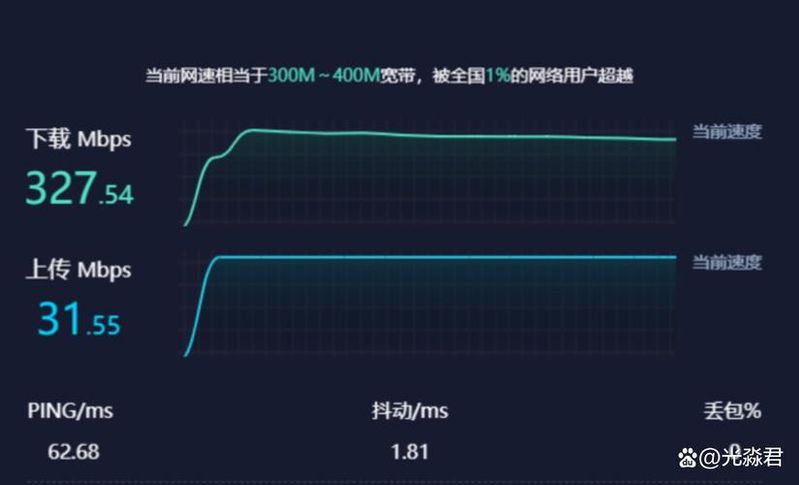
Rate of movement of parts or specific packages
In a small number of areas, highly competitive areas, or some upgraded packages (possibly tied to mobile phone operations, etc.), uplinks may be given to 30 mbps or slightly higher (e. G. 40 mbps, 50 mbps), but reaching or exceeding 50 mbps is very rare in standard 100m。
- 30 mbps up speed ≈ 3. 75 mb/s (30 ÷ = 3. 75)
- 20 mbps up speed, ≈, theoretical maximum upload speed 2. 5 mb/s
If both the up and down rates are wrong, the flow-control strategy for the line is certainly problematic. It makes sense to use the flow control to make a network of cartons。