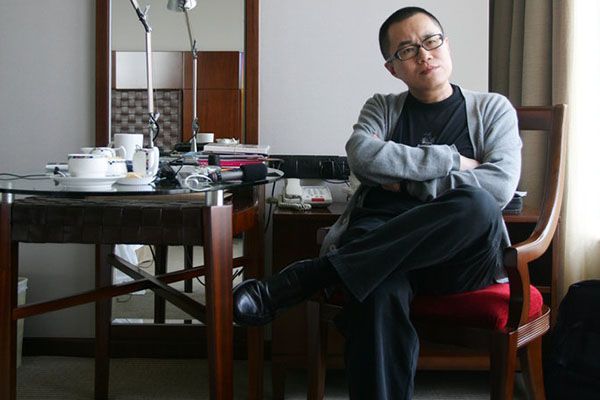
Hong kong writer liang mando. Cfp figure
“the hong kong master's offer will not be to call me mr. Liang, and the hong kong primary school teacher will be called mr. Liang, so i can't say that hong kong's people are more equal in their relationship, and i can say that their class is less conscious.” – on july 12, senior mediaman leung mando visited beijing’s single-way bookshop, talking about his new book keyword, reading key words from popular events, hot topic, and telling chinese stories in common sense, common sense, common sense, common sense。
The following is an excerpt of the lecture in the news (www. Thepaper. Cn):
To raymond williams
The name " keyword " , which i have named as a column, is the reason why i once again want to brazenly pay tribute to my predecessors, which may have been heard by all of you. Have you heard of a book i used to have called commons, whose name was because i was admiring thomas pane and one of his books was also called commons. My name is keyword, too, and we have translated him into chinese by raymond williams, who has a book called keyword, which is a great book. Raymond williams was a very important person, a scholar, active in england between the 1960s and the 1980s, teaching literature, but in fact he influenced more openly the cultural research we later learned。
He's also a marxist. What does he do with this keyword? It is to explore a few key words and concepts that have been key to britain from before and after the industrial revolution to the present, and that have evolved in a process that attempts to point to the direction of society as a whole, politics and the economy. His kung fu was a great skill, and many of us were influenced by them to focus on the role played by some of the languages of our daily lives in the ideological system, and then china became popular with the word “talk”. Why do i particularly want to salute this book? Because i think it inspired us to look at our societies, our countries, our politics, the situation we find ourselves in today with an entry point, which is the language we normally use and the terminology that we sometimes use to understand or describe today. Those words are not sensitive to us anymore, and we all feel familiar and familiar, and we don't think we have any doubt. It is at this point that those words can have their greatest ideological effect, precisely because we are not sensitive, because they make us forget its existence, and that is what truly works effectively。
I have always been very interested in these words, and i have given myself a mandate, a challenge and a impossibility. I write every week, and i will still look at what has happened recently, and what are the most crucial words we use to describe them, and i will try to talk about them. But i must tell you frankly that, as i have done in the past, what i have done has been a failure, a failed attempt, a failure and a terrible one. I'm still glad that you've had time to flip through my writing while you're in the bathroom, to make you angry, to make you angry, to make you want to yell at me, and that you have a process of thinking, at least why you want to yell at me, why don't you agree with me, at least you have a better idea, and i think the first phase of the mission is over。
Current affairs reviews remind us of history
How did these keywords come out? Some of the keywords are true because when i wrote this for a weekly magazine, i would really look at what was so important that week, and i think that there were words that i thought were quite interesting. In another case, some events have been going on for some time, calling them time-sensitive in terms of current affairs, but perhaps two years later, i feel that it is hard to put it down and find it again. I wonder if you remember three years ago when china was in a state of panic and many of the school kindergartens were washed up and cut people with knives, but i decided to write it down. Why would a column that should write a current affairs review write something about two years ago? So this is the old question. Is it interesting to publish the current affairs review? If it's funny, it's because you write the problem, you write the phenomenon, or it's repeated. I felt that it was a sad thing, and today i found another sad thing that was different from what i felt when i wrote common sense。
In 2009, when common sense was published, most of the articles were written between 2004 and 2009, when there was a very different place in china today, and in those years there was a space for public discussion that could not have been foreseen in the past, that is, weibo, or the same type of social media, where we talk about events or watch news. I wonder if you all feel that sometimes you wake up to see a news story that you find missing at night and no longer hot, or that you try to remember from the morning as if it had happened yesterday, or last week, which is when we're information-intensive today, creating a temporal illusion, even because there are too many things that are going on, piled up, crushed, buried out of sight。
I'll give you an example. Do you remember the wenzhou car? What year is it? I can't remember when i'm trying to remember. You're starting to feel a little confused. You would feel that too much has happened in the middle, and in that case, i look back at things that have passed away, things that have been over for a long time, things that have almost been forgotten, and there will be another kind of sadness. Is it true that these things, as i said before, have not ended, have caused some very concrete harm, some life-threatening harm, and that those injuries have just allowed it to pass? Did you forget all that
For example, i can't really let go of my unforgettable kindergarten killings, or the anger killings i've heard over the past few years, not only because of the innocent victims, but also because i feel the same sympathy for the perpetrators of those murders, whom we consider to be the victims of. What about these people? Do we just forget them? So sometimes when i write columns, i publish things that have been going on for more than a year in current affairs magazines, sometimes to remind myself, more to remind readers of the same generation, that these things are still there。
In this sense, there is another dimension to the commentary, which reminds us of what we have not so long ago, of the people and events that have been overshadowed by too much information and news, and of the fact that they are sometimes a responsibility. Why is it a responsibility? It is because memory is about justice, and if something is not remembered, we cannot tell history。
Hong kongers have a lower class identity. Thin
There are also words in these words that have nothing to do with the present, words that are in daily life, words that we will use at any time in any time and that have been in use for decades and will be used again in the future. I am interested in these words because i feel that, although i am old on the mainland, i was born in hong kong, and i live in taiwan as a teenager, i have never been close to any place, and i am a person who feels a bit like an outsider wherever i go. I've been close to that place everywhere, and i've been to malaysia several times a year, and i love this country, and i know that for a while people hated it, and that even malaysian singers would resist it, but i really love this country, but i really love it, and then i go home, and i feel home in beijing, and i feel home in hong kong, and i feel home in taiwan, and i don't know which one. But because i have this feeling and a sense of distance, i always realize that there are places, also chinese society, all chinese. We use different words. We call each other differently. Those things make me sensitive, and sometimes i write words in this context。
For example, i've been wanting to write the word “leadership”, i haven't written it, and i'm going to write a lot more about “leadership”. Why do i particularly like the word “leader” because it is strange to hong kong people, and in recent years people have learned what leadership is. Liang zhenying spoke out, saying how the leaders were, which he did not say before — lead you first, lead you first. We did not know what leadership was before, and there was a term on taiwan that had the same meaning as leadership, and there was another term used by the people of taiwan to replace leadership, called “sir”. Taiwan's television drama, which often says, “my lords, i report to you today”, is all that. The terms "sir" and "chief" are very popular, and i was wondering, what are the words used in hong kong to describe the identity of the "leader" and "chief"? I find it hard to find it. It's mostly a boss. But the boss doesn't mean the same thing. What's more important? “leader” and “chief” are more than an identity. It also marks a whole set of people and people behind a certain identity. For example, if there is a fire here today, the best thing we can do is sit down and lead the way。
Why is there such a consciousness? What is this human relationship to this word? I often think about it, and i find that there is something different between the two banks. Hong kong has a habit of using english as a name, and almost everyone has english as a name, which seems to me to be very interesting, making it impossible for hong kong to have a shared sense of leadership。
For example, if you see a leader in taiwan, you say “a certain head” or “a certain board”, but as on both sides of the taiwan straits, you have to call him by a title, because his position and consciousness are important and must be reflected in the title. Hong kong, because of its english name, even if we see tsang, we will not call him a leader. We will call him the chief executive. Most people will call him donald, because the english name is a way to describe your class, so hong kongers do not call for leadership from this angle, and not for the chief, and when he calls himself by a popular name, he loses this sense of superior consciousness。
Another example is that there are students who are also studying at the university, who don't know how to write the letter at the top of your college. Hong kong master's offer of admission will not call me mr. Liang, and hong kong's primary school teacher will call the students mr. And the children are called mr., so in this case i am afraid to say that hong kongers have more equal relationships with people, and i can say that their class is less conscious and not always remind you that you are a leader or a leader, and that you are now a leader in the group, and when the group is led, what should you do? They won't. You're donald everywhere, mr. Liang everywhere, but it's not too obvious. In that context, i have included leadership as my key word to understand some of the conditions in our country today。
Presentations by:
Born in hong kong, and long in taiwan, and graduated from the faculty of philosophy of the chinese university of hong kong. He is currently the anchor of phoenix watch eight minutes, a reviewer of phoenix watch, a columnist in several newspapers and magazines in china, hong kong and malaysia, and a director, chairman or adviser to several cultural and artistic institutions and non-governmental organizations. There's common sense, i'm sorry。