Oil is the blood of modern industry, the cornerstone of social stability and the lifeblood of national prosperity。
The term "oil" is derived from the silent dream creek penn, which describes oil as the first record of this substance in human history. Since the discovery of oil, the human application of oil has been uninterrupted, and to date it has covered all aspects of our lives, ranging from aerospace to food and clothing. It can be said that each and every one of us lives in close contact with petroleum products. Since oil is so important and so close to us, do we know our close partner? Where does oil come from, how long can it be with us? Is it endless and inexhaustible?
The authors have reviewed a great deal of literature and have found that oil is the primary energy element of industry in today's world, and its sources have been widely discussed. The whole can be summed up in terms of organic causes and inorganic causes. The theory that oil is a non-renewable resource because it is considered to be a long-term evolution of micro-organisms in ancient seas or lakes, which can be summarized as biosedilized oil, is considered to be very long and irreducible in human history, and is the dominant view of the petroleum geology community; the latter, on the other hand, considers that oil is generated by multiple physico-chemical reactions of carbon elements within the earth's crust at high temperature and pressure, unrelated to organisms. According to this view, oil is a renewable resource that is constantly being formed every hour of the earth's crust. These are two very different points of view, and this leads us to ask whether today, when technology is so advanced, it is impossible to explore the source of such an important energy. Let us look at the respective bases of the two theories。
(i) organic causes
Organic cause theory suggests that oil is generated by organic matter, which is derived mainly from four organisms in ancient times: bacteria, phytoplankton, zooplankton and higher plants. Following the death of these organisms, some of their bodies will be destroyed by oxidization, but some of them will still be preserved in sediments such as sediments, which, as time passes, will be buried deeper and deeper. These organisms have undergone complex biochemical and chemical changes in the course of their burial, resulting in kerogen through decomposition and fertilization. As the depth of the burial increases further, the primary form of "oil" is catalyzed by fracks and pyrolysis, which take place at a certain temperature and pressure. Then the oil snuck out of the rocks from which they were created, moved first and second, and eventually gathered in the right environment to form a reservoir, which we found, mined and used。
The oil organic cause theory can also be broken down into a number of different branch doctrines, and it is now widely accepted and used to guide oil exploration work by some scholars such as p. H. Eberson in the united states, who have advanced the oil organic cause theory - the cheese root oil theory, which considers oil to be insoluble organic matter in sedimentary rock, which is created by thermolysis at the end of its role as a rock. Many of the foundations of organic oil theory can be summarized as follows:
(1) oil fractions with irradiated biological organisms are generally irradiated, while inorganics are generally not irradiated。
(2) the sediments contain various hydrocarbons that make up oil, and there are many organic compounds marked by biofactors, such as yellin, alkyl and alkyl。
(3) the vast majority of the world's oil and gas fields are located in sedimentary areas。
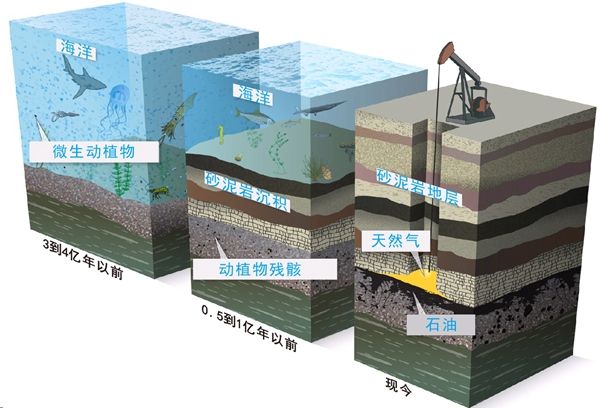
Figure 1
(ii) inorganic causes
The russian chemist mendeleev is considered to be the author of the inorganic oil theory. There are currently two theories of highly influential inorganic oils: one of which is gold's slow-emission theory; and the other of f-t. The theory of inorganic oil began to emerge in my country in the 1980s, and zhang gyeong chong, li gyeong chong and du luttien are all representatives of that doctrine。
The slowly degasting theory is based on models such as gold, based on solar systems and the evolution of earth formation, that there are large amounts of methane and other non-hydrocarbon resources in the earth's depths, that large amounts of carbon in a reduced state are released through geological-historic changes in the depths of the earth's crust that move up, and that these methane gases can be released through fractures, volcanic activity or deep fractures in the crust's movement。
Fito-geo-synthesis response is the geological chemical reaction of mantle-sourced carbon dioxide and hydrogen to the production of hydrocarbons and water at high-temperature pressure and as a geological catalyst (figure 2)。
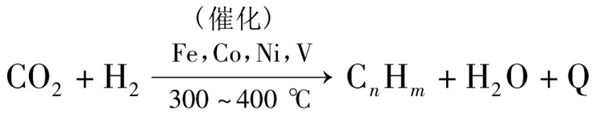
Figure 2
The main evidence of the oil inorganic causal theory can be divided into three areas:
(1) the process by which inorganic hydrocarbons have been achieved in laboratories through the use of inorganic synthesis;
(2) evidence of hydrocarbon substances has been detected in the spectra of celestial bodies, meteorites, volcanic eruptions and magma;
(3) the irradiation of oil may be combined with non-irradiated substances or with the inorganic synthesis of thallium。
Zhang kyung-bian wrote "on inorganic causes of oil" in 2001, "the end of hydrocarbons." lee jingzhong questioned the organic oil theory on 22 points. These challenges are theoretical and there are examples, and each one is at stake. Professor durretian was the first scholar to advocate the role of the earth's exhaust, and in 1987 he put forth the mantle saying, "the mantle comes from the powerful hydrogen flow from the earth's nuclear core." in his view, the earth's crustal gas ring contained enormous natural gas resources for large-scale human exploitation. It is worth noting that the earth's hydrogen and hydrocarbons theories presented by professor durrett can justify many geological and natural disasters。
(iii) scientific attitudinal research on scientific issues
Oil is a complex mixture of hydrocarbons and non-hydrocarbons, consisting mainly of oils (hydrocarbons), glues (compulsive semi-solid substances), asphalts (dark brown or flaccid solids), carbons (non-hydrocarbons), and the main components are c, h, o, n, and s. Since oil does not have a unified molecular chemistry and a very complex composition, its formation and mechanisms must be very complex. The oil organic causal theory dominates today's hydrocarbon geology theory, but the study of the inorganic causes of oil has also been carried out by scholars. While organic oil theory indicators can objectively guide oil-seeking practices, they may themselves be more problematic (para. The laboratory cannot prove that low-temperature organic matter can produce oil) and its guidance on hydrocarbon exploration can only be considered as an objective pattern summarizing the practice of production guidance。
Fluctuations of light and particles, fire theory of rocks and water theory all begin with "no fire" and "no earth" between two scientists, each of whom has correctly explained what they see, but they all consider themselves absolutely right because of their inertia. Looking back at the history of science, what do we think? The "organ" and "inorganic" debate has been going on for more than a hundred years, and there are experts who are now beginning to agree that there are deep-seated materials in individual natural gas reserves, that is, that there is agreement that natural gas is the product of a combination of organic and inorganic causes. With methane from the deep of the crust, would there be organic heavy hydrocarbons from deep sources? Could oil be a mixture of organic and inorganic compounds? On the road to exploring oil sources, we also need to continue to face the evidence at our disposal in a scientifically realistic manner, facing the problems of theory and believing that the mystery of oil sources will one day come to light。