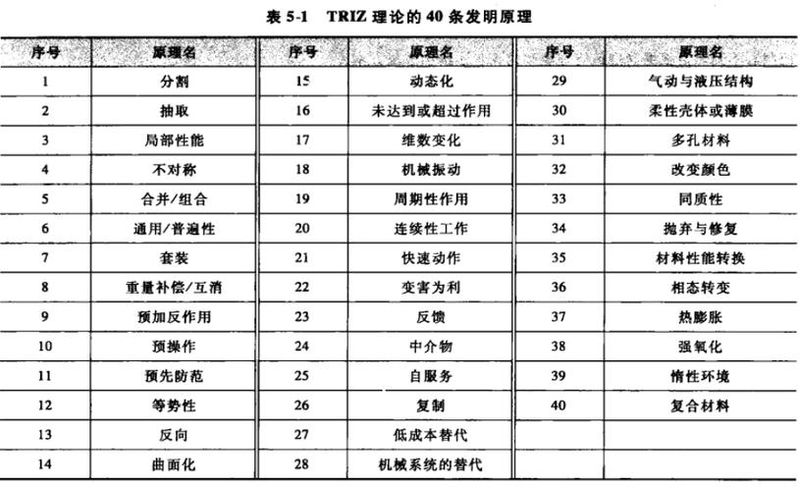
The 40 inventive matrices and contradictions are the foundational elements of the classic triz theory, which was developed after gÉnÉric archishul and his colleagues analysed over 40,000 patents. They found that the same basic problems and solutions arose in different technical areas. The core idea is to systematically overcome “technical contradictions”. Technical contradictions arise when attempts are made to improve one feature of the system (e. G. Speed) and lead to the decline of another (e. G. Reliability)。
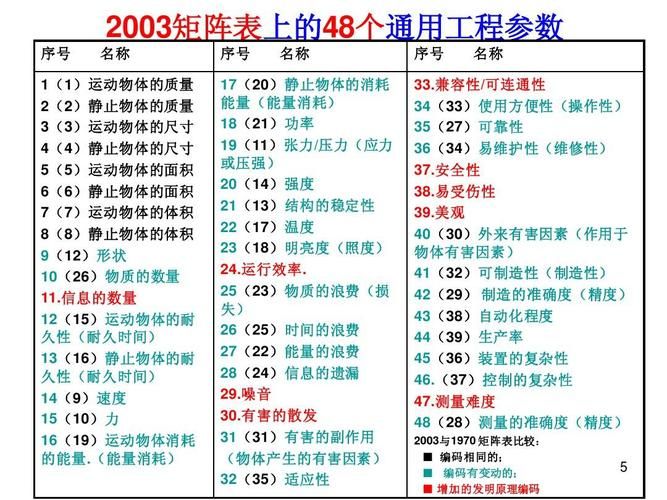
Altschuler identified 39 standard system parameters, such as “mass of motion objects”, “intensity”, “temperature” and “productivity”. The paradox matrix is a 39x39 grid in which rows represent parameters that need improvement and columns represent parameters that lead to deterioration. At the intersection of particular rows and columns, the matrix provides figures corresponding to the most commonly used invention rationale for this type of conflict in the patent database. For example, in order to resolve the contradiction between “intensity” (required for improvement) and “weight of geostationary objects” (required for improvement), the matrix may recommend principles such as #1 (separation), #10 (preliminary measures) or #40 (composite material). The principles themselves are an abstract and enlightening approach, such as “separation” (separating objects into separate parts), “asymmetric” (making objects asymmetric) or “utilisation” (making a component function multiple). This structured approach turns a specific and complex problem into a pervasive one, using these principles to find a common solution, then applying this common solution back to the specific context, thus avoiding psychological inertia and repeated error。