On april 12th, at 2:37 p. M., a visit to the community health service centre in gangura street, nanjing por district, broke the hearts of countless mothers - when the girl was born for only four days, when she was weighed by the old scale, the bag of the baby suddenly fell off and the child fell on the bed, and the iron scale fell and hit the child in the chest. The child, who was still crying, was crying, and the parents collapsed on the spot, ran away from three hospitals in nanjing during the month for an examination, and in the early hours of the morning went to the western courtyard of the nanjing children's hospital with blood on his urine。
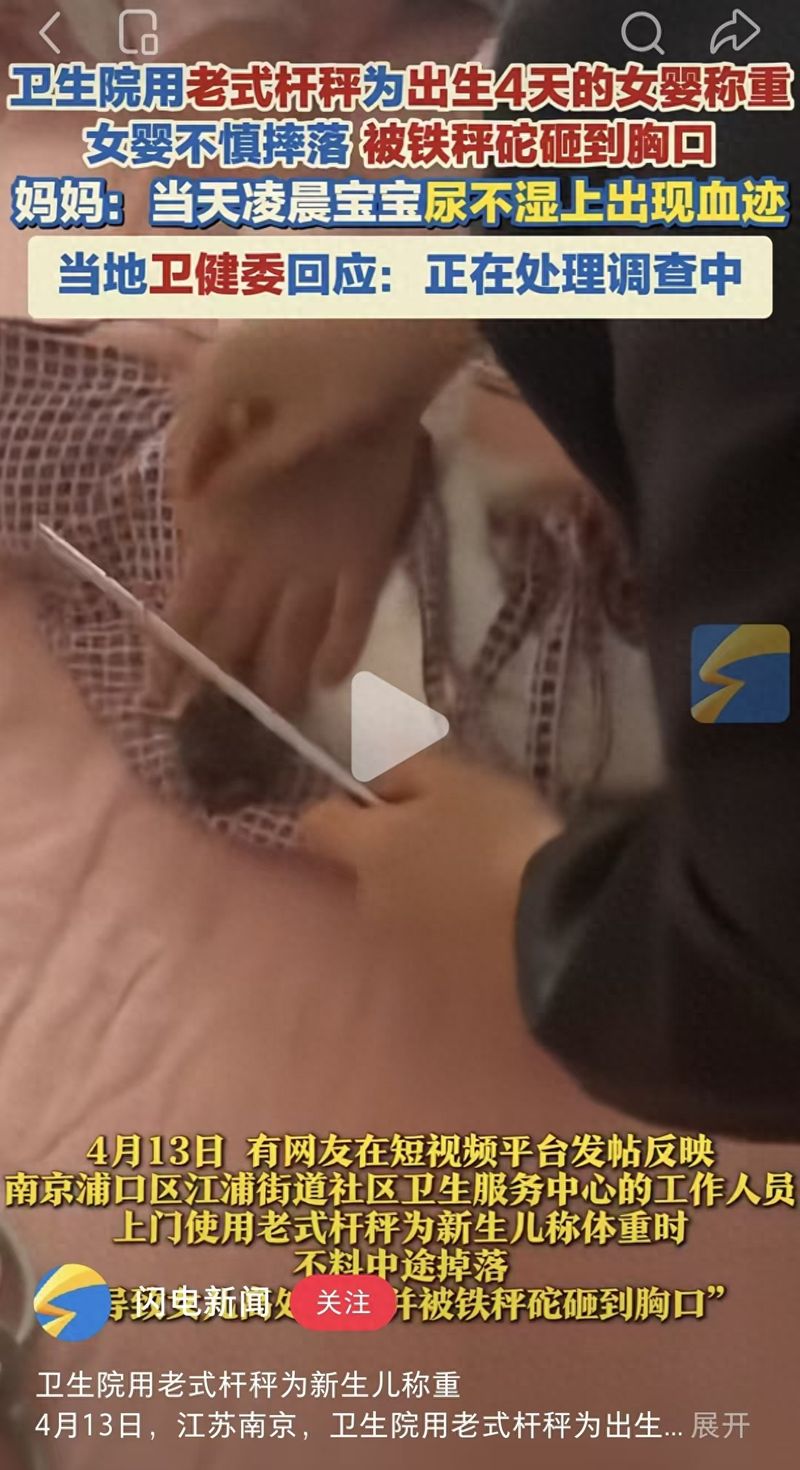
From a video screenshot
Following the fermentation of the incident, the puguchi district health and safety commission intervened at the first hour of the investigation, and the latest response on 15 april showed that after multiple examinations, the baby girl had no apparent physical abnormalities and had returned home safely, and that the relevant departments were in constant contact with parents to monitor her health. It is also clear from the health clinics that follow-up visits to newborns will be completely discontinued, electronic scales will be harmonized and personnel safety training will be conducted. But the surprises are still a source of debate: in 2026, the baby was weighed. Why is it still weighing this old scale? Is this going to work? What are the hidden industry loopholes behind it
It is not by chance that today we will speak the truth of events, of compliance disputes, of the current state of the industry and of the security risks behind it。
Revert the truth: every scene in the video is full of safety minefields
The video released by the parents is the most direct evidence, and we'll decipher it from one frame to another, and we'll see how crazy it is:
1. The equipment was wrong: the medical staff was holding an old wooden scale with the iron scale of the sun, which was common in the agricultural market and used to call pork, live chickens, and never seen a newborn born four days earlier。
2. The operation was wrong: instead of using any specially called heavy pallet, the baby was packaged with a piece of cloth, attached directly to the scales, completely oversized and without any fixed protective measures。
3. A double-risk outbreak: during weighing, the packaged baby suddenly loosed its bag and the baby fell directly on the bed; immediately thereafter, the iron scales hanging at the other end of the scale slipped and struck precisely on the chest of the baby。
The father recalled that the family was in a state of emergency after the incident and that the doctor had recommended a ct examination, but had finally opted for an ultrasound examination, considering that the baby was too small and feared radiation risks. Fortunately, as of 14 april, the results of the examination showed that the baby had no chest cavity, abdominal fluid, no damage to the organs, and no haematological haemorrhage。
On 14 april, the staff of the children's health section of the health facility in question disclosed that the medical staff had ceased to work and that no similar accident had occurred before that facility, that the staff had been examined on the spot at the time of the incident, that no visible external injuries had been detected, and that “wetless blood in the urine” was reflected by the parents, presumably a haemorrhage from the newborn。
Core dispute: is it compatible to weigh the weight of the newborn
This is the most intense point of debate on the whole network, with some saying, “the scale is also a leverage principle, compliance”, and others saying, “a complete violation, making fun of the baby's life”. Let's be clear about the official regulations of the national health commission。
First of all, the state's hard-line regulations: there are two clear rules
In 2012, the national commission for health and health issued the national code of practice and technical guidelines for child health, including the technical guidelines for neonatal visiting (who/wha 2012). (49), the only official basis for weighing newborns, with two core requirements:
1. Equipment requirements: the use of leverage scales or electronic scales shall be strictly prohibited and other non-earmarked weighing equipment shall be prohibited。
2. Timing requirements: the newborn child must be placed in a bedroom when weighing and must not be exposed to other objects to ensure stability and safety。
There's a critical area of error, and there's a lot of confusion: what the code says about leverage weight scales, it's a scale, that's a baby lying flat. On dedicated trays, the leverage principle is weighed, with a fixed weighting platform and no visible scales, while in health clinics, the old scale is tied to the old scale, which is not the same equipment and is completely different in nature。
And then look at the response from the health clinic: it's a contradiction, it's hard to reconcile
In the face of a “compliance” challenge, inconsistencies in the statements of the staff at the health facility also gave rise to more controversy:
On 14 april, the first-line staff member stated that “in accordance with local regulations, both the leverage scales (i. E. The old scale) and the electronic scales are within permitted use and are not non-violable equipment” and that the daily medical examination at the clinic is based on electronic scales, with a uniform subsequent approximate rate of conversion to electronic scales。
On 15 april, the puguchi district health commission did not respond positively to compliance, stating only that “the focus of its work is on the health status of newborns, and other issues are temporarily difficult to respond”。
Lawyers and professional opinion: expressly identifying “violations”
A number of legal and professional experts agreed that the operation was a clear violation of at least three mandatory rules:
Violation of the technical instructions on neonatal visiting: equipment does not meet the requirements and is flaunted as completely contrary to the core requirement of “no contact with other objects” in the “placed”。
2. Violation of article 24 of the regulations on medical institutions: the practice of medical institutions is subject to medical technical norms and is not carried out in accordance with those norms, which constitute an offence。
Violations of the rules for the application of the regulations on the management of medical institutions: failure to ensure medical safety, accident caused by the suspension of newborns, unprotected scales and medical safety failure。
There's blood on the net: "the farm market calls the scale of pork, which is used to call the four-day baby, not compliance, but ignorance!"
Soul torture: why is 2026 and the health center weighing
A lot of people wonder why community health centres still weigh the old scale when electronic scales and exclusive baby scales are so popular and expensive. There are three real reasons behind this, which point to the pain of primary health care。
Reason 1: “portability” trap for door-to-door visits
Within seven days of the birth of the newborn child, the community health centres are subject to home visits, which are provided free of charge by the state。
Electronic scales and specially leveraged weight scales, most of which are larger and heavier, are inconvenient, and require specialized tools to carry them; and old scales are easily carried, and medical staff can carry them with them, without having to ask their parents to help with the equipment, which seems to save time and be easy for parents。
Reason 2: delay in upgrading primary medical equipment
That is the central reason. As a front-line city, nanjing still faces the problem of delays in upgrading the facilities of health centres, not to mention the primary health centres in other regions。
Primary health centres have limited funding and priority is given to securing diagnostic equipment, while access to public health services is often neglected. Many health centres do not purchase enough electronic or dedicated leverage scales because they are under-funded, and can only use old scales。
Reason 3: lack of operational habits and training
Some primary health-care workers are not familiar with the state-of-the-art technical norms of the country, are not even aware of the explicit requirements of the technical guidelines for newborn visiting and are still stuck in the old operating habits of “previous visits”。
At the same time, the lack of training and skills testing of health personnel in health institutions and the lack of emphasis on safety norms that weigh newborns have resulted in medical staff not being aware of the risk of being weighed, which eventually leads to accidents。
Industry truth: this is not an example
Many consider this to be an isolated case, but in practice, primary health centres weigh the weight of the newborn, not an example, and are exposed in several regions of the country。
There was a comment from an internet user: “my baby weighed heavily in his home health clinic in 2023 and used a scale, and it felt wrong and had no accident.”
"the community health house visited the house and came with a scale, saying that the electron scale was too heavy to bring, and i refused and called it at home."
According to interviews with journalists, some of the other community health service centres in nanjingguchi district also have problems of visiting and reporting discrepancies in heavy equipment, either using electronic scales or still using scales。
The security gaps in grass-roots public health services are exposed:
1. The procurement criteria for equipment are not uniform and there is no mandatory requirement for basic health centres to be equipped with special weighing equipment
2. Inadequate training of health-care personnel in safety awareness and operating norms, and irregularities
3. Supervision is not in place and public health services equipment and operations at primary health centres are not regularly examined。
Recent developments: comprehensive renovation of health centres and upgrading of facilities throughout the country
Following the incident, the relevant corrective measures were quickly put on the ground, giving parents and netizens an initial account:
1. The health clinic immediately stopped using the scale: on 15 april, the puguchi district health commission made it clear that follow-up visits to the jiangpur street community health service centre for newborns had completely stopped using the old scale, moving to electronic scales and completely eliminating security hazards。
2. Safety training for all: first-line health personnel have been trained in safety education and work code to enhance safety awareness and avoid similar accidents。
3. Ongoing attention to the health of the baby: hns staff indicated that close communication with parents will be maintained on an ongoing basis, follow up on the health of newborns and mothers。
4. The puguchi district will study rehabilitation programmes: the puguchi district health commission has indicated that, in response to the incident, it will study a unified rehabilitation programme of equipment for newborn visits by community health centres throughout the district to avoid similar problems in other health institutions。
A reminder to mom: how can we avoid the pits
The incident reminded all new parents that visits to the home are free of charge, but that parents have the right to supervise the safety of their operations and must refuse them promptly if they encounter irregularities。
Three pit avoidance techniques. Remember
1. Checking equipment: medical personnel are required to use electronic weight scales or dedicated desk scale leverage and the use of old stick scales is prohibited
2. Operation watch: when weighing, the baby must lie flat on a special tray and not be able to hang, package or access other non-earmarked items
3. Dare to refuse: if medical personnel use irregular equipment or mishandling it, they may request that the compliance equipment be replaced or, if they weigh it at home, feed it back to the health facility。
Wrap-up and reflection: an accident, alarm for primary medical security
The accident in nanjing, which did not have serious consequences for the newborn, sounded a wake-up call for the entire primary health care sector:
Public health services at the grass-roots level must not simply seek “convenientness”, but rather maintain the “security floor”. The ease of access must not be at the expense of the safety of the newborn, equipment must be updated and standardized simultaneously, and old equipment must not become “safety killers”。
2. National technical norms must be strictly enforced. The technical guidelines for neonatal visiting have defined the requirements for equipment and operations, which must be implemented unconditionally in primary health centres, and cannot be violated under the pretext of “under-funded” “habilitation”, let alone “a dead letter”。
3. The supervisory authorities need to strengthen primary medical supervision. Periodic inspection of public health facilities and operating regulations in primary health centres, timely correction of violations, removal of safety hazards from the source and safety of newborns。
In the case of parents, we must learn to monitor the quality of services and refuse to perform irregularities; in the case of primary health care, we must speed up equipment upgrades, strengthen training tests and make every visit safe for parents and children。
And at the heart of the accident is not only the issue of the “scale” but also the issue of the “security consciousness”. Only by taking every detail and putting every norm into action can similar surprises be avoided。
In conclusion, i wish nanjing a healthy, healthy and flourishing baby girl, and hope that all newborns will grow well in safe and regular medical care。