Hello, boys
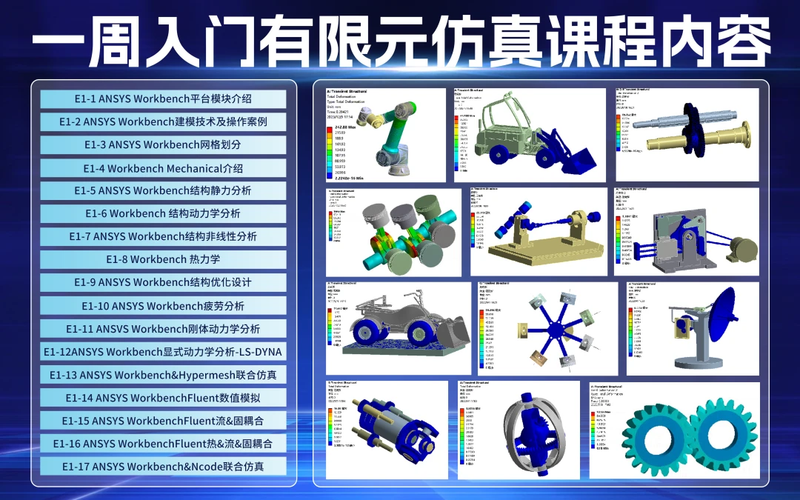
Next, we will launch a series of heavy-pound articles focusing on the introduction of the ansys workbench limited meta-simulation, from the 2016 to the 2025 editions, which will be optimized over five editions with a cumulative number of over tens of millions, covering core research directions such as heat analysis, fatigue simulation, shock response, vibration properties, collision simulations。
Our series will be structured around 17 core modules: from the basic elements of the ansys 2025 platform configuration, modelling techniques, grid delineation, to core applications such as static mechanics, kinetics, non-linear analysis, to the progressive elements of fluent fluent fluency, hypermesh joint simulation, fish sea software in chinese, covering all aspects of complex cae simulations of really critical knowledge points, and helping people from entry to excellence。
Before formally entering the software operation and the project, we must first resolve a fundamental problem:
How can limited simulations be learned quickly and systematically
The following will be removed from multiple dimensions and will lead you to a clear simulation of learning paths and thinking frameworks。
I. What is a limited imitation
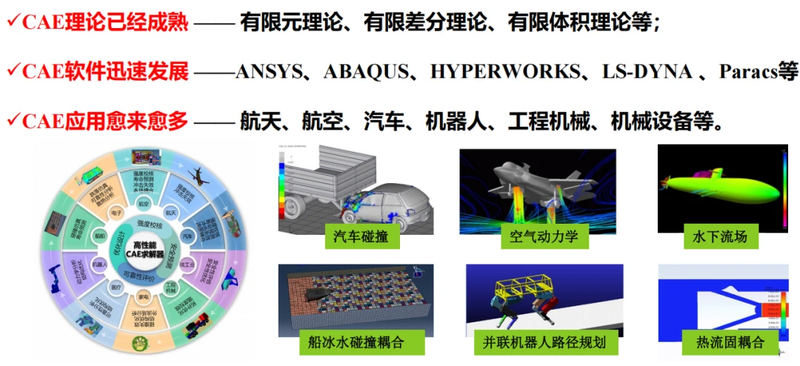
A limited meta-simulation is really a mathematically approximate numerical simulation, by dispersing the real physical system (geometric, payload, condition, etc.) to the true system of unlimited freedom with a limited combination of simple units. Its core doctrine, which includes limited meta-methods, limited differentials, limited volume, etc., has been widely applied in a wide range of areas, including aerospace, automobiles, robots, mechanical equipment, etc。
Mainstream cae software such as ansys, abaquas, ls-dyna, hyperworks, comsol, etc. Have become essential tools for r & d and engineering analysis。
Ii. Why study limited simulations? - “win-win options” for individuals and businesses
Learning limited simulation, both for enterprise development and for personal professional growth, is of irreplaceable value:
Enterprise level: core engine for downside efficiency
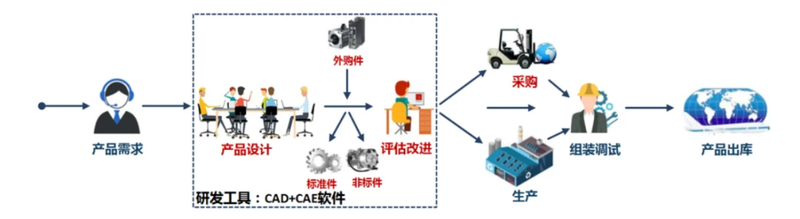
Optimizing product overlay: to provide a precise basis for optimization by imitating product performance, reducing the number of physical experiments and the research and development cycle
(a) savings in r & d costs: physical experiments often cost a lot of human, material and financial resources, while simulations depend on computer power and cost reductions are significant
Supplementary test shorts: performance of critical positions (e. G., gear collage) cannot be directly tested through the experiment, imitation can achieve precision simulations and can be calibrated with experimental data
Validation theory reasonableness: simulation can go hand in hand with theoretical calculations and physical experiments to verify consistency and ensure that research and development is in the right direction。
The individual dimension: key to building core competitiveness
(a) scientific skills: publication of high-level engineering-type papers such as sci, ei, simulation being an essential core component
(b) high-paying employment: the r & d jobs in large factories such as huacheng, mi, biadi and peng all include limited meta-simulation as a central requirement, and mastering this skill creates an exclusive technical barrier
Rapid capacity development: even with weak mechanics and a weak mathematical base, rapid engineering can be achieved by imitation, while at the same time reinforcing the theoretical foundation。
How do you learn to imitate limited dimensions? - the three-tier path from "will use" to "exact"
Learning limited meta-simulations, at the core of which is “appliance-oriented”, is like “six in six”: self-articulations (impersonations) are fundamental, different weapons (simulation software types) are tools, and the ultimate goal is to solve practical problems (through customs). In particular, the following steps could be followed:
Preception of the “enemy”: a clear core physics of simulation field
At the heart of the limited meta-simulation is the “field analysis”, where almost all products are based on three fundamentals:
Structure field: linear / non-linear static, kinetic, modular analysis, etc.
Temperature field: containing stable heat, transient heat, linear / non-linear heat analysis, etc.
Fluid field: focus on current speed, pressure, temperature temporal variations, etc.
Outreach areas: electric field, magnetic field, acoustic field, and heat-structure, heat-flow, flow-condensation, and design needs such as certainty optimization and reliability optimization。
Access to “heart”: three steps + three steps
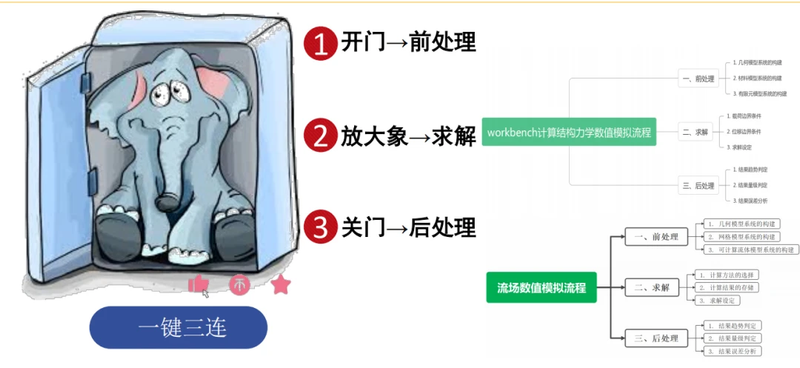
Regardless of the degree of complexity, the simulation is based on the three core steps of "purpose - solution - post-process," like "puting elephants in refrigerators":
Pre-processing (opening of refrigerator doors): determination of the type of unit, material content, grid division, connection, etc.
Solution (place elephants in refrigerators): set load conditions, position constraints, solver parameters, etc.
Reprocessing (closing of refrigerator doors): extracts the unit node results, makes model animations, draws road maps/ surface maps, etc。
Refinement of “marine” from “capable” to “quick”
The three core dimensions of simulation learning need to be gradually broken:
(a) first weight: capable (quick gain): in the face of complex assembly, capable of quickly completing modelling, solvency and achieving effective results
(b) second weight: counting (assurance accuracy): the result error is within the scope of the project and consistent with theoretical/experimental data
Third, fast-calculation (high-efficiency calculations): reduction of solvency time for large-scale, non-linear problems through technologies such as parallel computing。
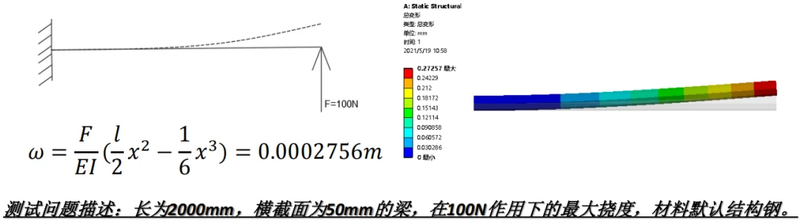
Iv. What can a limited metaanalysis do
The limited meta-analysis application covers almost all engineering areas and core competencies include:
Structural mechanics performance: static/dynamic analysis, linear / non-linear deformation, modulation analysis, random vibration, collision impact, etc.
Thermodynamic performance: steady heat / transient heat analysis, heat-structure coupling, temperature field distribution simulation, etc.
Fluid physical properties: piped fields, high iron outlet, flow speed/pressure distribution, heat-flow coupling, etc.
Multiple coupling and optimization: thermal - structure - flow coupling, electromagnetic - structure coupling, certainty / reliability / uncertainty optimization design, etc。
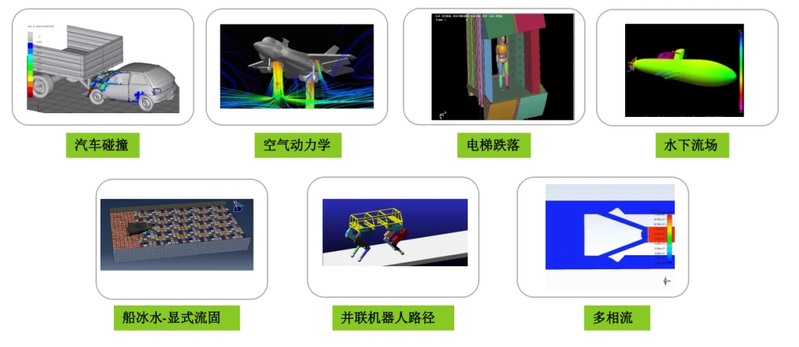
In simple terms, “sky flying, ground running, water swimming” can solve the core problems of r & d with limited meta-simulation, as long as it is an engineering product (note: subject to computational constraints, extreme complexity needs to be balanced between calculation and precision)。
Sources of discrepancies in limited meta-analysis? - four major categories of error cannot be ignored
Model error: geometry simplification, unit type selection, material model
Grid error: quantity, mass, width ratio, malformation, etc
Loads and constraints error: approximation of centralized and distributed loads, idealization of boundary conditions
Interception and rounding error: single/double accuracy, number of digits, solver
Result extraction error: difference between node and unit result plugin
Vi. How to improve the precision of limited meta-analysis? - standardized process + specialized method
At the heart of the improvement is the “process standardization + functional specialization”, which follows 337 processes (complex systems) or 7-337 processes (high precision requirements), focusing on the following:
1. Pre-treatment optimization
Model dimensions: selection of 2d / 3d models based on demand to avoid excessive complexity
(a) selection of units: point / line / face / body unit fit scenario (e. G. Beam unit for pole structure and shell unit for sheet structure)
Grid optimization: control of grid coarseness, improvement of grid quality (reduction of malformations) and non-relevance verification of grids where necessary
Simplified features: characteristics such as round corners, small holes, and lubricant lanes need to be judged against the needs of the project (but not more precise)。
2. Optimization of the solvency phase
(a) load / restraining: avoiding oversimplification, complex loads (with time and space changes) need to be precisely defined
Solving methods: linear problems fit hidden solutions, dynamic issues such as shocks, collisions fit visible solutions (e. G. Ls-dyna)
Multiple coupling: clear coupling (thermal - structure, flow - solid, etc.), choosing the right coupling algorithm
Parallel calculations: use of high-performance computing techniques to improve solvency efficiency and accuracy of large-scale problems。
3. Post-treatment certification
Establish a "theory - simulation - experiment" closed-ring certification system to further enhance local accuracy through technologies such as self-adaptation models, submodels, substructures, etc。
Vii. How's the quick opening? ♪ sit and talk and walk ♪
At the heart of the fast-track entry is the “multi-practice, non-drive” principle, which follows the following principles:
1. Focus on cases
The accumulation of a large number of foundation cases covering different physical fields, different model types, leading to a “systemic thinking” followed by an in-depth development of details (avoiding over-compelling on a single issue)。
2. Distinguished and gradual
First, it solves the problem of "calculating" (e. G. Simple semantic analysis), then it pursues "calculating" (accuracy validation), and finally it breaks down "calculating" (efficient calculation); it masters one field (e. G. Structure field) and expands multiple couplings。
Rejection of “ineffective learning”
Sit-in, walk-in: after listening to the course and reading the course, you have to do something to avoid the "eyes don't"
No more than three things: three mistakes of the same kind, requiring high-level feedback (teachers, business masters, peers)
Sensitivity and learning: learning to shine others (even competitors), not blindly asking questions and focusing on core issues。
4. Behave and standardize processes
Following the "model - grid - solving - post-processing" fixed process, refer to authoritative information (e. G., the ansys platform manual of former teachers at the university of qinghua, the limited law of jusheng)。
Software-oriented vs product-oriented
Learning limited meta-simulation, with two orientations, each with advantages and disadvantages, needs to be combined with targeting:
Software orientation: a tool that works quickly, but has a narrower job
Product orientation: aimed at solving real problems, imitation as a means and more competitive employment
Conclusion: for long-term development and higher wages, it must be “product-oriented” - - the ultimate goal of learning software is to optimize the product, which can only be of technical value and “learning to use”。
Benefits coming in! Study materials are free
In order to help you keep up with the pace of the course, we have prepared a special study video + a ppt resource

At the end
The limited meta-similar industry is at a high rate of climb, and the huge shortage of high-performance cae analogue talent among 12 million researchers in china presents both challenges and opportunities。
Next, we will break down each of the core modules of ansys workbench, from platform configuration, modelling techniques to multiple couplings, joint simulations, and take you to every point of knowledge with actual battle cases。
Just as “the opportunity comes with hard work and hard work,” there are no shortcuts to learning in limited dimensions, but by following scientific methods and continuing practice, it is possible to build exclusive core competitiveness。
Follow-up articles will be kept up to date, and attention will be paid to the "bing story engineers' club," so let's go from entry to mastery, and in a world of limited dimensions, "big fish jump!"
But the sweepers are communicating with more simulation engineers