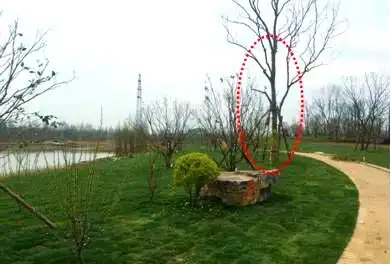
Earning point for the 01 wood
In landscape design, wood cultivation uses a variety of techniques, such as v, v, w, m, c and five cakes, to meet different design needs. Different planting techniques are used depending on demand, including v fonts, reverse v fonts, w fonts, m fonts, c fonts and five pies. At the same time, isolated seedlings, symmetry and array cultivation are also essential techniques for the creation of precision effects。
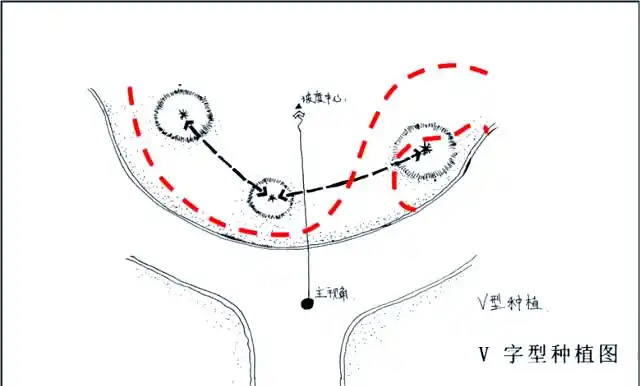
V font cultivation
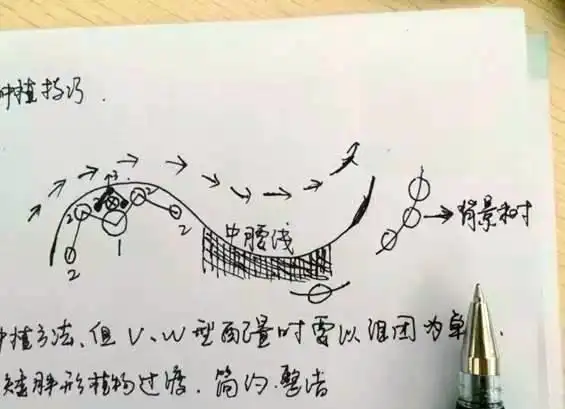
A sense of hierarchy is created through the selection of suitable positions on the main angles for wood cultivation, combining the height of the plant with the terrain features. First, the position of the first wood is determined on the main angle, then the second at the near end of the main angle and the third at the far end. In determining the angle, the slopes need to be adjusted appropriately to avoid the formation of a straight angle or an equal angle. In the front of the main view, a chubby plant should be selected to create a sense of hierarchy (the red dotted line part of the picture can be used as a reference for the forest line)。
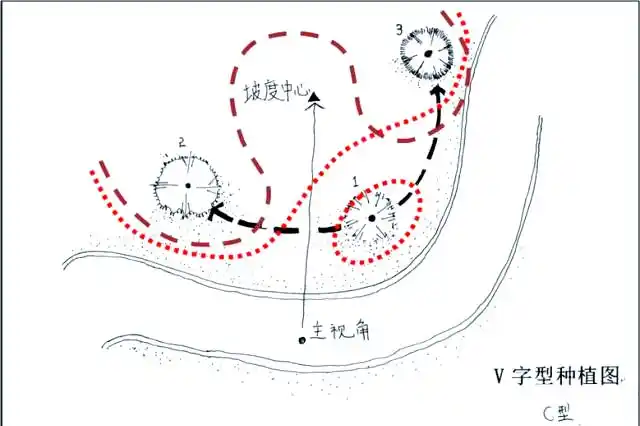
C font cultivation
With the slope heights at its centre, arc cultivation forms visual fluid. Central to the height of the slope, the first wood of the main angle is selected, and the centre is then rounded, with a radius of distance from the centre, drawing an arc that is essentially parallel to the outer edge of the terrain. On this arc, we further select the suitable location of the second and third wood (the red dotted part of the picture can be used as a reference for the forest line)。
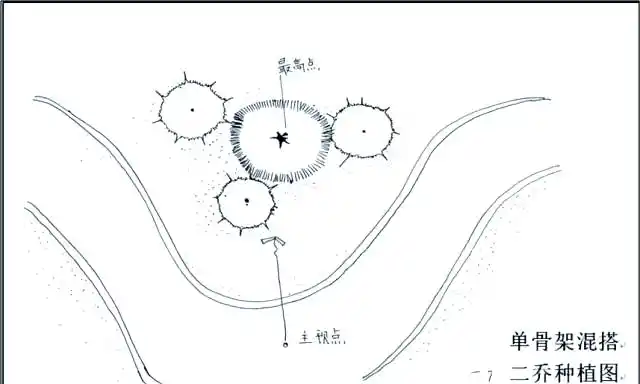
He's got a bone
Through a combination of single skeletons and two joes, it enriches the landscape and adapts the design concept of modern small and medium-sized wood. At the height of the slopes, we have chosen to plant a skeletal cartilage of a significant size, which is significantly greater than the size of the two. On this basis, we use the v or c fonts to tweak the outer edges of the wood with two. This combination not only compensates for the deficiencies of single v-c font farming, but also creates a sharp visual focus that makes the antenna look full and harmonious。
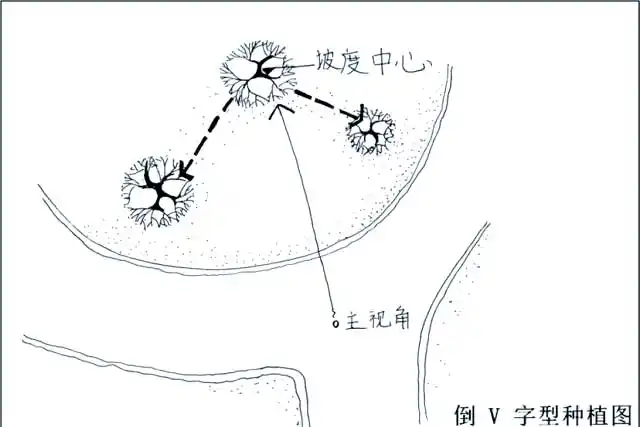
Type v cultivation
Designed to create visual focus through a reverse v word structure. In the design, scattered trees should be kept at an appropriate spatial distance from the group behind them to ensure sensory independence, while the boundaries need to be clearly visible。
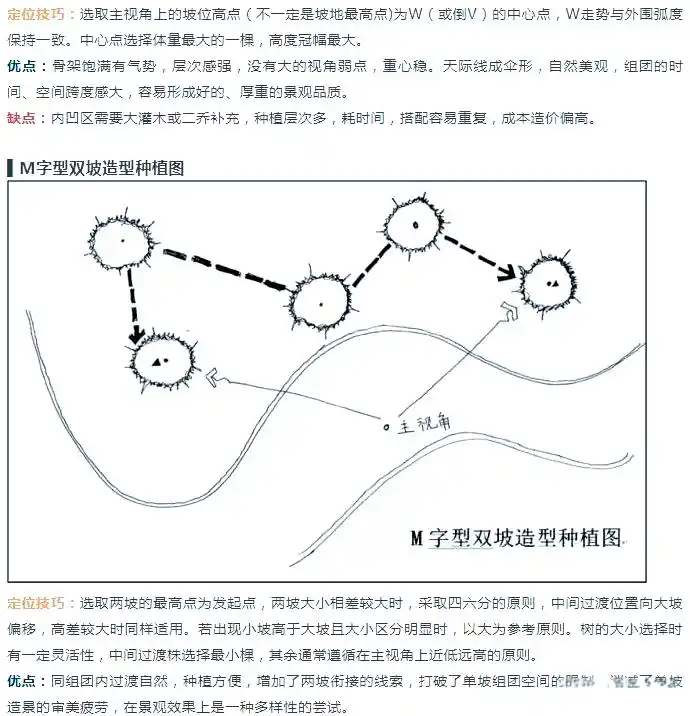
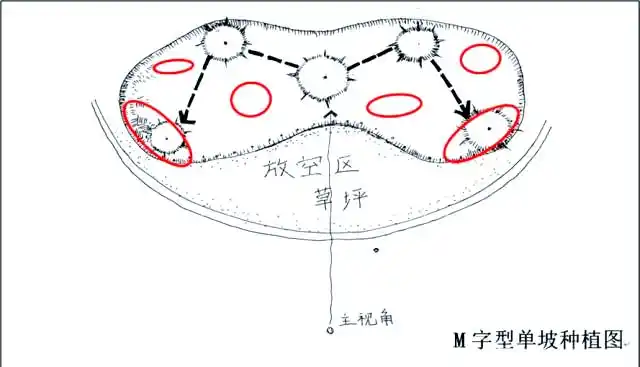
M font cultivation
Combining the advantages of v and c, creating a layered landscape. With a well-designed m font layout, we can create a unique visual effect on the slopes, making the overall landscape more lively and stereotic。
Art of cultivation of the 02 bush
Success cases
Flower bush cultivation creates a vivid landscape through subtle colouring and matching. Through rational planting techniques, bushes can create rich and colourful visual effects, making space live and hierarchical。
Failed cases
The negative effects of misdescribed planting methods on landscape effects. These problems not only affect the beauty of the landscape but may also adversely affect plant growth。
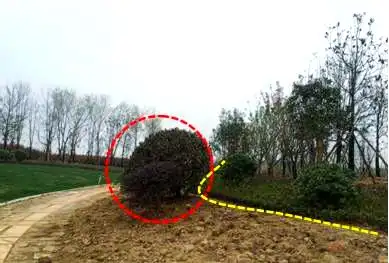
Lonely tree application
At some of the key nodes, the visual focus, through unique forms and positions, can break through the constraints of cluster farming and bring new visual experiences to people。
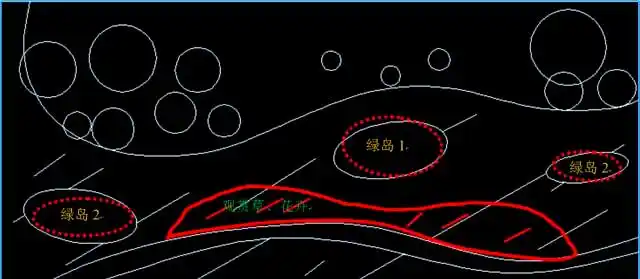
The land is matched by plants
The land is enriched by plants and its ecological effects are enhanced. Through the clever application of plants, the spatial dimension of the group can be further enriched and the ecological effects of the overall landscape enhanced。
Colour spelling
The landscape glamours are enhanced by the use of different colours of plant materials to collide, increase visual impact using colour contrasts。
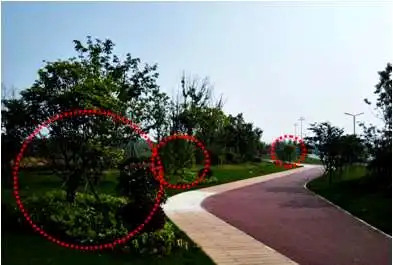
Grystal connection design
When dealing with cortex, the cortex is designed to improve the beauty of the interface using curves and sharp angles. In order to ensure the harmony and nature of the overall landscape, the use of a rigid straight-angle interface should be avoided, with a preference for a sharp or smooth curve interface。