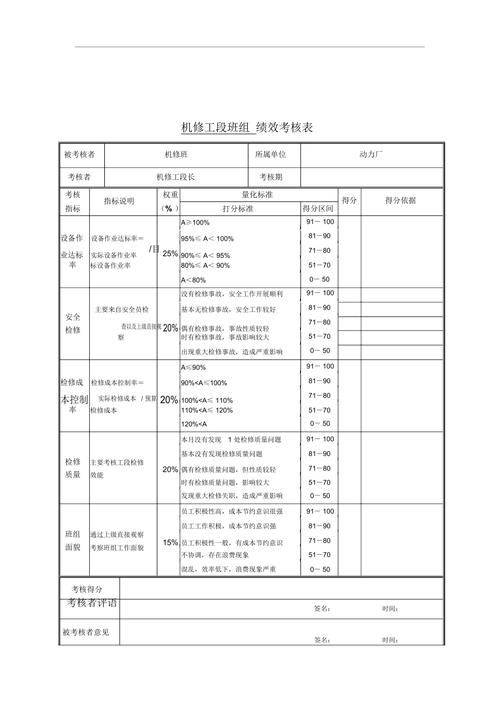
The programme's electromechanical workshop, which serves as the core assurance module for the enterprise's production system, has a direct impact on the efficiency of the operation of the equipment and the continuity of production. This performance appraisal management programme is designed to stimulate the subjective mobility of the maintenance team, standardize operational standards, upgrade the level of detail in maintenance management and integrate the actual operational needs of the workshop. Principle 1. Fairness and impartiality: the criteria for the appraisal are uniform and clear, the process is transparent and traceable, the results are based on objective data, on on-site records, free from subjective assumptions and interference, and ensure that differences are reflected in the appraisal “more or less”. 2. Quantitative orientation principle: to translate core indicators such as quality, efficiency, cost of maintenance into measurable quantitative data (e. G., one-time repair rate, consumption rate), to reduce ambiguity in qualitative evaluation, and to allow the results of the appraisal to visualize the effectiveness of work. (c) the principle of binding unions of incentives: to stimulate the exemplary effects of high-quality employees through performance incentives, to clearly improve the requirements and support measures for substandard employees, and to create a virtuous competitive atmosphere of “desiring and penalizing poor performance”. The principle of continuous improvement: the results of the appraisal are used not only for the distribution of remuneration but also as a basis for optimizing maintenance processes and upgrading staff skills, as well as for promoting the upgrading of the overall effectiveness of the workshops over time, through the “validation - feedback - improvement” closed-ring management. Ii. The target audience and cycle (i) the entire staff of the machine and power workshop for which the examination is conducted, including maintenance technicians, class leaders, spare parts management posts, security supervision, etc. (the performance indicators for support positions may be adjusted according to functional characteristics). (ii) monthly appraisal of the appraisal cycle: focusing on the day-to-day completion of tasks (e. G., maintenance timeliness, safety protocol implementation rate) and completing the evaluation within three working days after the end of the month, as the basis for monthly performance payroll. Quarterly review: in conjunction with phase maintenance objectives (e. G., specialized equipment modifications, control of spare parts costs), completed within 5 working days of the end of the quarter for quarterly merit and skills upgrading analysis. Annual appraisal: consolidated year-round performance, teamwork contribution, innovation improvement results, completed by mid-january of the following year, as the central basis for promotion, annual bonus allocation. The system of content and indicators is designed around six dimensions: “quality, efficiency, cost, security, collaboration, innovation”, with the following indicators: (i) one-time repair rate for the quality dimension of maintenance: the proportion of work orders (90 per cent of target value) that return equipment to normal operation after individual maintenance. Refurbishment rate: the proportion of secondary work orders (target 5 per cent) reported due to the same failure within 72 hours of maintenance. Client satisfaction: production workshops rate maintenance services (accessed through online questionnaires or on-site interviews, target 95 points). (ii) maintenance efficiency dimension failure response time: average time between notification of failure and arrival at the site (30 minutes target). Timeliness of maintenance: percentage of work orders (target 95 per cent) to complete maintenance within prescribed deadlines (e. G. Four hours for equipment shutdown and two hours for production line failure). Worksheet completion rate: the total completion ratio of monthly scheduled maintenance worksheets to temporary worksheets (target value 98 per cent). (iii) cost-control dimension consumption material usage: ratio of actual consumption of materials to the quota standard (target ≤105 per cent, over-alignment is justified). Spare parts turnover rate: margin between monthly spare parts inventory value (target value 2 times/month, reflecting efficiency in the utilization of spare parts). The proportion of the commission's maintenance is: the proportion of the commission's maintenance costs to the total maintenance costs (target 15 per cent, encouraging increased capacity for autonomous maintenance). (iv) safety management dimension safety incidents: damage to equipment, minor injury to personnel and above as a result of improper maintenance operations (target = 0). Implementation rate of safety protocols: the proportion of routine operations (e. G., blackout, high-altitude protection) performed during on-site inspections (target 98 per cent). Security training participation rate: the percentage of staff participating in annual security training (including new protocol learning, emergency exercises) (target = 100 per cent). (v) team collaboration and growth dimension cross-group rating: quality and timeliness rating to assist other teams in completing maintenance tasks (evaluated by team leaders assisted, target 90 points). Skills training compliance rate: proportion of staff who complete the specified skills training during the year (e. G., maintenance of new equipment, plc programming) and pass the test (target 95%). Contribution: the effect of the senior technician in teaching the new person (measured by the number and quality of work orders completed independently by the new person, with a target of 3 person days/year). (vi) number of proposals for innovative improvements in dimension: number of staff proposals for maintenance process optimization, equipment modifications, cost-saving categories (target value 2 per person per year). Proposal acceptance rate: the proportion of proposals that have been accepted after workshop evaluation (30 per cent target). Innovations: economic benefits (target value £5,000 per year per person) associated with direct savings in maintenance costs or increased equipment efficiency through improved proposals. Iv. Examination process (i) data acquisition maintenance worksheet data: the equipment management department exports information from the erp system that includes information on the description of the failure, the length of the maintenance, and the use of consumables. Safety and quality data: daily on-site inspection logs by security supervisors, operational tracking forms for equipment feedback from production workshops. Cost data: warehouses provide expendable material inventory forms, spare parts inventory accounts and treasury accounts for detailed maintenance costs. Collaboration and innovation data: class leaders record cross-class collaboration and improve proposal review results by registration. (ii) test rating 1. Self-assessment (10 per cent): staff complete the self-assessment of performance with monthly/quarterly work records against performance indicators, indicating highlights and deficiencies. Peer review (20 per cent): staff members of the same team evaluate each other from the point of view of collaboration, mission support, etc., to avoid “rotational sit-in”, with specific examples requested. Workshop assessment (50 per cent): the team scored core indicators such as quality, efficiency, cost of maintenance in conjunction with data collection, with a focus on achievement of objectives and process improvement. Functional audit (20 per cent): the department of human resources and the department of finance review compliance with performance data (e. G., authenticity of cost data, determination of safety incidents) to ensure fairness of the appraisal. (iii) feedback on results and the outcome of the appeals appraisal are fed back to the staff member within two working days of completion, with a one-to-one communication between the class leader or the workshop director to identify strengths, weaknesses and directions for improvement. If an employee objects to the results of the examination, he or she may submit a written complaint within three working days to the appraisal panel, which must verify and respond within five working days. V. Evaluation results apply (i) the monthly performance pay allocation: on the basis of the examination scores (100 full points), the scores ranged from 10 to 15 per cent, 80 to 89 were granted normally, and the performance pay was suspended by 5 to 10 per cent for 70 to 79 points, pending improvement. Annual performance bonus: allocated at the annual examination level (excellent/good/qualified/unqualified), an additional one-to-two month salary for an excellent person, elimination of a bonus for an unqualified person and initiation of a reassignment or training process. (ii) job development and promotion to training posts: employees who have been “excellent” on the annual appraisal and who have been “good” for more than two consecutive years are given priority in the pool of class leaders and technical cadres. Training empowerment: development of specific training schemes (e. G., rapid diagnostic skills training) for short-scale appraisals (e. G., low maintenance efficiency), re-testing within one month of training, and achievement of the target. (iii) the award for honour incentives and culture-building, “monthly maintenance star” “quarterly innovation champions”, which is published in the workshop poster section, awards for honour certificates and toolkits, professional books, etc. Organization of a “performance pole experience-sharing conference”, which invites good staff to share maintenance skills, cost-control methods and create a “scramble-up” team atmosphere. (vi) safeguards (i) organization guarantees the establishment of assessment teams consisting of workshop chiefs (leaders), technical cadres (3) and human resources commissioners (1) to be responsible for programme revision, process oversight, complaint processing and ensuring clearance of site. (ii) the system guarantees the refinement of supporting systems such as the standard operating manual for mechanical and electrical maintenance, the manual for the management of spare parts, and the safety operating protocol, so that the evaluation indicators have a clear basis for implementation and criteria for evaluation. (iii) resource security tools and equipment: planned upgrade of maintenance tools (e. G., high-precision detectors, smart diagnostic terminals) to ensure hardware support for maintenance efficiency enhancement. Training resources: in cooperation with equipment manufacturers and vocational colleges, two to three specialized skills trainings are conducted each year, with expert on-site mentoring。(iv) cultural security through morning meetings