Number one, new guy
What's relay protection
Relay protection literally means the use of relays as a system-protected device. In short, it is an electrical device that reflects the failure of the power system and gives instructions to jump-off the circuit breaker. We know that the breaker body is only an executive body and that he does not have a protective function。
To know how relay protection works with circuit breakers to protect the power system, first we need to know what the failure of the power system is
First, it's short circuit failure. It's usually three-way, two-way, one-way
The basic characteristic of short circuits is a sharp rise in currents。
The second was a breakout. Single or dichotomy lines
The basic feature of the breakout is the loss of pressure
There are also common failures. Like voltage, overload, triple imbalance
The provision of these electrical system failures to relay protection to perform the jump order will require the addition of corresponding detection equipment to detect failure。
For short circuit failure and overload, current sensor detection is available
For broken circuits and excess voltage, electro-voltage intersensors can be used to detect
For single-stage, three-way imbalances, zero-order current sensor testing can be used
For grounding, insulation surveillance, the opening triangle (i. E., zero sequence voltage) of the voltage intersensor can be used
This is done by means of inter-sensor detection of phase changes between current and voltage
The differential protection is the current margin of two points of the detection line。
The principle of re-electric protection
The process of issuing a jump order following electrical protection is: measurement -- logical judgement -- execution
Measurement: measurement of system voltage, current values, and determination of whether the protection is activated compared to the fixed values。
Logical judgement: further determination as to whether to issue a jump order or other signal。
Enforcement: orders to perform the work of the breaker jumper's switch。
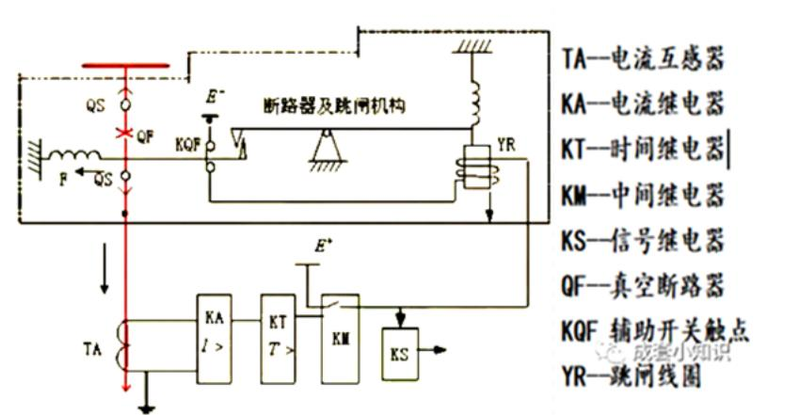
Relay protection principles
When ta detected an overflow in a single system with an overflow value greater than ka's rated value, implement ka contact connections to the next level kt, reach the time relay default contact, connect to km and transmit the overflow signal through ks. The kqf co-location of the breaker at this time will lead to yr jump wire. Do the brakes. This is the traditional principle of relay protection, which is now widely used as an integrated protection device and is essentially the same。
Four basic characteristics of reductive protection: selectivity, speed, sensitivity, reliability
Selective: the failure point moves within the specified range, not within the range
Speeding: most rapid to remove malfunctions and avoid further breakdowns
Sensitivity: sensitivity to execute orders within specified limits
Reliability: protection of essential features
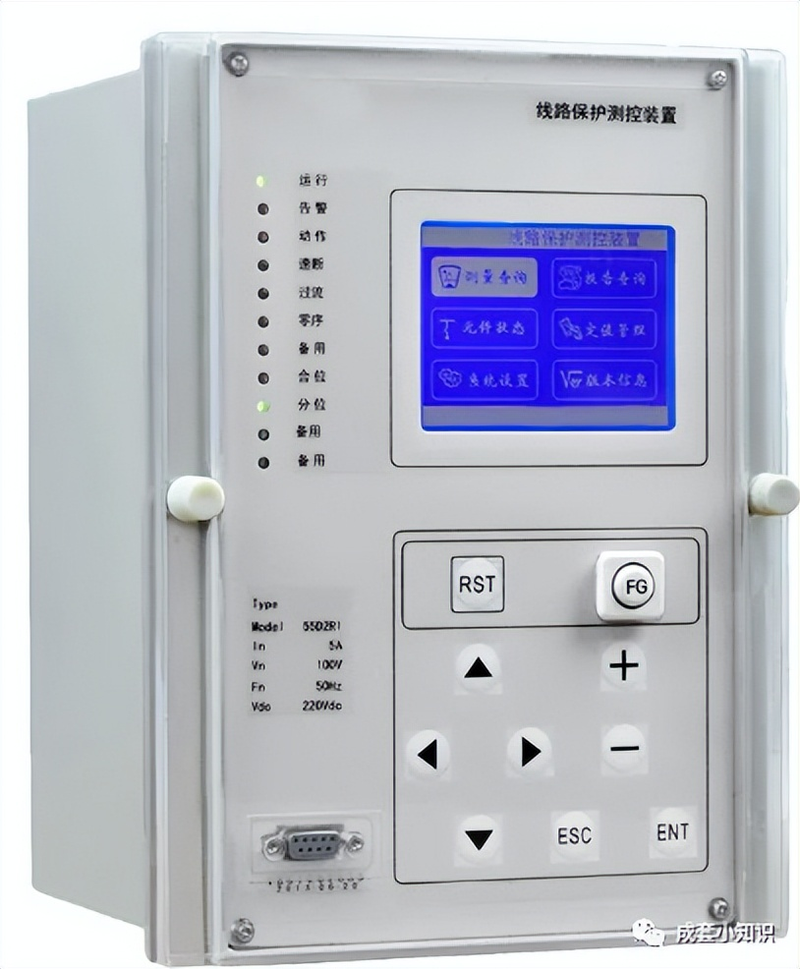
Relay protection
Relay protection fixation value
For the setting of protected fixed values, there are special standard documents, and the fixed values are generally set by the power authority. Let's just say here. Details can be found in dl t584, dl t684, etc。
Relay protection can be divided into circuit protection, transformer protection, motor protection, capacitors protection, etc. According to the protected object。
For the three-part electrical current protection commonly used, it refers to fast break protection (para. 1), time limit break protection (para. 2, overflow), time limit overflow protection (para. 3, overload). In the case of the 10kv line 500kva load, the current value can be calculated:
500 kw/10kv/1732 = 28. 8a, with the option of 50/5a current sensor。
50/5 = 10, with a tenfold reduction in secondary current values. When a single current reaches the rated 28. 8a, the secondary current 28. 8/10 = 2. 88a。
A velocity protection of a generic rated current of 5-8 times. The fixed value for protection of speed break can therefore be set at:
2. 88x (5 ~ 8) = 14. 4 ~ 23 (a), which must be 0s。
Two passages to protect the general rated value of 1. 2 ~ 1. 5 times, or 3. 5 ~ 4. 3 a. The transition time is normally 0. 2 ~ 0. 5s。
Three passages of the direct load protection rating, i. E. 2. 88a, and the excess load is generally taken 5s。
For single-stage protection, a pt-open triangulation test can be used, with an open-triangular voltage of 0 at normal times of the system, and 100/3 of the long-lived voltage when an adjacent site occurs. Adding a protection fixed value of 20 v, 33. 3 v > 20 v, the protection will execute the jump order。
When protected separately, the interface also produces a current of electric capacity that can be protected on the basis of the ct-detected current values in zero sequence. Usually the zero-order current does not exceed 50a, and the 100/5-zero-series sensor is generally selected. 20 times the ratio, 5/20 = 0. 25a when a zero sequence current is set at 5a, followed by a consolidation value of 0. 25a. Of course, factors such as reliability factors, sensitivity, imbalance factors, and transient and dilatory multipliers (4-5 times and 1. 5-2 times) must be taken into account。
In addition to the above types of protection, there are voltage protections (over voltage, default, zero-sequent voltage), differential protections (cross, vertical), high-coup protection, distance protection, direction protection, etc。