Article 63 of the trademarks act, as amended in 2013, first introduces punitive damages for intellectual property infringement in our country. Both copyright and patent laws, which are currently in the process of revision, have introduced a punitive compensation system in the revised version. In the course of the revision of the law, the trademarks act changed the scope of statutory compensation to “under $3 million” with its own “punitive” intent, and the statutory compensation system was a special case of a punitive compensation system, which was not expressed in multiple terms in the legislative model, but directly set the amount. In other words, punitive damages are the same as statutory damages, not a parallel or complementary relationship, and therefore cannot be used in combination with punitive damages. Article 76 of the draft revision of copyright law and article 65 of the draft revision of patent law (submitting the review) should be adjusted and amended。
I. Equipment equipment for punitive reparation
Article 63, paragraph 1, of the trademarks act provides that “in the case of malicious infringement of the right to exclusive use of a trademark, the amount of compensation may be determined less than twice or three times the amount determined in accordance with the above-mentioned method”, i. E., punitive damages may be imposed for malicious infringement and aggravating circumstances. The term “bad faith” is used here and is relatively rare in terms of legislation. Semanticly, “bad intent” is more derogatory than “intentional intent”, and “bad willful tort” is more wrong than “intentional tort”, but it is difficult in practice to provide for or interpret the distinction. The view was expressed that the adoption of the concept of “negative tort” in legislation could easily lead to disagreements in judicial application over the identification and application of “negative torts”, leading to inconsistent judicial standards. However, since trademark law establishes the expression “intentional infringement of the right to exclusive use of trademarks”, judicial practice can only be regarded as a more serious “intentional infringement”。
There may be ambiguity in the understanding of “gravity” after “bad faith”, which refers to the gravity of the violation as a whole or to the extent of “bad faith”? In the case of the latter, “bad faith” is itself a subjective expression of “gravity”, which, taken together, does not seem necessary; in the case of the former, means that the determination of punitive liability introduces elements of the consequences of damage, which might lead to greater controversy. The author tends to believe that this is a technical flaw in the legislation. It would be more feasible in practice to interpret it as “intentional violations of grave circumstances”. As to the specific definition of “serious”, it was inevitable to rely on the internal confirmation and discretion of the judge。
It is worth noting that the issue of punitive damages is also covered by the copyright and patent laws under revision. The most recent drafts available are the draft revision of copyright act, published by the legal affairs office of the state council in june 2014, which states in article 76, paragraph 2, and the draft amendment to the patent act, published by the national intellectual property administration in march 2014 that “in the case of two or more intentional violations of copyright or related rights, the people's court may fix the amount of compensation based on two to three times the amount calculated in the preceding paragraph”, and article 65, paragraph 3, which states that “in the case of an intentional violation of patent rights, the people's court may increase the amount of compensation determined in accordance with the circumstances of the violation, its size and the consequences of the damage, to two to three times the amount established in the preceding two”. There are differences from the provisions of the trademark act。

In the view of the author, the “more than two” provisions of the draft law on copyright do not appear to be necessary and are susceptible to confusion in practice. By contrast, the provisions of the draft patent law are most desirable. On the one hand, the conditions for the application of punitive damages are limited to “intentional infringement of patent rights” and, on the other hand, the circumstances of the tort are used as factors in determining the multiple of the amount of compensation. It is consistent with the rationale of subjective attribution and practicality. When proposing changes to the copyright act, reference is made to the expression of the trademark act or the patent act。
Ii. Interpretation of punitive levels
An important element of punitive compensation is the determination of the level of punishment, i. E. The criteria or range of punishment. Punitive damages under trademark law may be “more than twice as much as three times more than the amount determined by the above method” (i. E. Compensatory damages). It is clear that the “twice” here is inclusive. Otherwise, there would be a gap between compensatory and punitive damages. Logically, it is possible to set a specific amount or set a multiple for a given situation (e. G. Fraud in the provision of goods by the operator), but if a certain range of compensation is established to distinguish the gravity of the act, it requires a continuous and progressive relationship between the beginning and the end. Thus, if the amount of compensatory compensation calculated is $100,000, the amount of punitive compensation is over $100,000 and under $300,000. In other words, the least punitive damages are more than compensatory damages, and the most serious punitive damages are three times the compensatory damages. Of course, there is no need in practice to over-delineate this relationship. Several typical values (e. G. 1. 5 times, 2 times, 2. 5 times, 3 times) could be considered as the basic criterion for punitive damages in successive lines。
However, a comparison of the provisions of the above-mentioned revised copyright act and the revised draft patent law (submitting the draft) would reveal different results. In both cases, the expression “two to (to) three times” is used, which means that punitive damages should be at least two times more than compensatory damages. If compensatory damages are $100,000, punitive damages should range from $200,000 to $300,000, leaving a gap between $100,000 and $200,000. Such an approach, in the view of the author, raised the threshold for punitive damages, was not logically automatic and was not widely seen in national legislation, and therefore preferred to accept the model of the trademark act legislation on the matter。
Iii. Relationship between punitive and statutory compensation
(i) existing models of reparation
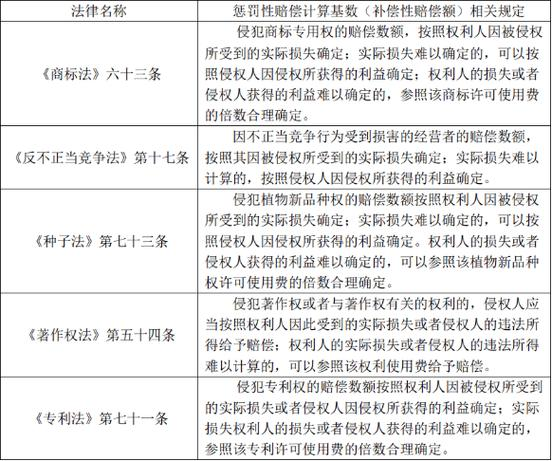
Article 63, paragraph 1, of the trademarks act, before providing for punitive damages, reads: “the amount of compensation for the violation of the right to exclusive use of the trademark is determined on the basis of the actual loss suffered by the holder as a result of the violation; the actual loss is difficult to determine and can be determined on the basis of the interests of the infringer as a result of the violation; the loss of the rights holder or the benefit obtained by the infringer is difficult to determine, reasonably by reference to the multiple of the royalties of the trademark.” thus, the “amount determined by the above-mentioned methods” of succession refers to the amounts determined in accordance with these forms of compensation and in a sequential manner between them when applicable. It should be noted, in particular, that the form of reparation here does not list statutory compensation。
Prior to the amendment of the trademarks act in 2013, it was considered that there were four types of compensation determined in our intellectual property law: actual loss of rights holders, illicit enrichment of infringers, multiple licence fees and statutory compensation. If the amended trademark act establishes a system of punitive damages, the previous forms of compensation should be considered compensatory or compensatory. There is, however, some disagreement about the nature of statutory compensation. Legal compensation is a compensation system whereby the court determines the specific amount of compensation within the range or base of the amount provided by law, which is essentially at the discretion of the judge. The problem was that statutory compensation only defined the scope of compensation and that judges enjoyed greater discretion in specific decisions. In practice, it cannot be denied that in many cases statutory compensation has had some punitive character, with some judges expressly referring to “as an aggravating factor in the calculation of compensation” in their judgements in response to the defendant's gross and flagrant violations. Thus, in the judicial practice of damages for intellectual property infringement, a certain punitive element has in fact been reflected, and the view that damages for intellectual property are merely compensatory is not true. This determination of statutory compensation also objectively forms a basis for the establishment of a punitive compensation system。
This recognition is also reflected in the provisions of the trademarks act. The trademark law follows the model of legislation providing for a double relationship between punitive and compensatory damages, and it is clear that the lawmakers exclude statutory damages from the “methods described above” only to be understood that statutory damages are not compensatory. In other words, compensatory damages, which are the basis for punitive damages, can only be “losses” proven by the right-holder and cannot be statutory damages that are not sufficiently substantiated by an alternative approach。
The further question is, then, whether the trademarks act applies a punitive compensation rule to statutory compensation, or how the relationship between statutory compensation and punitive damages should be understood。
(ii) due interpretation of article 63 of the trademarks act
In isolation from the content of article 63 of the trademarks act, it would seem appropriate to consider punitive damages only in cases of gross and malicious infringement and where the right holder has proved his actual loss or illicit enrichment by the infringer, or where there are trademark licence fees. If the right-holder is unable to prove the relevant facts, the court shall decide within the limits of legal compensation. The rules on statutory compensation, on the other hand, did not change significantly from article 56 of the prior trademark act, but increased the maximum compensation from $500,000 to $3 million。

If the above-mentioned understanding of article 63 of the trademarks act is established, an inescapable question is whether, in the case of statutory compensation, there are no punitive elements for statutory compensation in the event that the infringer continues to be “aggravated tort, aggravating circumstance”. In other words, the above-mentioned understanding considers statutory compensation as an option in cases where there is a lack of proof on the part of the right-holder, but cannot deny the fact that the conditions applicable to punitive damages may have been fulfilled in the case of so-called statutory compensation。
In fact, the greatest problem in the implementation of the current regime of intellectual property rights damages is the overrepresentation of statutory compensation, so that other methods of reparation are so illusory in practice. (a) if any, studies have been conducted to take stock of the 4,768 effective jurisprudence on intellectual property violations before courts at all levels throughout the country since the implementation of the national intellectual property strategy in june 2008, concluding that 78. 54 per cent of cases of copyright infringement were awarded using the statutory compensation standard; in the case of trademark rights infringement, 97. 63 per cent of the awards were made using the above criteria, compared with 97. 25 per cent of patent infringement judgements. (a) such a high percentage, on the one hand, indicates that, under existing conditions, it is very difficult to prove a loss when the rights holder has suffered a violation; on the other hand, attention must be paid to the generalization of statutory compensation and to the simplisticness of the determination. If the introduction of a punitive compensation system was not conducive to resolving the issue of statutory compensation, it would be difficult to say that the reform would be successful。
Indeed, a careful analysis of the provisions of article 63 of the trademarks act would shed light on the relationship between punitive damages and statutory damages. As already discussed, article 63, paragraph 1, of the trademarks act does not mention the method of statutory compensation precisely because it considers that the existing statutory compensation is not purely compensatory. It would therefore be contradictory to interpret the content of the statutory compensation provided for in paragraph 3, in particular the cap of $3 million, as a special compensatory reparation in addition to punitive damages. The most reliable understanding should be that the modification of the scope of statutory compensation to “under $3 million” is inherently “punitive”. One of the possible reasons for this is that the maximum statutory compensation for patent tort was changed to $1 million at the time of the third amendment of the patent act in 2008 and, in theory, the maximum legal compensation for trademark tort should be kept up to $1 million, in addition to punitive damages. Is it not “more than one and more than three times” of punitive damages that the legal compensation following the amendment of trademark law is related to the original scope? At this point, we can conclude that the legal system of compensation under the existing trademarks act is a special case of a punitive compensation system, which is not expressed in multiple terms in the legislative model but is directly set out in the amount. This can also be demonstrated through a systematic interpretation. It is precisely because statutory compensation is an exceptional case of punitive damages that the rule of law places its content (para. 3) after the general provision of punitive damages (para. 2)。
The amendment of the increased punitive compensation regime in the trademark act was a major change, but to date the author has not seen an authoritative interpretation of the relevant provisions. If the above understanding is correct, it means that punitive damages are the same as statutory damages, rather than a parallel or complementary relationship, and therefore cannot be used in combination with punitive damages. Unprecedentedly, in the united states of america, there have been no cases where punitive damages have been awarded in addition to statutory damages. Under the united states copyright act, in the event of an intentional infringement of a copyright, the maximum statutory liability of the aggressor for each tort is increased to not more than $150,000. In response to this provision, it has been argued that “because of the intent often used to punish the perpetrator of the violation, this increase in damages is thus punitive in nature ... In the context of the imposition of statutory damages, it is not appropriate to pursue an increased punitive effect. It is therefore not surprising that the court has refused to impose punitive damages in addition to the statutory damages.” it is clear that american scholars have a different understanding。
Finally, we turn again to the provisions of the aforementioned draft revised copyright act and the draft amendment to patent law. The approach to statutory compensation provisions is almost identical, and after the basic elements of statutory compensation have been laid down separately, the two drafts are followed by provisions for punitive damages, which may be applied on the basis of statutory compensation. Clearly, this is a method of compensatory compensation that equates statutory compensation with the actual loss of the rights holder, the illicit enrichment of the infringer and the licence costs of the rights. The advantage of such design is that the applicable method is clear and direct, and there is no dispute as to whether statutory compensation is punitive. Moreover, in terms of its effects, it should be said that it has helped to reduce the abuse of existing legal remedies and has undoubtedly increased the protection of rights holders. On the other hand, the denial of the punitive nature of statutory compensation, which contradicts practice and is not theoretical, may lead to confusion in the application of statutory compensation and punitive damages based on the application of statutory compensation. On the whole, on the basis of a clear definition of the punitive nature of statutory compensation, the author endorses the legislative model of the trademarks act, which is logical and hierarchical and could be used in the revision of the copyright act and the patents act. Yoon su-jin