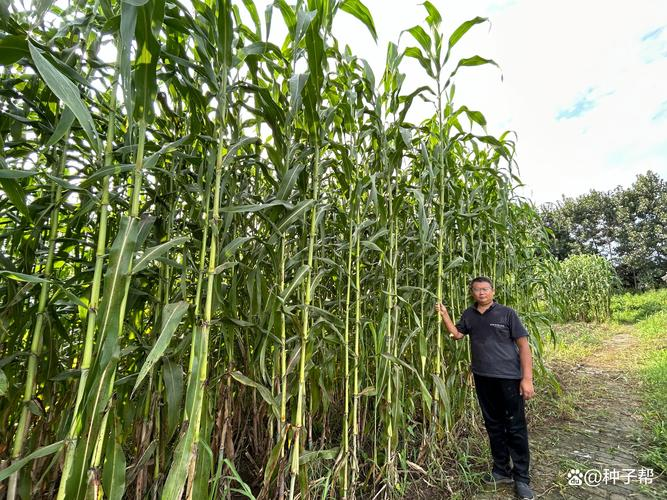
Sorghum bi col or moench has a long history of cultivation in china, raising heilong river in the north, south to sichuan, guizhou and yunnan provinces; and from xinjiang uighur autonomous region to the east to jiangsu, shanghai and cities, especially downstream, are particularly common. Sweet sorghum grows in arid areas, with drought-resistant, flood-resistant, salin-resistant characteristics. Sugar sorghum reproduces mainly through seeds and is suitable for mechanical sowing and harvesting of one of its morphological characteristics. The root is thicker. It's strong, 2-4 meters tall, the base radius 2-5 centimetres, juicy, sweet. Leaf 7? 12 or more, approximately 1 m long and 8 cm wide. Shrimp periods are strong, leaves have waxy veins. It's green and gray, and the marrow contains sweet raw juice. Ii. Growth properties. Sweet sorghum, warm, drought-resistant, flood-resistant, salin-resistant, etc., can grow in most of the world's semi-arid regions. The environmental conditions of growth are less stringent, soil adaptive, especially saline, more resistant than corn, and sweet sorghum can grow on ph 5. 0? 5. The sweet sorghum warms up to 2,600 c? 4,500 c. Sweet sorghum is a high-energy crop, an acre of sweet sorghum synthetic carbohydrates can produce 3. 2 l alcohol, while maize can produce only 1. 0 l, 0. 2 l for wheat, and sweet sorghum is 3. 2 and 16 times more for corn and wheat. It's 18%? 28% of the country's suitable area can grow sweet sorghum if it's half-crystal. Iv. Plantation techniques (i) land preparation the plumes of sweet sorghum are less capable and should be ploughed in depth before sowing in order to promote soil fertilization and modification of soil structures, to create suitable soil environments for seed seeding and seedlings, and to ensure the fragmentation and tattering of cropland. 4 tonnes/acre, 10 kg/acre, 10 kg/acre urea, 50 kg/acre compound fertilisation, in combination with deep-dry application. (-) seeding techniques. Sweet sorghum has a long, inches of seeding and it is essential to make full use of the frostless season to mature. 50 centimeters, 25-30 centimeters. It is appropriate to sow about three centimetres in depth, if too deep, because the particles are small, the top soil is weak and not easy to catch. For that reason, planting in time, mastering depth is the key to cultivation. Shortages due to such factors as poor seeding quality or the underground infestation of mountains should be filled in a timely manner with ffio seedlings in dense tracts, in the same manner as seedlings, which are replaced by fertilized water, prompting them to catch up with normal seedlings (iii) water fertilisation. After the runoff, the pole grows 4. 10 centimetres a day, and the lack of water inhibits plant growth and the separation of young ears. The period of pregnancy is a rich period of sweet and sorghum, an inch free of water, a flowering period peaks in need of water, sufficient water for flowering and pollination, and a solid foundation for the accumulation of solid and fracking sugar. If the climate is chronically dry, it should be irrigated in time to ensure that sweet sorghum grows normally. It's 30 kilos of nitrogen in acre, and it's determined how much weight it is. The timely pursuit of fat after each harvest facilitates the regeneration of the leaves. And when you're fat, you pour water, and when you're dry, you're used to the rain. The type and quantity of fertilization depends on soil fertility, soil type and moisture. (iv) vegetable weed control sweet sorghum is more resistant to disease but less resistant to insects. In the field, if the disease is found, it should be removed and buried. The phenol worm uses 2. 5% oxen permethrin as 3000 times the cream, or 20% kills 5,000, 8,000, or 50% anti-methrin vitro-wettable powder 3,000, 4,000, to spray the plant during the oxen period; 50% thiophosphorus cream is administered 400, 400, per cent during the chromium of the eggs produced by the corn worm, with a dose of loml, which can be used to control it with a dose of 2. 5% dichloride to kill the cream 1,200, and the tiger uses 2. 5% of the enemy to kill the milk 600, 900 times the fluid. In the arid, semi-arid zone, kawasai, tsindu and tsindi regions, where precipitation is at 200,580 mm, can be planted using membranes. (i) spectrum, sowing, sheeting, depending on the condition of the soil wall, seeding when the farming layer contains between 13 and 15% of the water. " one? Two days, and then the drizzle flattens the soil and sows it, so that the seed hole is not blocked. When the film is laid, the film surface requires that it be levelled, that the membrane be attached to the ground, that it cover a layer of thin ground on the membrane, and that the thickness of the soil be determined by semi-terrestrial weather conditions. If it's dry and rain-free, it's thicker than about lcm. It's too thin, it's impurity, it's easy to create a hole in the hole, it's too thick, it's too thick, it's too heavy to remove the fragments. The average temperature of 5 cni for soil tillage can be sowed at 12 °ci1 inch, in area h - in late april? 50 cm long, 20-30 cm long, deep sandy soil is 4 cm deep, clay is 3 cm thick, soil is very wet, it's inch low, it's inch low, it's inch deep. 11. 25 kg/hm2, 90. 0 million seedlings? 120. 0 million seedlings/hm2? (ii) managing membrane sweet sorghums for the use of lavenders, which should be sealed in time if the scavengers are under pressure. The membrane is followed by a small amount of weed that is drilled out of the membrane and requires manual weeding. A timely check of seedlings can be carried out to replant the water belts when the seedlings grow five leaves, and if there is a lack of saplings, a strong plant can be selected in a more dense area. V. The harvest uses sweet sorghum, which is characterized by multiple harvests and more dense. So shaw's first one is 1. 2:1. 5 inches taller than an inch of harvest to boost the next one, and the lower one is better. If not harvested in time. When it is up to the level of masters, it has a high fibre content, which affects the overall quality of the plant. Direct feed: 1. 2? 1. 5m is suitable for the production of a blubber feed of 2. 5? 3. Om is appropriate. 10:15 cm inch. It's easy to die with dehydration through low root. Rainy days don't harvest and cut in case you cause a rotten root. Feeding sweet sorghum young inches, like sorghum, corn, contains toxic substances that can release hydrogen sulfide。so you have to be careful at feed in