


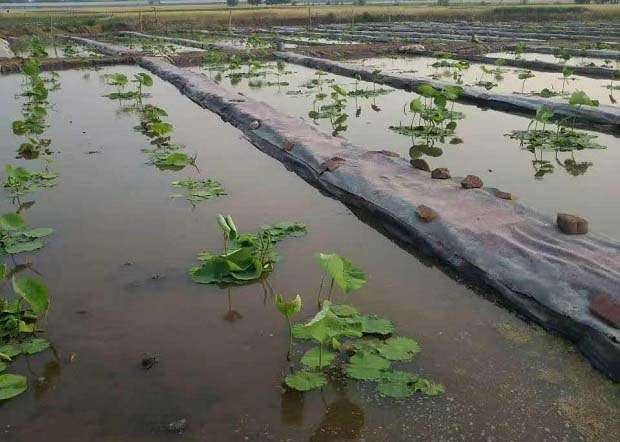
Adaptation to water levels can be divided into two ecological types, shallow and deep. The shallow water is suitable for a water level of 10-20 cm and a water-resistant depth of 30-50 cm. Deep water is suitable for a level of 30 to 50 cm and * water-resistant depth of 1 to 1. 2 m。
The general principles of shallow water management are shallow, mid-deep and shallow. After planting, the buds are born long after the leaf has been planted, and the shallow water should be kept to increase the temperature of the earth and to promote the growth of the buds. In general, it is better to maintain a deep water layer of 4 to 7 cm, which, with the emergence of the levees, grows more and more, rising to 12 to 15 cm. When the leaves are terminated, they indicate that they begin to condensate and that the water layer is gradually reduced to 4 to 7 centimetres, promoting the condensation. Deep-water water levels are not easily regulated, mainly to prevent flooding during periods, especially when the leaves are inundated, and should be drained urgently within eight hours to expose the leaves to prevent drowning。
During the growth of the lichen, especially before the growth of the shallow water, weeds such as the eyes of the water field, the oxen, the short mushrooms, the trigs and the plums are larger, growing faster, affecting the growth of the lichen, and weed should be mowed in time. Previously, weeding was often done manually, with a heavy workload, and it was easy to step on the root of the bed. If weeding is used chemically, it saves labour and effort and does not harm the lichen。
In recent years, experiments have led to the identification of safe and effective methods of chemical weeding in the field, which are being promoted in production。
(1) the choice is to use 50% of the veroglycerous cream, to take 100 ml of medicine when the lichen leaves are 30 cm above the water surface, to mix 5 kg of urea with 5 kg of fine soil, to be fully modulated, and to sow in the field when the dew is dry. When administered, the water depth is 7 to 10 cm and the water layer is maintained after application for more than a week, with good results and a period of more than one month。
(2) the selection of 12. 5 per cent of herbiving energy or 35 per cent to kill 40 ml with water of 40 to 50 kg, which, after full mixing, sprays the weeds when the dew is dry, after four days, has had a significant effect on the killing of the herb grass of the three to four leaves。
The nutrients required for the growth and development of the lichen are, on the one hand, from the light co-operation of the loaf and, on the other hand, from the soil, where the old fertilizer is limited, with the growing of the plant growing less and less, and although fish manure and baits can provide a certain amount of nutrients, they are small compared to the demand for the loaf, and must be followed up in a timely manner。
Liang has a long reproductive period and usually follows two to three times. * the second time a leaf begins to appear, after weeding, 750-1000 kg of manure per acre; the second time when five-6 pieces of manure is applied, approximately 1,000 kg of manure per acre. The third fertilisation occurs when leaves are terminated and the knot begins, called fertilizer. Per acre, manure is 1,500 kg and cake is 30-50 kg。
Fertilizers should choose clear weather and avoid hot noon. The field is released before fertilization so that the fertilizer is inhaled into the water and then watered to its original depth. In deep-water fields, where fertilizers are prone to loss and cannot be applied directly to liquid fertilizers, the method of solid application, i. E. Re-fertilization, should be used and buried in the mud. In pursuit of fertilizer, fertilizer is first fully blended with river mud, which is then used in the field。



